

The original enthusiasm has been frozen by our scarce knowledge of the persistence of CO 2 in disposal sites (after how long time it will come back to the
atmosphere?) and the effect on living organisms if disposed in oceans. Spent NG
wells can be considered a quite safe option because they already contained CO 2 and
if they are correctly sealed after down-pumping CO 2 , leakage should be minimized
or even annulled. Conversely, aquifers are scarcely known for their leakage and
hydrated CO 2 are quite unstable as unexpected warm water streams may convert the
solid hydrate into gaseous CO 2 that can violently be released to the atmosphere
causing serious damages. It is worth to recall here the violent emission of CO 2 that
occurred on August 21, 1986 in Lake Nyos, Africa that caused 1 746 victims by
asphyxia [13].
Moreover, waters rich in CO 2 have a low pH that can disturb the physiology of
fishes. Therefore, as assessed at the recent summit on Innovative Technologies held
in Houston in 2018, deep studies are necessary in order to gain knowledge of CCS
effects before large-scale disposal may be implemented.
CCS requires a conscious political decision based on popular consensus. Several
countries (USA, Japan, UK) have accepted CCS while others have rejected it
(Germany, Austria, Denmark). Key issues are availability of sites, distance of the
disposal site from the source, real economic cost, and real energetic cost (20–60%
penalty on electric energy production including capture). Safe sites that can store
CO 2 for long time are scarce and often far away from the point where CO 2 is
generated.
An example which is worth to consider is the case of some European countries,
such as Italy, that import natural gas from Siberia, some 5000+ km away. As shown
in Table 6.4, for pumping methane from Siberia to Italy, a penalty of 9–18% of
extracted methane is paid, and for sending back CO 2 (Fig. 6.4) the energy requested
is higher because of the different physical state and viscosity of CO 2 with respect to
CH 4 that require a higher number of pumping stations (Fig. 6.4). As a matter of
fact, for sending back CO 2 to the place of extraction of methane, the energy penalty
would be 36–72% of the energy produced from methane. Such energetic cost is not
acceptable as it would imply a significant shortening of fossil resources. Therefore,
a must for the implementation of CCS is that the storage site is close to the source
of CO 2 : a distance of 30 km implies a penalty of 20–25% of the electric energy
produced, including capture. Such situation is not common, and logistics represents
a serious drawback to an extensive exploitation of CCS. Three cases of disposal of
CO 2 will be presented in different areas of our planet.
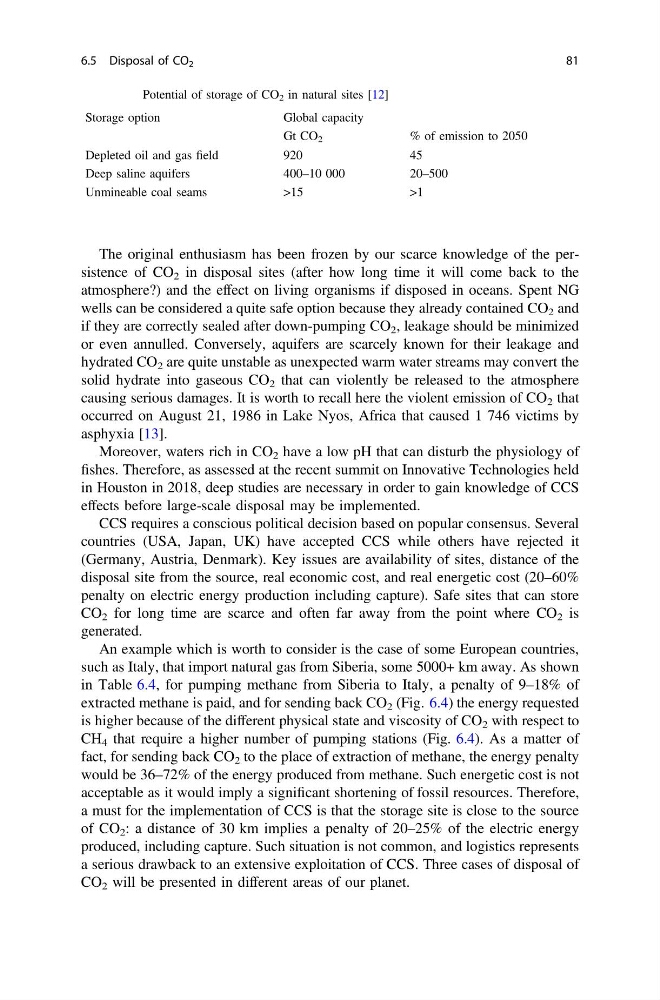
Table 6.3 Potential of storage of CO 2 in natural sites [12]
Storage option
Global capacity
Gt CO 2
% of emission to 2050
Depleted oil and gas field
920
45
Deep saline aquifers
400–10 000
20–500
Unmineable coal seams
>15
>1
6.5 Disposal of CO 2
81
atmosphere?) and the effect on living organisms if disposed in oceans. Spent NG
wells can be considered a quite safe option because they already contained CO 2 and
if they are correctly sealed after down-pumping CO 2 , leakage should be minimized
or even annulled. Conversely, aquifers are scarcely known for their leakage and
hydrated CO 2 are quite unstable as unexpected warm water streams may convert the
solid hydrate into gaseous CO 2 that can violently be released to the atmosphere
causing serious damages. It is worth to recall here the violent emission of CO 2 that
occurred on August 21, 1986 in Lake Nyos, Africa that caused 1 746 victims by
asphyxia [13].
Moreover, waters rich in CO 2 have a low pH that can disturb the physiology of
fishes. Therefore, as assessed at the recent summit on Innovative Technologies held
in Houston in 2018, deep studies are necessary in order to gain knowledge of CCS
effects before large-scale disposal may be implemented.
CCS requires a conscious political decision based on popular consensus. Several
countries (USA, Japan, UK) have accepted CCS while others have rejected it
(Germany, Austria, Denmark). Key issues are availability of sites, distance of the
disposal site from the source, real economic cost, and real energetic cost (20–60%
penalty on electric energy production including capture). Safe sites that can store
CO 2 for long time are scarce and often far away from the point where CO 2 is
generated.
An example which is worth to consider is the case of some European countries,
such as Italy, that import natural gas from Siberia, some 5000+ km away. As shown
in Table 6.4, for pumping methane from Siberia to Italy, a penalty of 9–18% of
extracted methane is paid, and for sending back CO 2 (Fig. 6.4) the energy requested
is higher because of the different physical state and viscosity of CO 2 with respect to
CH 4 that require a higher number of pumping stations (Fig. 6.4). As a matter of
fact, for sending back CO 2 to the place of extraction of methane, the energy penalty
would be 36–72% of the energy produced from methane. Such energetic cost is not
acceptable as it would imply a significant shortening of fossil resources. Therefore,
a must for the implementation of CCS is that the storage site is close to the source
of CO 2 : a distance of 30 km implies a penalty of 20–25% of the electric energy
produced, including capture. Such situation is not common, and logistics represents
a serious drawback to an extensive exploitation of CCS. Three cases of disposal of
CO 2 will be presented in different areas of our planet.
Table 6.3 Potential of storage of CO 2 in natural sites [12]
Storage option
Global capacity
Gt CO 2
% of emission to 2050
Depleted oil and gas field
920
45
Deep saline aquifers
400–10 000
20–500
Unmineable coal seams
>15
>1
6.5 Disposal of CO 2
81