

6.4 Recovery from Mobile Sources
An even more recent approach to cut the CO 2 emission is the capture from mobile
sources. This technology can be applied to large carriers, such as trucks, buses, and
boats while small vehicles are less suited for the lack of space where to allocate the
absorbents. The basic idea is to place on the carrier a container filled with an
absorber through which combustion gases are passed before the emission to the
atmosphere occurs. CO 2 would be trapped in significant amount and fixed in the
sorbent. The amount of CO 2 fixed would depend on the capacity of the absorber
and on the kinetics of adsorption, as the contact time with the combustion gases
would not be very long. Once exhausted, the container with the absorber would be
deposed at specific stations for regeneration and CO 2 collection. CaO has been
tested in such application, together with other materials. This technology is just in
its infancy and it is unknown what is its real potential and cost.
6.5 Disposal of CO 2
As already mentioned, once captured from flue gases, CO 2 can either be disposed in
natural fields (CCS) or used (CCU). The CCS concept had a large acceptance in the
1990s and 2000s and has experienced over 20 years of substantial investment in
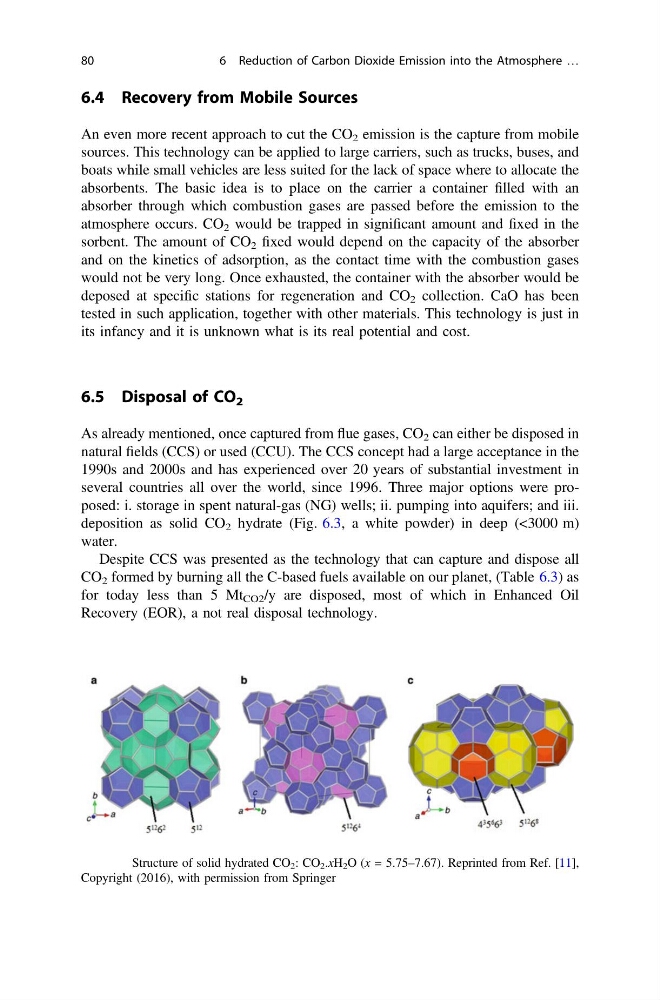
several countries all over the world, since 1996. Three major options were proposed: i. storage in spent natural-gas (NG) wells; ii. pumping into aquifers; and iii.
deposition as solid CO 2 hydrate (Fig. 6.3, a white powder) in deep (<3000 m)
water.
Despite CCS was presented as the technology that can capture and dispose all
CO 2 formed by burning all the C-based fuels available on our planet, (Table 6.3) as
for today less than 5 Mt CO2 /y are disposed, most of which in Enhanced Oil
Recovery (EOR), a not real disposal technology.
Fig. 6.3 Structure of solid hydrated CO 2 : CO 2 .xH 2 O (x = 5.75–7.67). Reprinted from Ref. [11],
Copyright (2016), with permission from Springer
80
6 Reduction of Carbon Dioxide Emission into the Atmosphere …
An even more recent approach to cut the CO 2 emission is the capture from mobile
sources. This technology can be applied to large carriers, such as trucks, buses, and
boats while small vehicles are less suited for the lack of space where to allocate the
absorbents. The basic idea is to place on the carrier a container filled with an
absorber through which combustion gases are passed before the emission to the
atmosphere occurs. CO 2 would be trapped in significant amount and fixed in the
sorbent. The amount of CO 2 fixed would depend on the capacity of the absorber
and on the kinetics of adsorption, as the contact time with the combustion gases
would not be very long. Once exhausted, the container with the absorber would be
deposed at specific stations for regeneration and CO 2 collection. CaO has been
tested in such application, together with other materials. This technology is just in
its infancy and it is unknown what is its real potential and cost.
6.5 Disposal of CO 2
As already mentioned, once captured from flue gases, CO 2 can either be disposed in
natural fields (CCS) or used (CCU). The CCS concept had a large acceptance in the
1990s and 2000s and has experienced over 20 years of substantial investment in
several countries all over the world, since 1996. Three major options were proposed: i. storage in spent natural-gas (NG) wells; ii. pumping into aquifers; and iii.
deposition as solid CO 2 hydrate (Fig. 6.3, a white powder) in deep (<3000 m)
water.
Despite CCS was presented as the technology that can capture and dispose all
CO 2 formed by burning all the C-based fuels available on our planet, (Table 6.3) as
for today less than 5 Mt CO2 /y are disposed, most of which in Enhanced Oil
Recovery (EOR), a not real disposal technology.
Fig. 6.3 Structure of solid hydrated CO 2 : CO 2 .xH 2 O (x = 5.75–7.67). Reprinted from Ref. [11],
Copyright (2016), with permission from Springer
80
6 Reduction of Carbon Dioxide Emission into the Atmosphere …