

6.3 Direct Capture from the Atmosphere
Recently, the direct capture from the atmosphere (DAC) has attracted a lot of
interest as this technology decouples CO 2 capture from production sites and sources
and makes the capture a ubiquitous technology. This is important whatever use we
intend to do of CO 2 : disposal or utilization. Although this implies a substantial
work against entropy (455 kJ/kg CO2 ), being the concentration of CO 2 quite low in
the atmosphere (410 ppm or 0.041% v/v, more than two orders of magnitude lower
than in flue gases) this must be considered as the future approach to CO 2 capture.
The estimate of the actual economic cost of such operation is around 80–130 $/t CO2
[9] even if much higher costs have been encountered in practice [10].
If one frames together the capture of CO 2 and its conversion into fuels (vide
infra), then the fraction of energy which would be lost for CO 2 capture is important
as it would reduce the net available energy of produced fuels. This aspect is
dramatically more important in the case when fossil-C is used for powering the
process, but can lose priority if perennial energy sources are used.
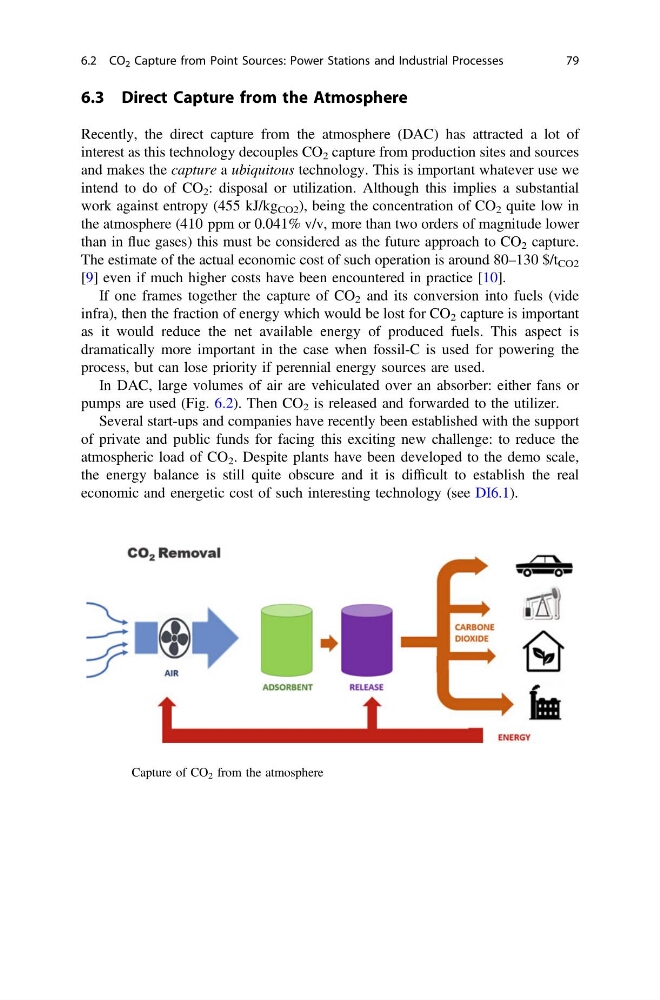
In DAC, large volumes of air are vehiculated over an absorber: either fans or
pumps are used (Fig. 6.2). Then CO 2 is released and forwarded to the utilizer.
Several start-ups and companies have recently been established with the support
of private and public funds for facing this exciting new challenge: to reduce the
atmospheric load of CO 2 . Despite plants have been developed to the demo scale,
the energy balance is still quite obscure and it is difficult to establish the real
economic and energetic cost of such interesting technology (see DI6.1).
Fig. 6.2 Capture of CO 2 from the atmosphere
6.2 CO 2 Capture from Point Sources: Power Stations and Industrial Processes
79
Recently, the direct capture from the atmosphere (DAC) has attracted a lot of
interest as this technology decouples CO 2 capture from production sites and sources
and makes the capture a ubiquitous technology. This is important whatever use we
intend to do of CO 2 : disposal or utilization. Although this implies a substantial
work against entropy (455 kJ/kg CO2 ), being the concentration of CO 2 quite low in
the atmosphere (410 ppm or 0.041% v/v, more than two orders of magnitude lower
than in flue gases) this must be considered as the future approach to CO 2 capture.
The estimate of the actual economic cost of such operation is around 80–130 $/t CO2
[9] even if much higher costs have been encountered in practice [10].
If one frames together the capture of CO 2 and its conversion into fuels (vide
infra), then the fraction of energy which would be lost for CO 2 capture is important
as it would reduce the net available energy of produced fuels. This aspect is
dramatically more important in the case when fossil-C is used for powering the
process, but can lose priority if perennial energy sources are used.
In DAC, large volumes of air are vehiculated over an absorber: either fans or
pumps are used (Fig. 6.2). Then CO 2 is released and forwarded to the utilizer.
Several start-ups and companies have recently been established with the support
of private and public funds for facing this exciting new challenge: to reduce the
atmospheric load of CO 2 . Despite plants have been developed to the demo scale,
the energy balance is still quite obscure and it is difficult to establish the real
economic and energetic cost of such interesting technology (see DI6.1).
Fig. 6.2 Capture of CO 2 from the atmosphere
6.2 CO 2 Capture from Point Sources: Power Stations and Industrial Processes
79