

ethanol vapors which are easy to separate. Emissions from cement manufacture
contain solid particles that must be separated before contacting the gas stream with
the absorber in order to avoid the deactivation of the surface of the latter.
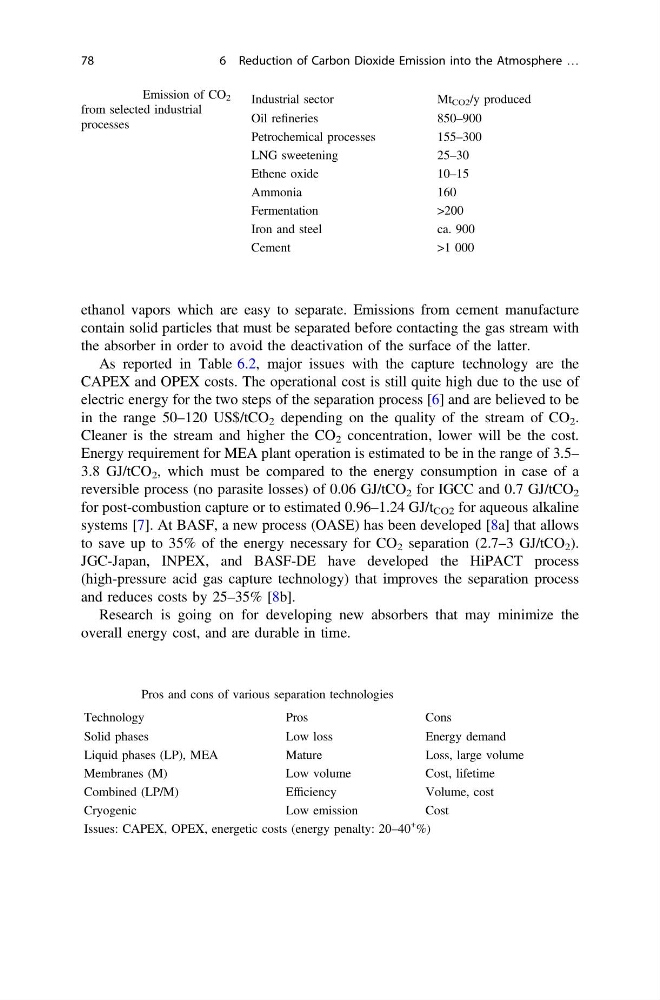
As reported in Table 6.2, major issues with the capture technology are the
CAPEX and OPEX costs. The operational cost is still quite high due to the use of
electric energy for the two steps of the separation process [6] and are believed to be
in the range 50–120 US$/tCO 2 depending on the quality of the stream of CO 2 .
Cleaner is the stream and higher the CO 2 concentration, lower will be the cost.
Energy requirement for MEA plant operation is estimated to be in the range of 3.5–
3.8 GJ/tCO 2 , which must be compared to the energy consumption in case of a
reversible process (no parasite losses) of 0.06 GJ/tCO 2 for IGCC and 0.7 GJ/tCO 2
for post-combustion capture or to estimated 0.96–1.24 GJ/t CO2 for aqueous alkaline
systems [7]. At BASF, a new process (OASE) has been developed [8a] that allows
to save up to 35% of the energy necessary for CO 2 separation (2.7–3 GJ/tCO 2 ).
JGC-Japan, INPEX, and BASF-DE have developed the HiPACT process
(high-pressure acid gas capture technology) that improves the separation process
and reduces costs by 25–35% [8b].
Research is going on for developing new absorbers that may minimize the
overall energy cost, and are durable in time.
Table 6.1 Emission of CO 2
from selected industrial
processes
Industrial sector
Mt CO2 /y produced
Oil refineries
850–900
Petrochemical processes
155–300
LNG sweetening
25–30
Ethene oxide
10–15
Ammonia
160
Fermentation
>200
Iron and steel
ca. 900
Cement
>1 000
Table 6.2 Pros and cons of various separation technologies
Technology
Pros
Cons
Solid phases
Low loss
Energy demand
Liquid phases (LP), MEA
Mature
Loss, large volume
Membranes (M)
Low volume
Cost, lifetime
Combined (LP/M)
Efficiency
Volume, cost
Cryogenic
Low emission
Cost
Issues: CAPEX, OPEX, energetic costs (energy penalty: 20–40
+ %)
78
6 Reduction of Carbon Dioxide Emission into the Atmosphere …
contain solid particles that must be separated before contacting the gas stream with
the absorber in order to avoid the deactivation of the surface of the latter.
As reported in Table 6.2, major issues with the capture technology are the
CAPEX and OPEX costs. The operational cost is still quite high due to the use of
electric energy for the two steps of the separation process [6] and are believed to be
in the range 50–120 US$/tCO 2 depending on the quality of the stream of CO 2 .
Cleaner is the stream and higher the CO 2 concentration, lower will be the cost.
Energy requirement for MEA plant operation is estimated to be in the range of 3.5–
3.8 GJ/tCO 2 , which must be compared to the energy consumption in case of a
reversible process (no parasite losses) of 0.06 GJ/tCO 2 for IGCC and 0.7 GJ/tCO 2
for post-combustion capture or to estimated 0.96–1.24 GJ/t CO2 for aqueous alkaline
systems [7]. At BASF, a new process (OASE) has been developed [8a] that allows
to save up to 35% of the energy necessary for CO 2 separation (2.7–3 GJ/tCO 2 ).
JGC-Japan, INPEX, and BASF-DE have developed the HiPACT process
(high-pressure acid gas capture technology) that improves the separation process
and reduces costs by 25–35% [8b].
Research is going on for developing new absorbers that may minimize the
overall energy cost, and are durable in time.
Table 6.1 Emission of CO 2
from selected industrial
processes
Industrial sector
Mt CO2 /y produced
Oil refineries
850–900
Petrochemical processes
155–300
LNG sweetening
25–30
Ethene oxide
10–15
Ammonia
160
Fermentation
>200
Iron and steel
ca. 900
Cement
>1 000
Table 6.2 Pros and cons of various separation technologies
Technology
Pros
Cons
Solid phases
Low loss
Energy demand
Liquid phases (LP), MEA
Mature
Loss, large volume
Membranes (M)
Low volume
Cost, lifetime
Combined (LP/M)
Efficiency
Volume, cost
Cryogenic
Low emission
Cost
Issues: CAPEX, OPEX, energetic costs (energy penalty: 20–40
+ %)
78
6 Reduction of Carbon Dioxide Emission into the Atmosphere …