

In addition to abovementioned metal oxides and amines, adsorbents such as
C-based materials, pillared clays, molecular sieves, zeolites, silica gel, carbon
nanotubes, and metal organic framework (MOFs) have been investigated, which
often do not show the required selectivity in the separation from N 2 , CH 4 , and other
gases. In general, chemical interactions result much more selective than physical
processes in the separation of gases, but demand more energy. Aminefunctionalized solid sorbents known since early 1990s [4] and the mechanism of
which is known since early 2000s [5] have attracted great attention for CO 2 capture
from flue gases and the atmosphere, as such materials have a lower heat capacity
compared to water and, thus, demand a lower parasitic energy for uptake and
release. Noteworthy, such new absorbers try to combine the selectivity of amines
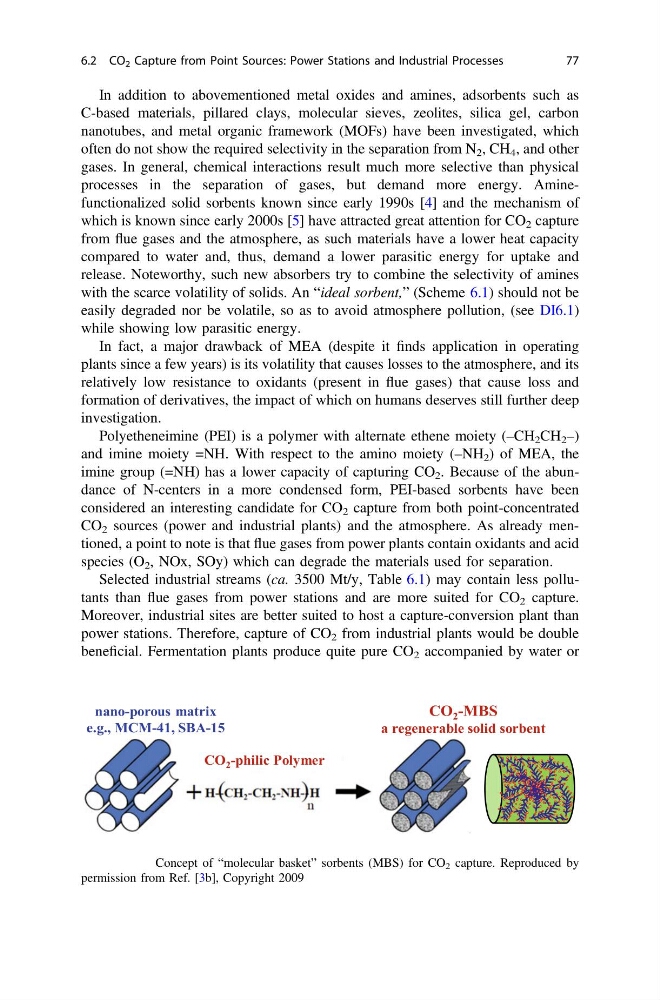
with the scarce volatility of solids. An “ideal sorbent,” (Scheme 6.1) should not be
easily degraded nor be volatile, so as to avoid atmosphere pollution, (see DI6.1)
while showing low parasitic energy.
In fact, a major drawback of MEA (despite it finds application in operating
plants since a few years) is its volatility that causes losses to the atmosphere, and its
relatively low resistance to oxidants (present in flue gases) that cause loss and
formation of derivatives, the impact of which on humans deserves still further deep
investigation.
Polyetheneimine (PEI) is a polymer with alternate ethene moiety (–CH 2 CH 2 –)
and imine moiety =NH. With respect to the amino moiety (–NH 2 ) of MEA, the
imine group (=NH) has a lower capacity of capturing CO 2 . Because of the abundance of N-centers in a more condensed form, PEI-based sorbents have been
considered an interesting candidate for CO 2 capture from both point-concentrated
CO 2 sources (power and industrial plants) and the atmosphere. As already mentioned, a point to note is that flue gases from power plants contain oxidants and acid
species (O 2 , NOx, SOy) which can degrade the materials used for separation.
Selected industrial streams (ca. 3500 Mt/y, Table 6.1) may contain less pollutants than flue gases from power stations and are more suited for CO 2 capture.
Moreover, industrial sites are better suited to host a capture-conversion plant than
power stations. Therefore, capture of CO 2 from industrial plants would be double
beneficial. Fermentation plants produce quite pure CO 2 accompanied by water or
CO 2 -philic Polymer
CO 2 -MBS
a regenerable solid sorbent
nano-porous matrix
e.g., MCM-41, SBA-15
Scheme 6.1 Concept of “molecular basket” sorbents (MBS) for CO 2 capture. Reproduced by
permission from Ref. [3b], Copyright 2009
6.2 CO 2 Capture from Point Sources: Power Stations and Industrial Processes
77
C-based materials, pillared clays, molecular sieves, zeolites, silica gel, carbon
nanotubes, and metal organic framework (MOFs) have been investigated, which
often do not show the required selectivity in the separation from N 2 , CH 4 , and other
gases. In general, chemical interactions result much more selective than physical
processes in the separation of gases, but demand more energy. Aminefunctionalized solid sorbents known since early 1990s [4] and the mechanism of
which is known since early 2000s [5] have attracted great attention for CO 2 capture
from flue gases and the atmosphere, as such materials have a lower heat capacity
compared to water and, thus, demand a lower parasitic energy for uptake and
release. Noteworthy, such new absorbers try to combine the selectivity of amines
with the scarce volatility of solids. An “ideal sorbent,” (Scheme 6.1) should not be
easily degraded nor be volatile, so as to avoid atmosphere pollution, (see DI6.1)
while showing low parasitic energy.
In fact, a major drawback of MEA (despite it finds application in operating
plants since a few years) is its volatility that causes losses to the atmosphere, and its
relatively low resistance to oxidants (present in flue gases) that cause loss and
formation of derivatives, the impact of which on humans deserves still further deep
investigation.
Polyetheneimine (PEI) is a polymer with alternate ethene moiety (–CH 2 CH 2 –)
and imine moiety =NH. With respect to the amino moiety (–NH 2 ) of MEA, the
imine group (=NH) has a lower capacity of capturing CO 2 . Because of the abundance of N-centers in a more condensed form, PEI-based sorbents have been
considered an interesting candidate for CO 2 capture from both point-concentrated
CO 2 sources (power and industrial plants) and the atmosphere. As already mentioned, a point to note is that flue gases from power plants contain oxidants and acid
species (O 2 , NOx, SOy) which can degrade the materials used for separation.
Selected industrial streams (ca. 3500 Mt/y, Table 6.1) may contain less pollutants than flue gases from power stations and are more suited for CO 2 capture.
Moreover, industrial sites are better suited to host a capture-conversion plant than
power stations. Therefore, capture of CO 2 from industrial plants would be double
beneficial. Fermentation plants produce quite pure CO 2 accompanied by water or
CO 2 -philic Polymer
CO 2 -MBS
a regenerable solid sorbent
nano-porous matrix
e.g., MCM-41, SBA-15
Scheme 6.1 Concept of “molecular basket” sorbents (MBS) for CO 2 capture. Reproduced by
permission from Ref. [3b], Copyright 2009
6.2 CO 2 Capture from Point Sources: Power Stations and Industrial Processes
77