

hydrogen carbonate which is only moderately soluble in water
(S = 11.13 g/100 g H2O ). Once the solution is saturated, the hydrogen carbonate starts
to set down. Similarly, Na 2 CO 3 (more soluble in water than the hydrogen carbonate,
S = 28.14 g/100g H2O ) can uptake CO 2 in water affording a slurry of sodium
hydrogen carbonate (reverse of reaction 6.10a, 6.10b). The slurry is thermally
decomposed to release CO 2 and regenerate the basic sodium carbonate solution that
can be reused. For such process, the energetics is less negative than with the calcium
system: 3.22 MJ/kg CO2 captured are necessary. Alternative sorbents have been used
such as ethanolamine which affords mixed ammonium carbonates (Eq. 6.9a) or
carbamates (Eq. 6.9b). The overall goal in the capture process is to reduce costs
(economic and energetic) and time, while keeping an eye at the security and health.
The MEA process is very popular even if it has an energetics worst than the sodium
carbonate system. In fact, 3.8 MJ/kg CO2 captured are necessary, which is ca. 20%
higher than the enthalpy of the sodium carbonate process [2]. The MEA process is at
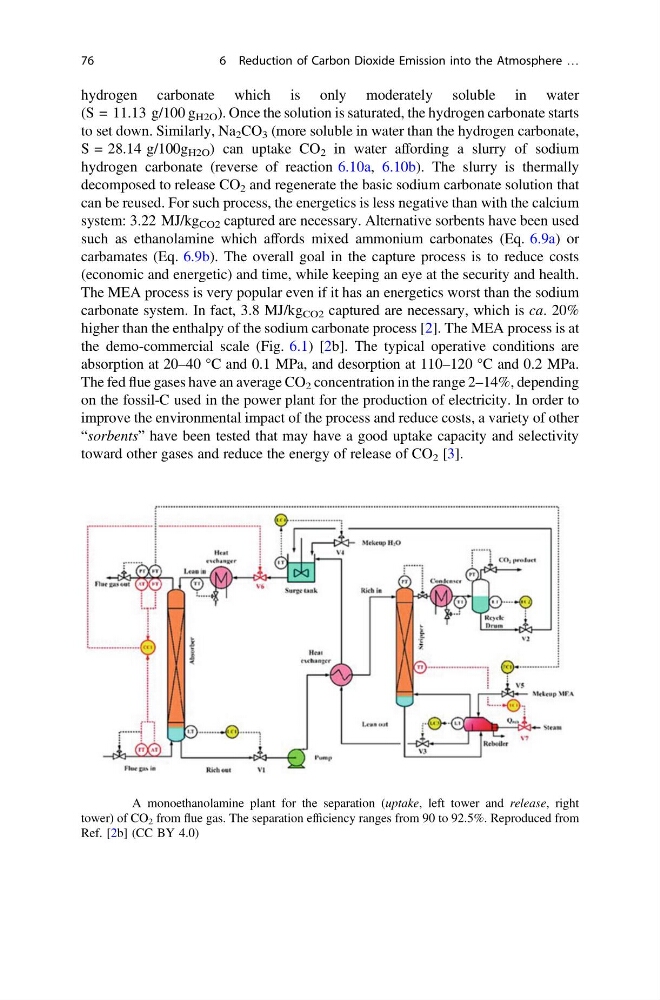
the demo-commercial scale (Fig. 6.1) [2b]. The typical operative conditions are
absorption at 20–40 °C and 0.1 MPa, and desorption at 110–120 °C and 0.2 MPa.
The fed flue gases have an average CO 2 concentration in the range 2–14%, depending
on the fossil-C used in the power plant for the production of electricity. In order to
improve the environmental impact of the process and reduce costs, a variety of other
“sorbents” have been tested that may have a good uptake capacity and selectivity
toward other gases and reduce the energy of release of CO 2 [3].
Fig. 6.1 A monoethanolamine plant for the separation (uptake, left tower and release, right
tower) of CO 2 from flue gas. The separation efficiency ranges from 90 to 92.5%. Reproduced from
Ref. [2b] (CC BY 4.0)
76
6 Reduction of Carbon Dioxide Emission into the Atmosphere …
(S = 11.13 g/100 g H2O ). Once the solution is saturated, the hydrogen carbonate starts
to set down. Similarly, Na 2 CO 3 (more soluble in water than the hydrogen carbonate,
S = 28.14 g/100g H2O ) can uptake CO 2 in water affording a slurry of sodium
hydrogen carbonate (reverse of reaction 6.10a, 6.10b). The slurry is thermally
decomposed to release CO 2 and regenerate the basic sodium carbonate solution that
can be reused. For such process, the energetics is less negative than with the calcium
system: 3.22 MJ/kg CO2 captured are necessary. Alternative sorbents have been used
such as ethanolamine which affords mixed ammonium carbonates (Eq. 6.9a) or
carbamates (Eq. 6.9b). The overall goal in the capture process is to reduce costs
(economic and energetic) and time, while keeping an eye at the security and health.
The MEA process is very popular even if it has an energetics worst than the sodium
carbonate system. In fact, 3.8 MJ/kg CO2 captured are necessary, which is ca. 20%
higher than the enthalpy of the sodium carbonate process [2]. The MEA process is at
the demo-commercial scale (Fig. 6.1) [2b]. The typical operative conditions are
absorption at 20–40 °C and 0.1 MPa, and desorption at 110–120 °C and 0.2 MPa.
The fed flue gases have an average CO 2 concentration in the range 2–14%, depending
on the fossil-C used in the power plant for the production of electricity. In order to
improve the environmental impact of the process and reduce costs, a variety of other
“sorbents” have been tested that may have a good uptake capacity and selectivity
toward other gases and reduce the energy of release of CO 2 [3].
Fig. 6.1 A monoethanolamine plant for the separation (uptake, left tower and release, right
tower) of CO 2 from flue gas. The separation efficiency ranges from 90 to 92.5%. Reproduced from
Ref. [2b] (CC BY 4.0)
76
6 Reduction of Carbon Dioxide Emission into the Atmosphere …