

and it is possible to reach 50 °C in 1 000 m. The temperature of rocks ranges over a
wide interval and can reach 200 °C.
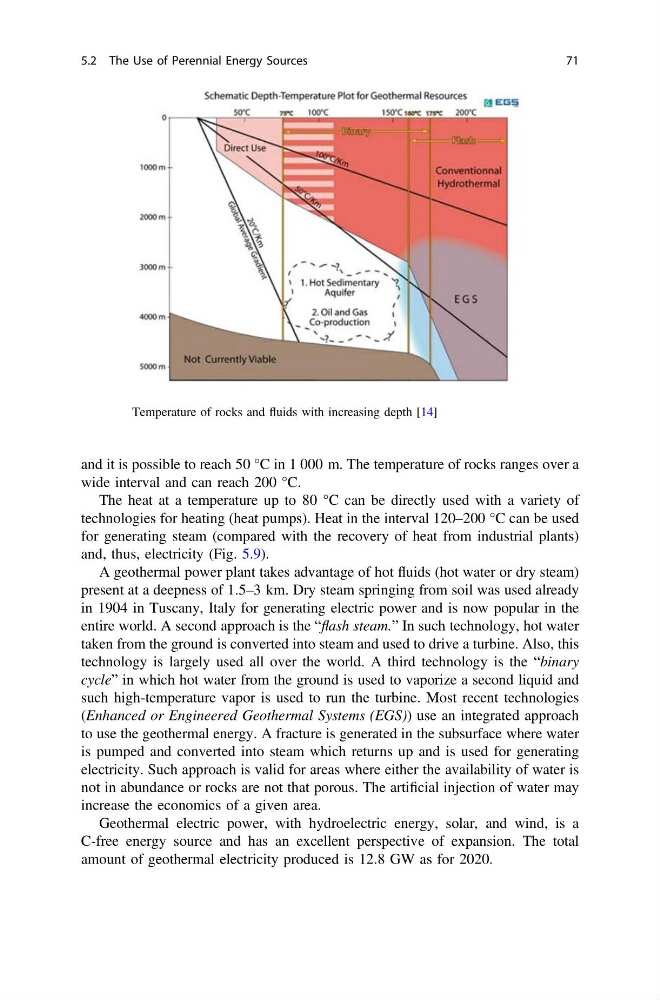
The heat at a temperature up to 80 °C can be directly used with a variety of
technologies for heating (heat pumps). Heat in the interval 120–200 °C can be used
for generating steam (compared with the recovery of heat from industrial plants)
and, thus, electricity (Fig. 5.9).
A geothermal power plant takes advantage of hot fluids (hot water or dry steam)
present at a deepness of 1.5–3 km. Dry steam springing from soil was used already
in 1904 in Tuscany, Italy for generating electric power and is now popular in the
entire world. A second approach is the “flash steam.” In such technology, hot water
taken from the ground is converted into steam and used to drive a turbine. Also, this
technology is largely used all over the world. A third technology is the “binary
cycle” in which hot water from the ground is used to vaporize a second liquid and
such high-temperature vapor is used to run the turbine. Most recent technologies
(Enhanced or Engineered Geothermal Systems (EGS)) use an integrated approach
to use the geothermal energy. A fracture is generated in the subsurface where water
is pumped and converted into steam which returns up and is used for generating
electricity. Such approach is valid for areas where either the availability of water is
not in abundance or rocks are not that porous. The artificial injection of water may
increase the economics of a given area.
Geothermal electric power, with hydroelectric energy, solar, and wind, is a
C-free energy source and has an excellent perspective of expansion. The total
amount of geothermal electricity produced is 12.8 GW as for 2020.
Fig. 5.9 Temperature of rocks and fluids with increasing depth [14]
5.2 The Use of Perennial Energy Sources
71
wide interval and can reach 200 °C.
The heat at a temperature up to 80 °C can be directly used with a variety of
technologies for heating (heat pumps). Heat in the interval 120–200 °C can be used
for generating steam (compared with the recovery of heat from industrial plants)
and, thus, electricity (Fig. 5.9).
A geothermal power plant takes advantage of hot fluids (hot water or dry steam)
present at a deepness of 1.5–3 km. Dry steam springing from soil was used already
in 1904 in Tuscany, Italy for generating electric power and is now popular in the
entire world. A second approach is the “flash steam.” In such technology, hot water
taken from the ground is converted into steam and used to drive a turbine. Also, this
technology is largely used all over the world. A third technology is the “binary
cycle” in which hot water from the ground is used to vaporize a second liquid and
such high-temperature vapor is used to run the turbine. Most recent technologies
(Enhanced or Engineered Geothermal Systems (EGS)) use an integrated approach
to use the geothermal energy. A fracture is generated in the subsurface where water
is pumped and converted into steam which returns up and is used for generating
electricity. Such approach is valid for areas where either the availability of water is
not in abundance or rocks are not that porous. The artificial injection of water may
increase the economics of a given area.
Geothermal electric power, with hydroelectric energy, solar, and wind, is a
C-free energy source and has an excellent perspective of expansion. The total
amount of geothermal electricity produced is 12.8 GW as for 2020.
Fig. 5.9 Temperature of rocks and fluids with increasing depth [14]
5.2 The Use of Perennial Energy Sources
71