

side flows through the barrage to the other side. In oceans, or large lakes, tides can
be an abundant, constant, clean, and, may be in future, cheap source of energy that
could be available to coastal countries which are not in reach of fossil-C, sun, and
wind.
The only drawback is our scarce knowledge on the impact that tidal power plants
may have on marine life. An accurate study by the European Commission says that
noise, vibrations, and electromagnetic radiations may influence the marine life,
even if not on a permanent mode. For example, eels were observed to be diverted
from their usual migration route, but they were finally able to resume it. Electromagnetic frequency seems to attract benthic species such as sharks, rays, and skates,
but not to cause detrimental damages. Deep studies are necessary in order to
understand to which extent humans can take profit of this opportunity without
causing damage to other species.
5.2.4 Geothermal Energy
Geothermal energy is the thermal energy of rocks and fluids on the subsurface of
the Earth crust [13]. As we go deeper, the temperature increases at an average rate
of 20 °C per km. Nevertheless, in some parts of the globe, such rate is much higher
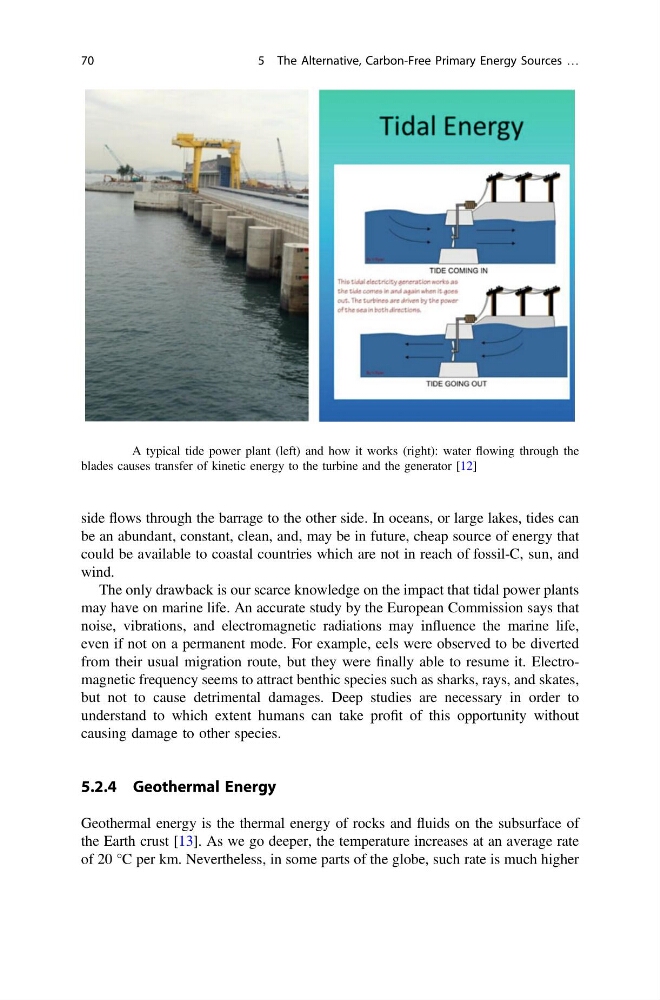
Fig. 5.8 A typical tide power plant (left) and how it works (right): water flowing through the
blades causes transfer of kinetic energy to the turbine and the generator [12]
70
5 The Alternative, Carbon-Free Primary Energy Sources …
be an abundant, constant, clean, and, may be in future, cheap source of energy that
could be available to coastal countries which are not in reach of fossil-C, sun, and
wind.
The only drawback is our scarce knowledge on the impact that tidal power plants
may have on marine life. An accurate study by the European Commission says that
noise, vibrations, and electromagnetic radiations may influence the marine life,
even if not on a permanent mode. For example, eels were observed to be diverted
from their usual migration route, but they were finally able to resume it. Electromagnetic frequency seems to attract benthic species such as sharks, rays, and skates,
but not to cause detrimental damages. Deep studies are necessary in order to
understand to which extent humans can take profit of this opportunity without
causing damage to other species.
5.2.4 Geothermal Energy
Geothermal energy is the thermal energy of rocks and fluids on the subsurface of
the Earth crust [13]. As we go deeper, the temperature increases at an average rate
of 20 °C per km. Nevertheless, in some parts of the globe, such rate is much higher
Fig. 5.8 A typical tide power plant (left) and how it works (right): water flowing through the
blades causes transfer of kinetic energy to the turbine and the generator [12]
70
5 The Alternative, Carbon-Free Primary Energy Sources …