

Wind and solar power are very close and grow at a similar rate: in 2019 with
respect to 2018, wind-installed power has grown by 27.4% and solar by 34.3%.
The way wind turbines work is quite simple and recalls the generation of electric
energy in a power station; in both cases, the protagonist is a flowing fluid that
operates a turbine connected to a generator. In a power station, it is the
high-temperature and high-pressure steam generated by burning fossil-C the driving
force, and in wind turbines it is the kinetic energy of air (wind) that forces the
blades of the tower mill to run a turbine which spins a generator of electricity.
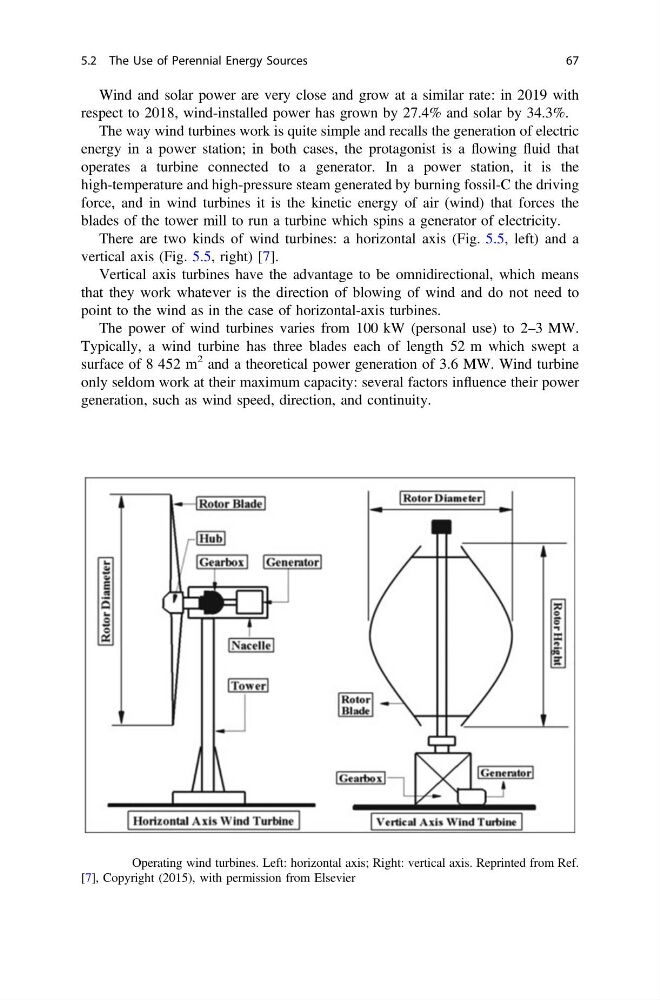
There are two kinds of wind turbines: a horizontal axis (Fig. 5.5, left) and a
vertical axis (Fig. 5.5, right) [7].
Vertical axis turbines have the advantage to be omnidirectional, which means
that they work whatever is the direction of blowing of wind and do not need to
point to the wind as in the case of horizontal-axis turbines.
The power of wind turbines varies from 100 kW (personal use) to 2–3 MW.
Typically, a wind turbine has three blades each of length 52 m which swept a
surface of 8 452 m
2 and a theoretical power generation of 3.6 MW. Wind turbine
only seldom work at their maximum capacity: several factors influence their power
generation, such as wind speed, direction, and continuity.
Fig. 5.5 Operating wind turbines. Left: horizontal axis; Right: vertical axis. Reprinted from Ref.
[7], Copyright (2015), with permission from Elsevier
5.2 The Use of Perennial Energy Sources
67
respect to 2018, wind-installed power has grown by 27.4% and solar by 34.3%.
The way wind turbines work is quite simple and recalls the generation of electric
energy in a power station; in both cases, the protagonist is a flowing fluid that
operates a turbine connected to a generator. In a power station, it is the
high-temperature and high-pressure steam generated by burning fossil-C the driving
force, and in wind turbines it is the kinetic energy of air (wind) that forces the
blades of the tower mill to run a turbine which spins a generator of electricity.
There are two kinds of wind turbines: a horizontal axis (Fig. 5.5, left) and a
vertical axis (Fig. 5.5, right) [7].
Vertical axis turbines have the advantage to be omnidirectional, which means
that they work whatever is the direction of blowing of wind and do not need to
point to the wind as in the case of horizontal-axis turbines.
The power of wind turbines varies from 100 kW (personal use) to 2–3 MW.
Typically, a wind turbine has three blades each of length 52 m which swept a
surface of 8 452 m
2 and a theoretical power generation of 3.6 MW. Wind turbine
only seldom work at their maximum capacity: several factors influence their power
generation, such as wind speed, direction, and continuity.
Fig. 5.5 Operating wind turbines. Left: horizontal axis; Right: vertical axis. Reprinted from Ref.
[7], Copyright (2015), with permission from Elsevier
5.2 The Use of Perennial Energy Sources
67