

5.2.3 Hydro Energy (Both Internal Waters and Oceans)
Hydroelectric energy has a long story. The kinetic energy of running water, similarly to that of wind, has been captured and used for many different purposes:
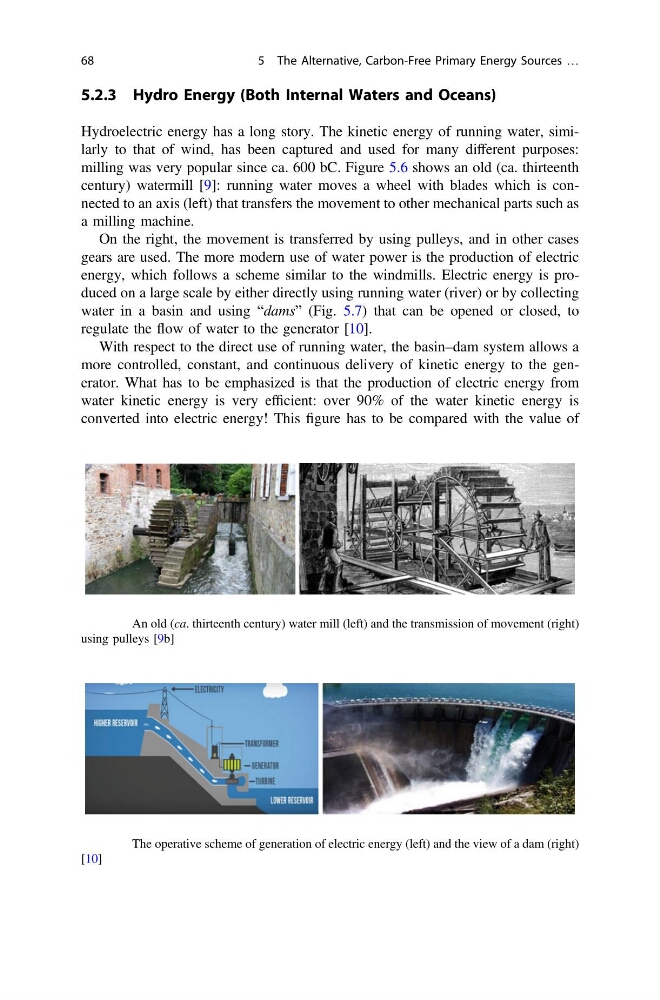
milling was very popular since ca. 600 bC. Figure 5.6 shows an old (ca. thirteenth
century) watermill [9]: running water moves a wheel with blades which is connected to an axis (left) that transfers the movement to other mechanical parts such as
a milling machine.
On the right, the movement is transferred by using pulleys, and in other cases
gears are used. The more modern use of water power is the production of electric
energy, which follows a scheme similar to the windmills. Electric energy is produced on a large scale by either directly using running water (river) or by collecting
water in a basin and using “dams” (Fig. 5.7) that can be opened or closed, to
regulate the flow of water to the generator [10].
With respect to the direct use of running water, the basin–dam system allows a
more controlled, constant, and continuous delivery of kinetic energy to the generator. What has to be emphasized is that the production of electric energy from
water kinetic energy is very efficient: over 90% of the water kinetic energy is
converted into electric energy! This figure has to be compared with the value of
Fig. 5.6 An old (ca. thirteenth century) water mill (left) and the transmission of movement (right)
using pulleys [9b]
Fig. 5.7 The operative scheme of generation of electric energy (left) and the view of a dam (right)
[10]
68
5 The Alternative, Carbon-Free Primary Energy Sources …
Hydroelectric energy has a long story. The kinetic energy of running water, similarly to that of wind, has been captured and used for many different purposes:
milling was very popular since ca. 600 bC. Figure 5.6 shows an old (ca. thirteenth
century) watermill [9]: running water moves a wheel with blades which is connected to an axis (left) that transfers the movement to other mechanical parts such as
a milling machine.
On the right, the movement is transferred by using pulleys, and in other cases
gears are used. The more modern use of water power is the production of electric
energy, which follows a scheme similar to the windmills. Electric energy is produced on a large scale by either directly using running water (river) or by collecting
water in a basin and using “dams” (Fig. 5.7) that can be opened or closed, to
regulate the flow of water to the generator [10].
With respect to the direct use of running water, the basin–dam system allows a
more controlled, constant, and continuous delivery of kinetic energy to the generator. What has to be emphasized is that the production of electric energy from
water kinetic energy is very efficient: over 90% of the water kinetic energy is
converted into electric energy! This figure has to be compared with the value of
Fig. 5.6 An old (ca. thirteenth century) water mill (left) and the transmission of movement (right)
using pulleys [9b]
Fig. 5.7 The operative scheme of generation of electric energy (left) and the view of a dam (right)
[10]
68
5 The Alternative, Carbon-Free Primary Energy Sources …