

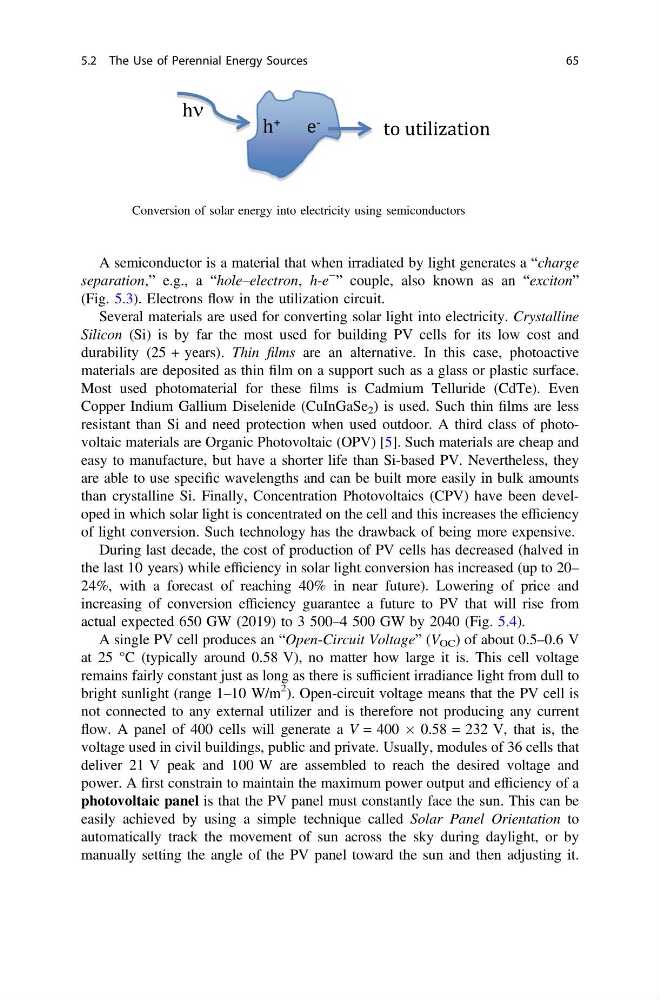
A semiconductor is a material that when irradiated by light generates a “charge
separation,” e.g., a “hole–electron, h-e
−
” couple, also known as an “exciton”
(Fig. 5.3). Electrons flow in the utilization circuit.
Several materials are used for converting solar light into electricity. Crystalline
Silicon (Si) is by far the most used for building PV cells for its low cost and
durability (25 + years). Thin films are an alternative. In this case, photoactive
materials are deposited as thin film on a support such as a glass or plastic surface.
Most used photomaterial for these films is Cadmium Telluride (CdTe). Even
Copper Indium Gallium Diselenide (CuInGaSe 2 ) is used. Such thin films are less
resistant than Si and need protection when used outdoor. A third class of photovoltaic materials are Organic Photovoltaic (OPV) [5]. Such materials are cheap and
easy to manufacture, but have a shorter life than Si-based PV. Nevertheless, they
are able to use specific wavelengths and can be built more easily in bulk amounts
than crystalline Si. Finally, Concentration Photovoltaics (CPV) have been developed in which solar light is concentrated on the cell and this increases the efficiency
of light conversion. Such technology has the drawback of being more expensive.
During last decade, the cost of production of PV cells has decreased (halved in
the last 10 years) while efficiency in solar light conversion has increased (up to 20–
24%, with a forecast of reaching 40% in near future). Lowering of price and
increasing of conversion efficiency guarantee a future to PV that will rise from
actual expected 650 GW (2019) to 3 500–4 500 GW by 2040 (Fig. 5.4).
A single PV cell produces an “Open-Circuit Voltage” (V OC ) of about 0.5–0.6 V
at 25 °C (typically around 0.58 V), no matter how large it is. This cell voltage
remains fairly constant just as long as there is sufficient irradiance light from dull to
bright sunlight (range 1–10 W/m
2 ). Open-circuit voltage means that the PV cell is
not connected to any external utilizer and is therefore not producing any current
flow. A panel of 400 cells will generate a V = 400 Â 0.58 = 232 V, that is, the
voltage used in civil buildings, public and private. Usually, modules of 36 cells that
deliver 21 V peak and 100 W are assembled to reach the desired voltage and
power. A first constrain to maintain the maximum power output and efficiency of a
photovoltaic panel is that the PV panel must constantly face the sun. This can be
easily achieved by using a simple technique called Solar Panel Orientation to
automatically track the movement of sun across the sky during daylight, or by
manually setting the angle of the PV panel toward the sun and then adjusting it.
Fig. 5.3 Conversion of solar energy into electricity using semiconductors
5.2 The Use of Perennial Energy Sources
65
separation,” e.g., a “hole–electron, h-e
−
” couple, also known as an “exciton”
(Fig. 5.3). Electrons flow in the utilization circuit.
Several materials are used for converting solar light into electricity. Crystalline
Silicon (Si) is by far the most used for building PV cells for its low cost and
durability (25 + years). Thin films are an alternative. In this case, photoactive
materials are deposited as thin film on a support such as a glass or plastic surface.
Most used photomaterial for these films is Cadmium Telluride (CdTe). Even
Copper Indium Gallium Diselenide (CuInGaSe 2 ) is used. Such thin films are less
resistant than Si and need protection when used outdoor. A third class of photovoltaic materials are Organic Photovoltaic (OPV) [5]. Such materials are cheap and
easy to manufacture, but have a shorter life than Si-based PV. Nevertheless, they
are able to use specific wavelengths and can be built more easily in bulk amounts
than crystalline Si. Finally, Concentration Photovoltaics (CPV) have been developed in which solar light is concentrated on the cell and this increases the efficiency
of light conversion. Such technology has the drawback of being more expensive.
During last decade, the cost of production of PV cells has decreased (halved in
the last 10 years) while efficiency in solar light conversion has increased (up to 20–
24%, with a forecast of reaching 40% in near future). Lowering of price and
increasing of conversion efficiency guarantee a future to PV that will rise from
actual expected 650 GW (2019) to 3 500–4 500 GW by 2040 (Fig. 5.4).
A single PV cell produces an “Open-Circuit Voltage” (V OC ) of about 0.5–0.6 V
at 25 °C (typically around 0.58 V), no matter how large it is. This cell voltage
remains fairly constant just as long as there is sufficient irradiance light from dull to
bright sunlight (range 1–10 W/m
2 ). Open-circuit voltage means that the PV cell is
not connected to any external utilizer and is therefore not producing any current
flow. A panel of 400 cells will generate a V = 400 Â 0.58 = 232 V, that is, the
voltage used in civil buildings, public and private. Usually, modules of 36 cells that
deliver 21 V peak and 100 W are assembled to reach the desired voltage and
power. A first constrain to maintain the maximum power output and efficiency of a
photovoltaic panel is that the PV panel must constantly face the sun. This can be
easily achieved by using a simple technique called Solar Panel Orientation to
automatically track the movement of sun across the sky during daylight, or by
manually setting the angle of the PV panel toward the sun and then adjusting it.
Fig. 5.3 Conversion of solar energy into electricity using semiconductors
5.2 The Use of Perennial Energy Sources
65