

high concentration, and quantum dot. Most of such systems demand a very good
sun-tracking system.
We shall further consider two types of devices: the parabolic or reflective
concentrators (Fig. 5.1a) and Fresnel or refractive concentrators (Fig. 5.1b). Fresnel
lenses have various advantages but are more difficult to construct. The receiver may
have a variety of structures and shapes: cylindrical, flat plate, even a cavity, etc.
Solar concentrators have been built at various sites in USA, Spain, Israel,
Germany, and Australia using the modes described above. The efficiency is highly
variable from 12 to 81%. They are characterized by a variety of geometries:
(A) conical concentrator, (B) CPC concentrator, (C) sphere concentrator,
(D) cylinder array concentrator, (E) array Fresnel lens concentrator, (F) heliostat
tower concentrator, (G) parabolic concentrator, (H) array parabolic concentrator,
(I) reflective Fresnel lens concentrator, (J) small disk reflective concentrator,
(K) convex lens concentrator, (L) transmittance Fresnel lens concentrator,
(M) trough conical concentrator, (N) mirror dual-focus concentrator, and (O) multi-curved compound concentrator.
The concentrated solar energy can be used for a variety of purposes. High
temperature can be used to run “energy demanding or endoergonic” chemical
reactions or for producing steam for running a turbine that will generate electricity,
or for producing high-temperature fluids that can work as solar energy storage, etc.
An interesting application is the production of diesel from air (vide infra). Among
thermal energy storage (TES) devices, we mention molten salts [3] that exist in the
likely range 150–600 °C, with some high levels of 250–1000 °C. They can be used
for storing solar energy collected during daylight and produce high-temperature and
high-pressure steam for generating electric energy; in this way, a continuous
electron flow can be generated day and night, offsetting the intermittency of solar
light that would be a serious problem in a frame in which solar energy would be
used for feeding electricity to the network (vide infra).
5.2.1.2 Electricity Generation: Photovoltaic Devices
A second way to use solar energy is the direct conversion into electricity by using a
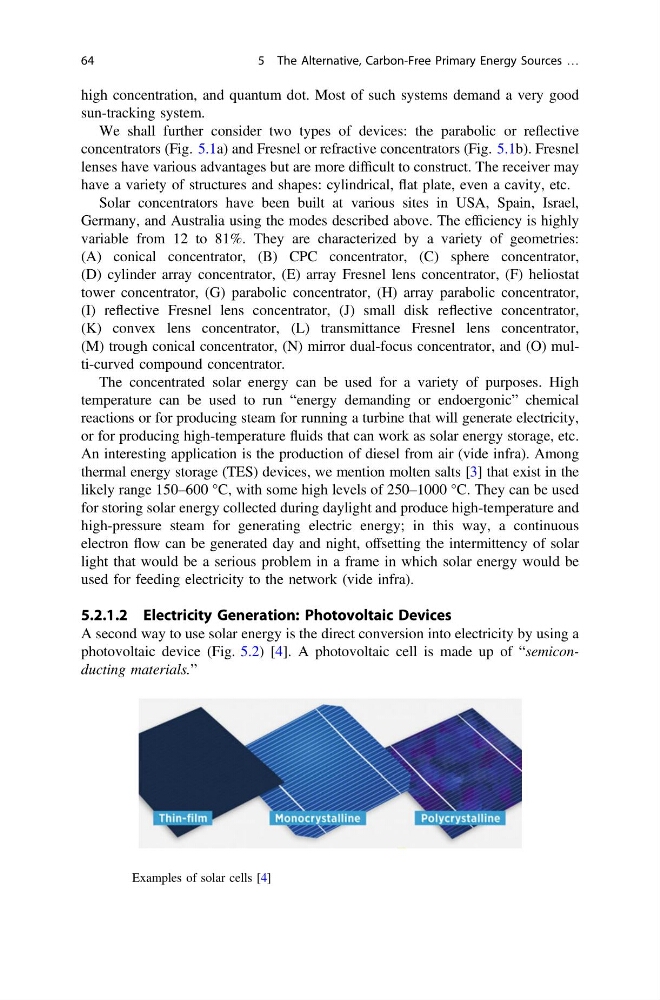
photovoltaic device (Fig. 5.2) [4]. A photovoltaic cell is made up of “semiconducting materials.”
Fig. 5.2 Examples of solar cells [4]
64
5 The Alternative, Carbon-Free Primary Energy Sources …
sun-tracking system.
We shall further consider two types of devices: the parabolic or reflective
concentrators (Fig. 5.1a) and Fresnel or refractive concentrators (Fig. 5.1b). Fresnel
lenses have various advantages but are more difficult to construct. The receiver may
have a variety of structures and shapes: cylindrical, flat plate, even a cavity, etc.
Solar concentrators have been built at various sites in USA, Spain, Israel,
Germany, and Australia using the modes described above. The efficiency is highly
variable from 12 to 81%. They are characterized by a variety of geometries:
(A) conical concentrator, (B) CPC concentrator, (C) sphere concentrator,
(D) cylinder array concentrator, (E) array Fresnel lens concentrator, (F) heliostat
tower concentrator, (G) parabolic concentrator, (H) array parabolic concentrator,
(I) reflective Fresnel lens concentrator, (J) small disk reflective concentrator,
(K) convex lens concentrator, (L) transmittance Fresnel lens concentrator,
(M) trough conical concentrator, (N) mirror dual-focus concentrator, and (O) multi-curved compound concentrator.
The concentrated solar energy can be used for a variety of purposes. High
temperature can be used to run “energy demanding or endoergonic” chemical
reactions or for producing steam for running a turbine that will generate electricity,
or for producing high-temperature fluids that can work as solar energy storage, etc.
An interesting application is the production of diesel from air (vide infra). Among
thermal energy storage (TES) devices, we mention molten salts [3] that exist in the
likely range 150–600 °C, with some high levels of 250–1000 °C. They can be used
for storing solar energy collected during daylight and produce high-temperature and
high-pressure steam for generating electric energy; in this way, a continuous
electron flow can be generated day and night, offsetting the intermittency of solar
light that would be a serious problem in a frame in which solar energy would be
used for feeding electricity to the network (vide infra).
5.2.1.2 Electricity Generation: Photovoltaic Devices
A second way to use solar energy is the direct conversion into electricity by using a
photovoltaic device (Fig. 5.2) [4]. A photovoltaic cell is made up of “semiconducting materials.”
Fig. 5.2 Examples of solar cells [4]
64
5 The Alternative, Carbon-Free Primary Energy Sources …