

Solar energy can be used for generating heat at various temperatures or electricity. The former use is the simplest and known since long time, and electricity
production is a much more recent achievement.
5.2.1.1 Heat Generation
Solar energy can be used for heating a fluid (either air or a liquid) that is then used
for a variety of applications. Flat collectors are very popular, in which water,
eventually added with anti-freeze agent (ethene or propene glycol, non-toxic,
non-corrosive) to prevent icing during cold days, is warmed up. In general, such
solar heating systems can be either active (once water reaches the wished temperature is circulated to a collector with the use of a pump) or passive (without
pump). The active systems can be either direct (water is heated) or indirect (an
anti-freeze agent is warmed-up which in turn transfers heat to water). The latter is
more suited for areas where it can freeze. Such heaters work all year long. An
alternative to flat collectors are the so-called integral collectors made of a cylinder
where water is preheated and then circulated to external tubes for continuing
heating. Such systems are suited for non-icing areas. A third device used is the
evacuated-tube solar collectors made of transparent tubes whose internal surface is
covered with materials which prevent loss of heat by radiation. Heat is absorbed by
metal elements. Such heaters are suitable for houses and some industrial buildings.
The heat generation unit is coupled to a backup unit for providing heat during dark
and in case of over demand. In addition to such devices which operate at mild
temperature, sun energy can be even collected and concentrated to reach high
temperature (>1000 °C).
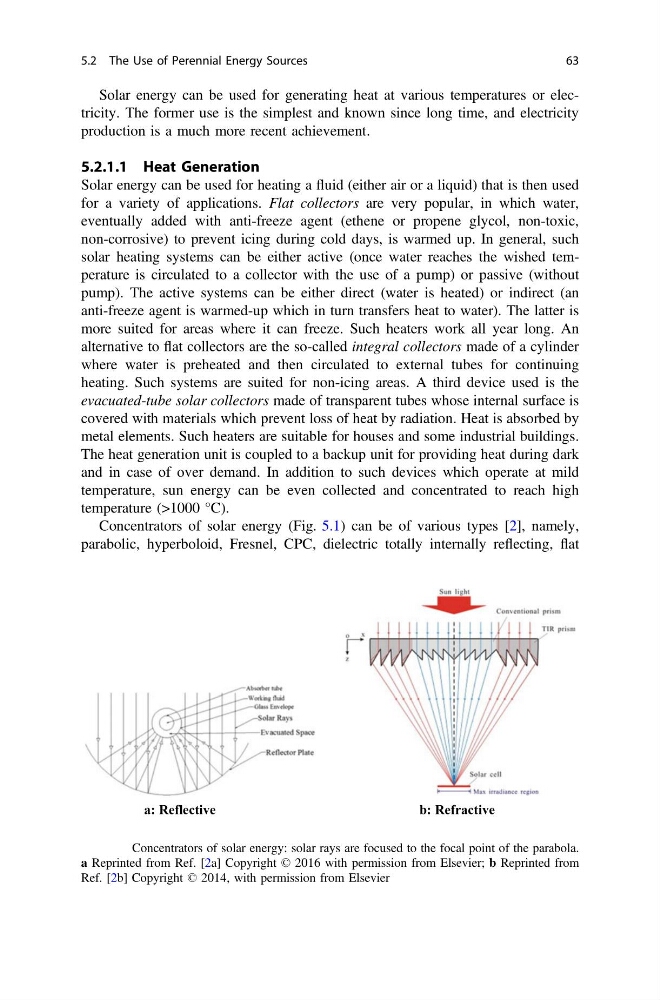
Concentrators of solar energy (Fig. 5.1) can be of various types [2], namely,
parabolic, hyperboloid, Fresnel, CPC, dielectric totally internally reflecting, flat
a: Reflective
b: Refractive
Fig. 5.1 Concentrators of solar energy: solar rays are focused to the focal point of the parabola.
a Reprinted from Ref. [2a] Copyright © 2016 with permission from Elsevier; b Reprinted from
Ref. [2b] Copyright © 2014, with permission from Elsevier
5.2 The Use of Perennial Energy Sources
63
production is a much more recent achievement.
5.2.1.1 Heat Generation
Solar energy can be used for heating a fluid (either air or a liquid) that is then used
for a variety of applications. Flat collectors are very popular, in which water,
eventually added with anti-freeze agent (ethene or propene glycol, non-toxic,
non-corrosive) to prevent icing during cold days, is warmed up. In general, such
solar heating systems can be either active (once water reaches the wished temperature is circulated to a collector with the use of a pump) or passive (without
pump). The active systems can be either direct (water is heated) or indirect (an
anti-freeze agent is warmed-up which in turn transfers heat to water). The latter is
more suited for areas where it can freeze. Such heaters work all year long. An
alternative to flat collectors are the so-called integral collectors made of a cylinder
where water is preheated and then circulated to external tubes for continuing
heating. Such systems are suited for non-icing areas. A third device used is the
evacuated-tube solar collectors made of transparent tubes whose internal surface is
covered with materials which prevent loss of heat by radiation. Heat is absorbed by
metal elements. Such heaters are suitable for houses and some industrial buildings.
The heat generation unit is coupled to a backup unit for providing heat during dark
and in case of over demand. In addition to such devices which operate at mild
temperature, sun energy can be even collected and concentrated to reach high
temperature (>1000 °C).
Concentrators of solar energy (Fig. 5.1) can be of various types [2], namely,
parabolic, hyperboloid, Fresnel, CPC, dielectric totally internally reflecting, flat
a: Reflective
b: Refractive
Fig. 5.1 Concentrators of solar energy: solar rays are focused to the focal point of the parabola.
a Reprinted from Ref. [2a] Copyright © 2016 with permission from Elsevier; b Reprinted from
Ref. [2b] Copyright © 2014, with permission from Elsevier
5.2 The Use of Perennial Energy Sources
63