

Such primary energy sources are C-free and can, thus, offset CO 2 emissions. There
are issues linked to their use, derived from their cyclical availability (day–night cycles
of solar energy), discontinuity (wind), and geographic availability (hydro and
geothermal energy). Nevertheless, man has since ever used such sources with a
variable intensity dictated by the easier availability of other energy sources. Fossil-C
has the great advantage of having the highest energy density and being easily
transported everywhere in the world. Such plus is not easy to even up. As a matter of
fact, differently from the various forms of fossil-C and biomass that can be shipped to
any part of the globe from any part and will have everywhere the same energetic
density and intensity, the above perennial energies can have only a local utilization. It
is one of their derivatives that can be transported and transferred. And among the
derivatives (heat, electrical, and mechanical energies), it is the electric energy that
most suited for distribution, with all its own limitations. If oil, gas, and coal can be
shipped from deep south to the upper north without problems, electricity cannot yet be
transported from Australia to Iceland. Maybe in future highways to electrons will be
open that are not too dissipative; today, the only way is the use of cables or the more
expensive and less intensive batteries. The discontinuous availability of the primary
sources, their geographical availability, and the variable local intensity are issues that
must be engineered for an optimal and wide utilization of such sources. We shall now
consider singularly the perennial sources listed above and give the frame into which
they can better contribute to the reduction of extraction and use of fossil-C.
5.2 The Use of Perennial Energy Sources
5.2.1 Solar Energy
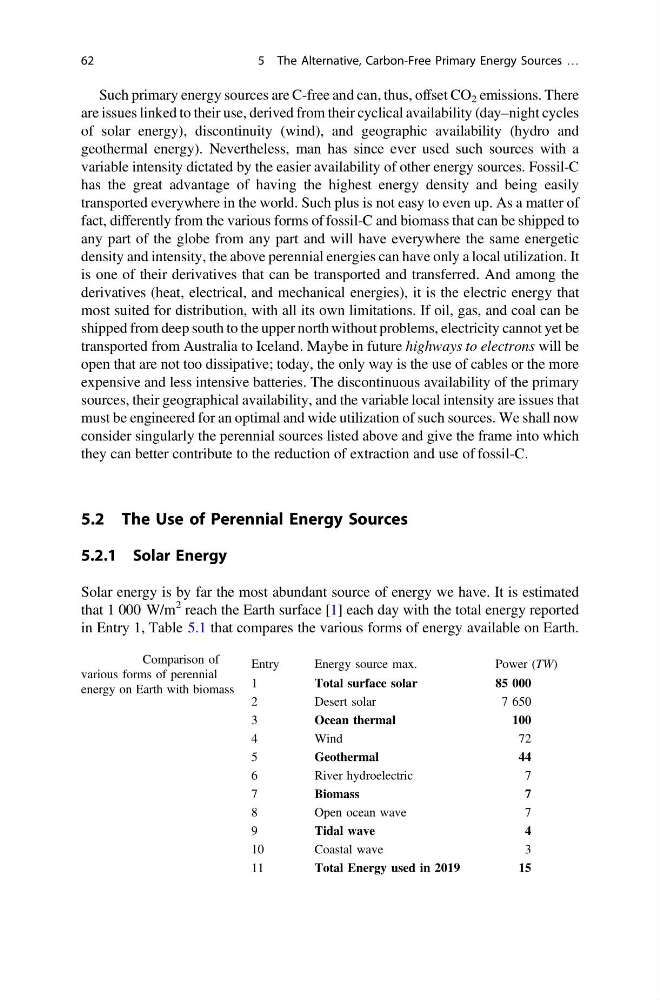
Solar energy is by far the most abundant source of energy we have. It is estimated
that 1 000 W/m
2 reach the Earth surface [1] each day with the total energy reported
in Entry 1, Table 5.1 that compares the various forms of energy available on Earth.
Table 5.1 Comparison of
various forms of perennial
energy on Earth with biomass
Entry
Energy source max.
Power (TW)
1
Total surface solar
85 000
2
Desert solar
7 650
3
Ocean thermal
100
4
Wind
72
5
Geothermal
44
6
River hydroelectric
7
7
Biomass
7
8
Open ocean wave
7
9
Tidal wave
4
10
Coastal wave
3
11
Total Energy used in 2019
15
62
5 The Alternative, Carbon-Free Primary Energy Sources …
are issues linked to their use, derived from their cyclical availability (day–night cycles
of solar energy), discontinuity (wind), and geographic availability (hydro and
geothermal energy). Nevertheless, man has since ever used such sources with a
variable intensity dictated by the easier availability of other energy sources. Fossil-C
has the great advantage of having the highest energy density and being easily
transported everywhere in the world. Such plus is not easy to even up. As a matter of
fact, differently from the various forms of fossil-C and biomass that can be shipped to
any part of the globe from any part and will have everywhere the same energetic
density and intensity, the above perennial energies can have only a local utilization. It
is one of their derivatives that can be transported and transferred. And among the
derivatives (heat, electrical, and mechanical energies), it is the electric energy that
most suited for distribution, with all its own limitations. If oil, gas, and coal can be
shipped from deep south to the upper north without problems, electricity cannot yet be
transported from Australia to Iceland. Maybe in future highways to electrons will be
open that are not too dissipative; today, the only way is the use of cables or the more
expensive and less intensive batteries. The discontinuous availability of the primary
sources, their geographical availability, and the variable local intensity are issues that
must be engineered for an optimal and wide utilization of such sources. We shall now
consider singularly the perennial sources listed above and give the frame into which
they can better contribute to the reduction of extraction and use of fossil-C.
5.2 The Use of Perennial Energy Sources
5.2.1 Solar Energy
Solar energy is by far the most abundant source of energy we have. It is estimated
that 1 000 W/m
2 reach the Earth surface [1] each day with the total energy reported
in Entry 1, Table 5.1 that compares the various forms of energy available on Earth.
Table 5.1 Comparison of
various forms of perennial
energy on Earth with biomass
Entry
Energy source max.
Power (TW)
1
Total surface solar
85 000
2
Desert solar
7 650
3
Ocean thermal
100
4
Wind
72
5
Geothermal
44
6
River hydroelectric
7
7
Biomass
7
8
Open ocean wave
7
9
Tidal wave
4
10
Coastal wave
3
11
Total Energy used in 2019
15
62
5 The Alternative, Carbon-Free Primary Energy Sources …