

3.6 The CO 2 Accumulation in the Atmosphere
and Correlation to Health of Our Planet
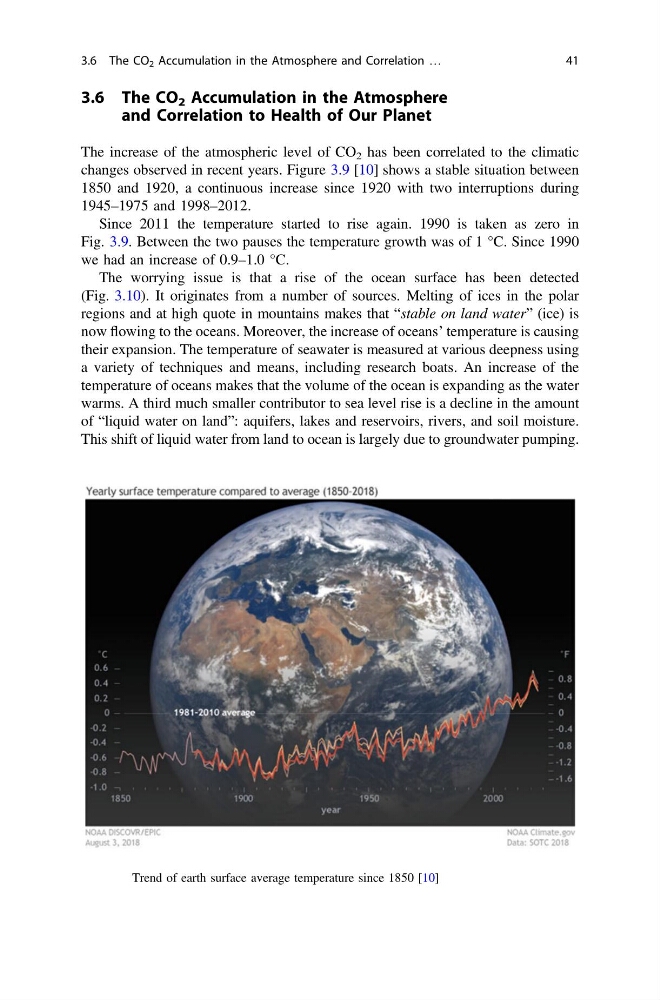
The increase of the atmospheric level of CO 2 has been correlated to the climatic
changes observed in recent years. Figure 3.9 [10] shows a stable situation between
1850 and 1920, a continuous increase since 1920 with two interruptions during
1945–1975 and 1998–2012.
Since 2011 the temperature started to rise again. 1990 is taken as zero in
Fig. 3.9. Between the two pauses the temperature growth was of 1 °C. Since 1990
we had an increase of 0.9–1.0 °C.
The worrying issue is that a rise of the ocean surface has been detected
(Fig. 3.10). It originates from a number of sources. Melting of ices in the polar
regions and at high quote in mountains makes that “stable on land water” (ice) is
now flowing to the oceans. Moreover, the increase of oceans’ temperature is causing
their expansion. The temperature of seawater is measured at various deepness using
a variety of techniques and means, including research boats. An increase of the
temperature of oceans makes that the volume of the ocean is expanding as the water
warms. A third much smaller contributor to sea level rise is a decline in the amount
of “liquid water on land”: aquifers, lakes and reservoirs, rivers, and soil moisture.
This shift of liquid water from land to ocean is largely due to groundwater pumping.
Fig. 3.9 Trend of earth surface average temperature since 1850 [10]
3.6 The CO 2 Accumulation in the Atmosphere and Correlation …
41
and Correlation to Health of Our Planet
The increase of the atmospheric level of CO 2 has been correlated to the climatic
changes observed in recent years. Figure 3.9 [10] shows a stable situation between
1850 and 1920, a continuous increase since 1920 with two interruptions during
1945–1975 and 1998–2012.
Since 2011 the temperature started to rise again. 1990 is taken as zero in
Fig. 3.9. Between the two pauses the temperature growth was of 1 °C. Since 1990
we had an increase of 0.9–1.0 °C.
The worrying issue is that a rise of the ocean surface has been detected
(Fig. 3.10). It originates from a number of sources. Melting of ices in the polar
regions and at high quote in mountains makes that “stable on land water” (ice) is
now flowing to the oceans. Moreover, the increase of oceans’ temperature is causing
their expansion. The temperature of seawater is measured at various deepness using
a variety of techniques and means, including research boats. An increase of the
temperature of oceans makes that the volume of the ocean is expanding as the water
warms. A third much smaller contributor to sea level rise is a decline in the amount
of “liquid water on land”: aquifers, lakes and reservoirs, rivers, and soil moisture.
This shift of liquid water from land to ocean is largely due to groundwater pumping.
Fig. 3.9 Trend of earth surface average temperature since 1850 [10]
3.6 The CO 2 Accumulation in the Atmosphere and Correlation …
41