

As said above, the increased atmospheric concentration of CO 2 witnesses that
high temperature heat is being transferred to the atmosphere with direct increased
heating. The increased temperature causes faster water evaporation and accumulation of water vapor in the atmosphere. From one side, this will cause a larger
absorption of IR radiations and from the other will cause heavy downpours. Violent
rains are not beneficial to soil. In fact, with a swift rain, water has time to permeate
soil and reach subsurface reservoirs with a double benefit of increasing the humidity
of deep layers of soil and enrich soft water reserve. With violent rains, water runs
away even causing damages.
However, the GHE is naturally caused by GHGs present in the atmosphere: if
the GHG concentration is increased the escape of radiations is slowed down with
increase of the heat trapped in the atmosphere and transferred to oceans and soil.
This causes climatic changes and extreme events.
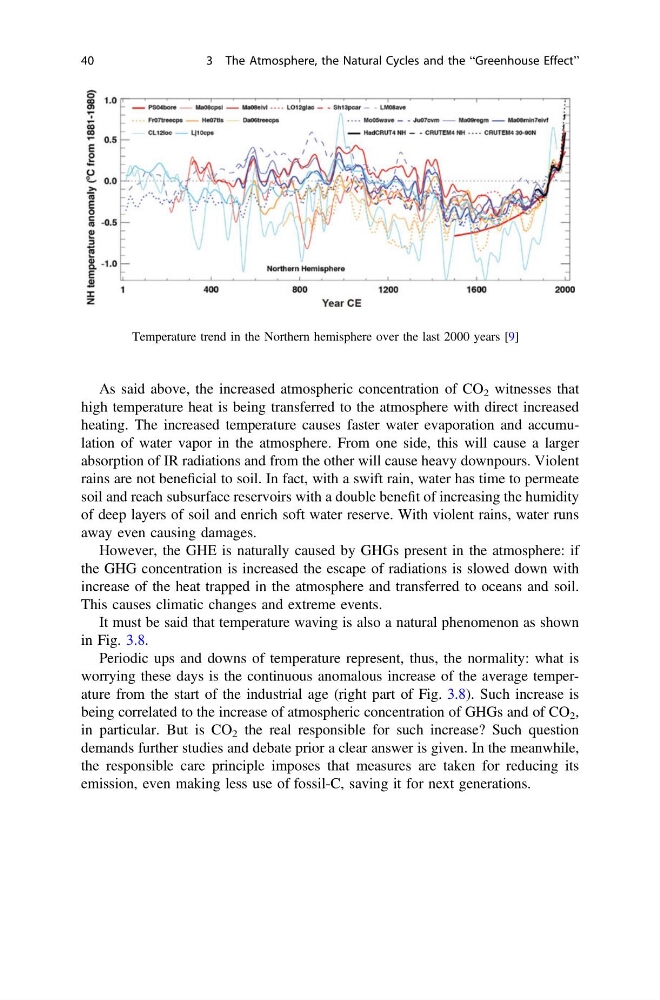
It must be said that temperature waving is also a natural phenomenon as shown
in Fig. 3.8.
Periodic ups and downs of temperature represent, thus, the normality: what is
worrying these days is the continuous anomalous increase of the average temperature from the start of the industrial age (right part of Fig. 3.8). Such increase is
being correlated to the increase of atmospheric concentration of GHGs and of CO 2 ,
in particular. But is CO 2 the real responsible for such increase? Such question
demands further studies and debate prior a clear answer is given. In the meanwhile,
the responsible care principle imposes that measures are taken for reducing its
emission, even making less use of fossil-C, saving it for next generations.
Fig. 3.8 Temperature trend in the Northern hemisphere over the last 2000 years [9]
40
3 The Atmosphere, the Natural Cycles and the “Greenhouse Effect”
high temperature heat is being transferred to the atmosphere with direct increased
heating. The increased temperature causes faster water evaporation and accumulation of water vapor in the atmosphere. From one side, this will cause a larger
absorption of IR radiations and from the other will cause heavy downpours. Violent
rains are not beneficial to soil. In fact, with a swift rain, water has time to permeate
soil and reach subsurface reservoirs with a double benefit of increasing the humidity
of deep layers of soil and enrich soft water reserve. With violent rains, water runs
away even causing damages.
However, the GHE is naturally caused by GHGs present in the atmosphere: if
the GHG concentration is increased the escape of radiations is slowed down with
increase of the heat trapped in the atmosphere and transferred to oceans and soil.
This causes climatic changes and extreme events.
It must be said that temperature waving is also a natural phenomenon as shown
in Fig. 3.8.
Periodic ups and downs of temperature represent, thus, the normality: what is
worrying these days is the continuous anomalous increase of the average temperature from the start of the industrial age (right part of Fig. 3.8). Such increase is
being correlated to the increase of atmospheric concentration of GHGs and of CO 2 ,
in particular. But is CO 2 the real responsible for such increase? Such question
demands further studies and debate prior a clear answer is given. In the meanwhile,
the responsible care principle imposes that measures are taken for reducing its
emission, even making less use of fossil-C, saving it for next generations.
Fig. 3.8 Temperature trend in the Northern hemisphere over the last 2000 years [9]
40
3 The Atmosphere, the Natural Cycles and the “Greenhouse Effect”