

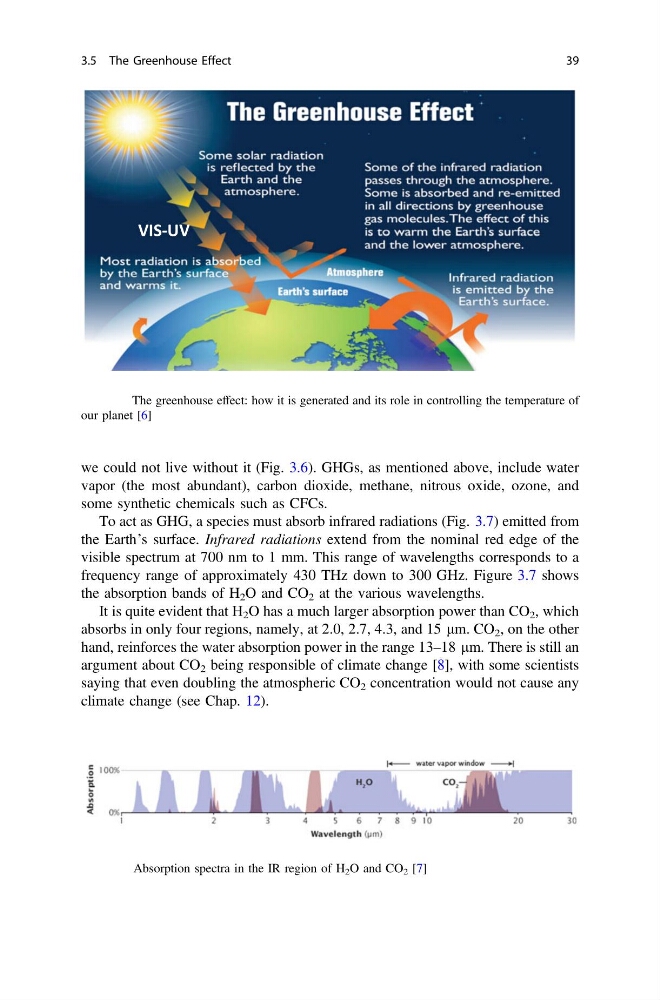
we could not live without it (Fig. 3.6). GHGs, as mentioned above, include water
vapor (the most abundant), carbon dioxide, methane, nitrous oxide, ozone, and
some synthetic chemicals such as CFCs.
To act as GHG, a species must absorb infrared radiations (Fig. 3.7) emitted from
the Earth’s surface. Infrared radiations extend from the nominal red edge of the
visible spectrum at 700 nm to 1 mm. This range of wavelengths corresponds to a
frequency range of approximately 430 THz down to 300 GHz. Figure 3.7 shows
the absorption bands of H 2 O and CO 2 at the various wavelengths.
It is quite evident that H 2 O has a much larger absorption power than CO 2 , which
absorbs in only four regions, namely, at 2.0, 2.7, 4.3, and 15 lm. CO 2 , on the other
hand, reinforces the water absorption power in the range 13–18 lm. There is still an
argument about CO 2 being responsible of climate change [8], with some scientists
saying that even doubling the atmospheric CO 2 concentration would not cause any
climate change (see Chap. 12).
VIS-UV
Fig. 3.6 The greenhouse effect: how it is generated and its role in controlling the temperature of
our planet [6]
Fig. 3.7 Absorption spectra in the IR region of H 2 O and CO 2 [7]
3.5 The Greenhouse Effect
39
vapor (the most abundant), carbon dioxide, methane, nitrous oxide, ozone, and
some synthetic chemicals such as CFCs.
To act as GHG, a species must absorb infrared radiations (Fig. 3.7) emitted from
the Earth’s surface. Infrared radiations extend from the nominal red edge of the
visible spectrum at 700 nm to 1 mm. This range of wavelengths corresponds to a
frequency range of approximately 430 THz down to 300 GHz. Figure 3.7 shows
the absorption bands of H 2 O and CO 2 at the various wavelengths.
It is quite evident that H 2 O has a much larger absorption power than CO 2 , which
absorbs in only four regions, namely, at 2.0, 2.7, 4.3, and 15 lm. CO 2 , on the other
hand, reinforces the water absorption power in the range 13–18 lm. There is still an
argument about CO 2 being responsible of climate change [8], with some scientists
saying that even doubling the atmospheric CO 2 concentration would not cause any
climate change (see Chap. 12).
VIS-UV
Fig. 3.6 The greenhouse effect: how it is generated and its role in controlling the temperature of
our planet [6]
Fig. 3.7 Absorption spectra in the IR region of H 2 O and CO 2 [7]
3.5 The Greenhouse Effect
39