

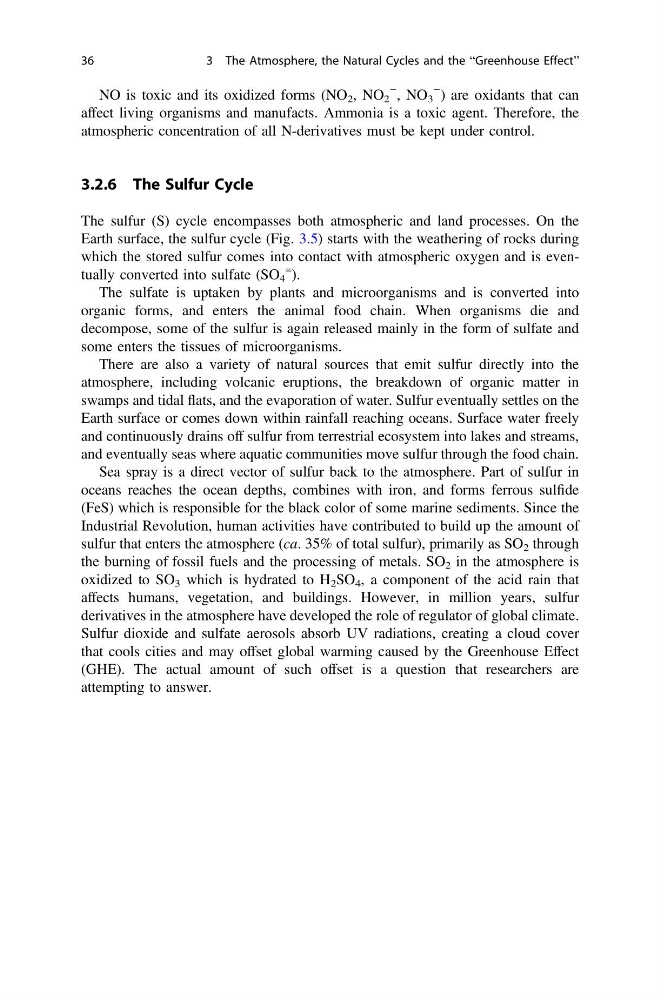
NO is toxic and its oxidized forms (NO 2 , NO 2
− , NO 3
− ) are oxidants that can
affect living organisms and manufacts. Ammonia is a toxic agent. Therefore, the
atmospheric concentration of all N-derivatives must be kept under control.
3.2.6 The Sulfur Cycle
The sulfur (S) cycle encompasses both atmospheric and land processes. On the
Earth surface, the sulfur cycle (Fig. 3.5) starts with the weathering of rocks during
which the stored sulfur comes into contact with atmospheric oxygen and is eventually converted into sulfate (SO 4
= ).
The sulfate is uptaken by plants and microorganisms and is converted into
organic forms, and enters the animal food chain. When organisms die and
decompose, some of the sulfur is again released mainly in the form of sulfate and
some enters the tissues of microorganisms.
There are also a variety of natural sources that emit sulfur directly into the
atmosphere, including volcanic eruptions, the breakdown of organic matter in
swamps and tidal flats, and the evaporation of water. Sulfur eventually settles on the
Earth surface or comes down within rainfall reaching oceans. Surface water freely
and continuously drains off sulfur from terrestrial ecosystem into lakes and streams,
and eventually seas where aquatic communities move sulfur through the food chain.
Sea spray is a direct vector of sulfur back to the atmosphere. Part of sulfur in
oceans reaches the ocean depths, combines with iron, and forms ferrous sulfide
(FeS) which is responsible for the black color of some marine sediments. Since the
Industrial Revolution, human activities have contributed to build up the amount of
sulfur that enters the atmosphere (ca. 35% of total sulfur), primarily as SO 2 through
the burning of fossil fuels and the processing of metals. SO 2 in the atmosphere is
oxidized to SO 3 which is hydrated to H 2 SO 4 , a component of the acid rain that
affects humans, vegetation, and buildings. However, in million years, sulfur
derivatives in the atmosphere have developed the role of regulator of global climate.
Sulfur dioxide and sulfate aerosols absorb UV radiations, creating a cloud cover
that cools cities and may offset global warming caused by the Greenhouse Effect
(GHE). The actual amount of such offset is a question that researchers are
attempting to answer.
36
3 The Atmosphere, the Natural Cycles and the “Greenhouse Effect”
− , NO 3
− ) are oxidants that can
affect living organisms and manufacts. Ammonia is a toxic agent. Therefore, the
atmospheric concentration of all N-derivatives must be kept under control.
3.2.6 The Sulfur Cycle
The sulfur (S) cycle encompasses both atmospheric and land processes. On the
Earth surface, the sulfur cycle (Fig. 3.5) starts with the weathering of rocks during
which the stored sulfur comes into contact with atmospheric oxygen and is eventually converted into sulfate (SO 4
= ).
The sulfate is uptaken by plants and microorganisms and is converted into
organic forms, and enters the animal food chain. When organisms die and
decompose, some of the sulfur is again released mainly in the form of sulfate and
some enters the tissues of microorganisms.
There are also a variety of natural sources that emit sulfur directly into the
atmosphere, including volcanic eruptions, the breakdown of organic matter in
swamps and tidal flats, and the evaporation of water. Sulfur eventually settles on the
Earth surface or comes down within rainfall reaching oceans. Surface water freely
and continuously drains off sulfur from terrestrial ecosystem into lakes and streams,
and eventually seas where aquatic communities move sulfur through the food chain.
Sea spray is a direct vector of sulfur back to the atmosphere. Part of sulfur in
oceans reaches the ocean depths, combines with iron, and forms ferrous sulfide
(FeS) which is responsible for the black color of some marine sediments. Since the
Industrial Revolution, human activities have contributed to build up the amount of
sulfur that enters the atmosphere (ca. 35% of total sulfur), primarily as SO 2 through
the burning of fossil fuels and the processing of metals. SO 2 in the atmosphere is
oxidized to SO 3 which is hydrated to H 2 SO 4 , a component of the acid rain that
affects humans, vegetation, and buildings. However, in million years, sulfur
derivatives in the atmosphere have developed the role of regulator of global climate.
Sulfur dioxide and sulfate aerosols absorb UV radiations, creating a cloud cover
that cools cities and may offset global warming caused by the Greenhouse Effect
(GHE). The actual amount of such offset is a question that researchers are
attempting to answer.
36
3 The Atmosphere, the Natural Cycles and the “Greenhouse Effect”