

which, in turn, is split by solar UV radiation into atomic and molecular oxygen
(Scheme 3.1).
Ozone is essential for “filtering” the solar UV radiations and preventing the
radiations from reaching the Earth’s surface where it can damage humans, animals,
and vegetation.
3.2.5 The NO Cycle
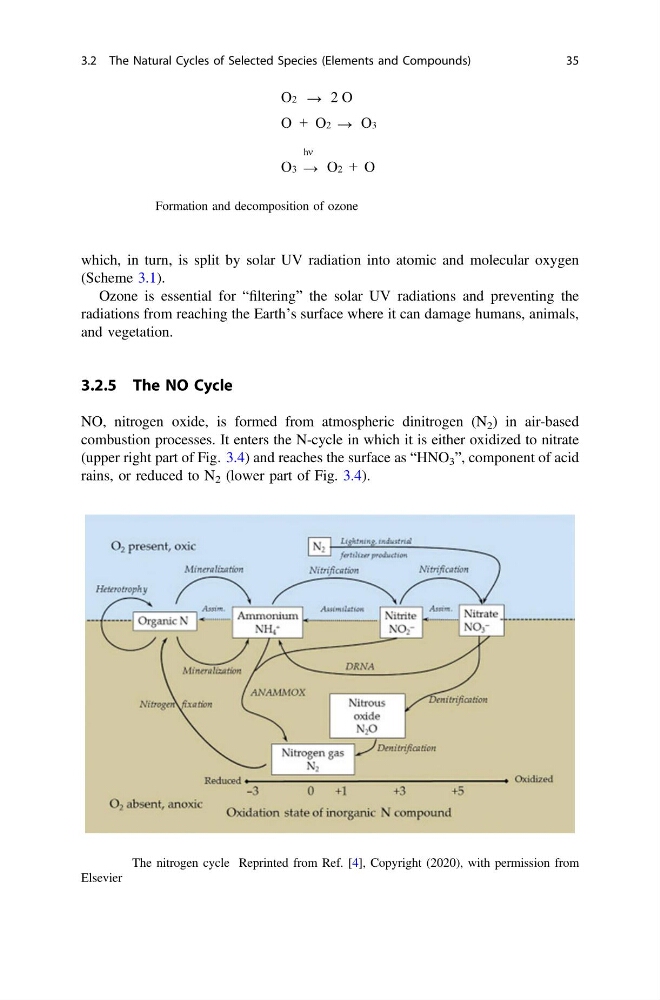
NO, nitrogen oxide, is formed from atmospheric dinitrogen (N 2 ) in air-based
combustion processes. It enters the N-cycle in which it is either oxidized to nitrate
(upper right part of Fig. 3.4) and reaches the surface as “HNO 3 ”, component of acid
rains, or reduced to N 2 (lower part of Fig. 3.4).
O2
2 O
O + O2
O3
h
O3
O2 + O
Scheme 3.1 Formation and decomposition of ozone
Fig. 3.4 The nitrogen cycle Reprinted from Ref. [4], Copyright (2020), with permission from
Elsevier
3.2 The Natural Cycles of Selected Species (Elements and Compounds)
35
(Scheme 3.1).
Ozone is essential for “filtering” the solar UV radiations and preventing the
radiations from reaching the Earth’s surface where it can damage humans, animals,
and vegetation.
3.2.5 The NO Cycle
NO, nitrogen oxide, is formed from atmospheric dinitrogen (N 2 ) in air-based
combustion processes. It enters the N-cycle in which it is either oxidized to nitrate
(upper right part of Fig. 3.4) and reaches the surface as “HNO 3 ”, component of acid
rains, or reduced to N 2 (lower part of Fig. 3.4).
O2
2 O
O + O2
O3
h
O3
O2 + O
Scheme 3.1 Formation and decomposition of ozone
Fig. 3.4 The nitrogen cycle Reprinted from Ref. [4], Copyright (2020), with permission from
Elsevier
3.2 The Natural Cycles of Selected Species (Elements and Compounds)
35