

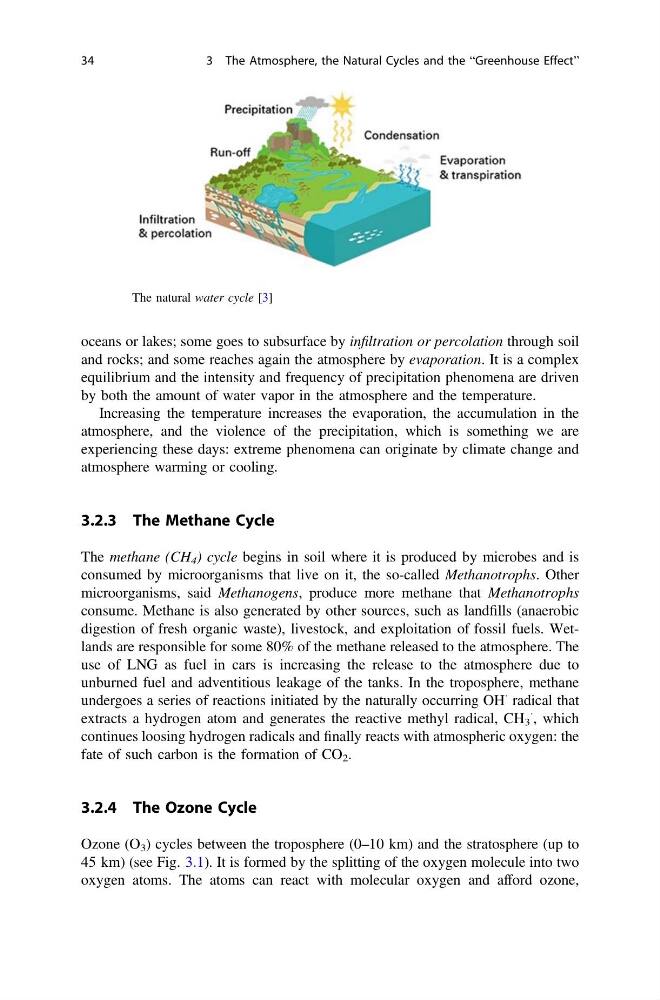
oceans or lakes; some goes to subsurface by infiltration or percolation through soil
and rocks; and some reaches again the atmosphere by evaporation. It is a complex
equilibrium and the intensity and frequency of precipitation phenomena are driven
by both the amount of water vapor in the atmosphere and the temperature.
Increasing the temperature increases the evaporation, the accumulation in the
atmosphere, and the violence of the precipitation, which is something we are
experiencing these days: extreme phenomena can originate by climate change and
atmosphere warming or cooling.
3.2.3 The Methane Cycle
The methane (CH 4 ) cycle begins in soil where it is produced by microbes and is
consumed by microorganisms that live on it, the so-called Methanotrophs. Other
microorganisms, said Methanogens, produce more methane that Methanotrophs
consume. Methane is also generated by other sources, such as landfills (anaerobic
digestion of fresh organic waste), livestock, and exploitation of fossil fuels. Wetlands are responsible for some 80% of the methane released to the atmosphere. The
use of LNG as fuel in cars is increasing the release to the atmosphere due to
unburned fuel and adventitious leakage of the tanks. In the troposphere, methane
undergoes a series of reactions initiated by the naturally occurring OH
Á radical that
extracts a hydrogen atom and generates the reactive methyl radical, CH 3
Á , which
continues loosing hydrogen radicals and finally reacts with atmospheric oxygen: the
fate of such carbon is the formation of CO 2 .
3.2.4 The Ozone Cycle
Ozone (O 3 ) cycles between the troposphere (0–10 km) and the stratosphere (up to
45 km) (see Fig. 3.1). It is formed by the splitting of the oxygen molecule into two
oxygen atoms. The atoms can react with molecular oxygen and afford ozone,
Fig. 3.3 The natural water cycle [3]
34
3 The Atmosphere, the Natural Cycles and the “Greenhouse Effect”
and rocks; and some reaches again the atmosphere by evaporation. It is a complex
equilibrium and the intensity and frequency of precipitation phenomena are driven
by both the amount of water vapor in the atmosphere and the temperature.
Increasing the temperature increases the evaporation, the accumulation in the
atmosphere, and the violence of the precipitation, which is something we are
experiencing these days: extreme phenomena can originate by climate change and
atmosphere warming or cooling.
3.2.3 The Methane Cycle
The methane (CH 4 ) cycle begins in soil where it is produced by microbes and is
consumed by microorganisms that live on it, the so-called Methanotrophs. Other
microorganisms, said Methanogens, produce more methane that Methanotrophs
consume. Methane is also generated by other sources, such as landfills (anaerobic
digestion of fresh organic waste), livestock, and exploitation of fossil fuels. Wetlands are responsible for some 80% of the methane released to the atmosphere. The
use of LNG as fuel in cars is increasing the release to the atmosphere due to
unburned fuel and adventitious leakage of the tanks. In the troposphere, methane
undergoes a series of reactions initiated by the naturally occurring OH
Á radical that
extracts a hydrogen atom and generates the reactive methyl radical, CH 3
Á , which
continues loosing hydrogen radicals and finally reacts with atmospheric oxygen: the
fate of such carbon is the formation of CO 2 .
3.2.4 The Ozone Cycle
Ozone (O 3 ) cycles between the troposphere (0–10 km) and the stratosphere (up to
45 km) (see Fig. 3.1). It is formed by the splitting of the oxygen molecule into two
oxygen atoms. The atoms can react with molecular oxygen and afford ozone,
Fig. 3.3 The natural water cycle [3]
34
3 The Atmosphere, the Natural Cycles and the “Greenhouse Effect”