

gas, after the industrial use of such fuels was developed) became more and more
intensive, shifting in time from low-density energy sources (wood) to more
intensive ones (coal, oil, gas, man-made fuels). With energy becoming available in
many forms, even the style of life of mankind improved. The utilization of electricity started a new era. Electricity was known to Greeks since 600 bC, but it was
the Italian Alessandro Volta in 1801 who discovered that it is possible to generate
steady electric flows and to produce portable-electric energy (electrochemical cell
that is the basic unit of batteries). Such discovery has caused a great change in
human life.
All chemical species (elements or compounds, except noble gases) present in the
atmosphere are subject to cyclic changes in their nature that can be represented in
the so-called “natural cycle.” Some of the most relevant to the topic of this book are
represented below.
3.2.2 The Water Cycle
Figure 3.3 shows the water natural cycle, which is based on several physical
phenomena. Water (H 2 O) vapor present in the atmosphere reaches the Earth surface
by precipitation in various condensed phases (rain, snow, ice) depending on the
atmosphere temperature. Some of it runs off on the surface (rivers) and reaches the
Older soils 1500
inactive
Intermediate
Deep
Surface
900
470
25
39
14
25
Fossil C
4200
FOSSIL FUEL
TERRESTRIAL BIOSPHERE
OCEAN
7
150
31800
6600
580
43
31
74
31
residential in GtC;
fluxes in GtC per year
90
90
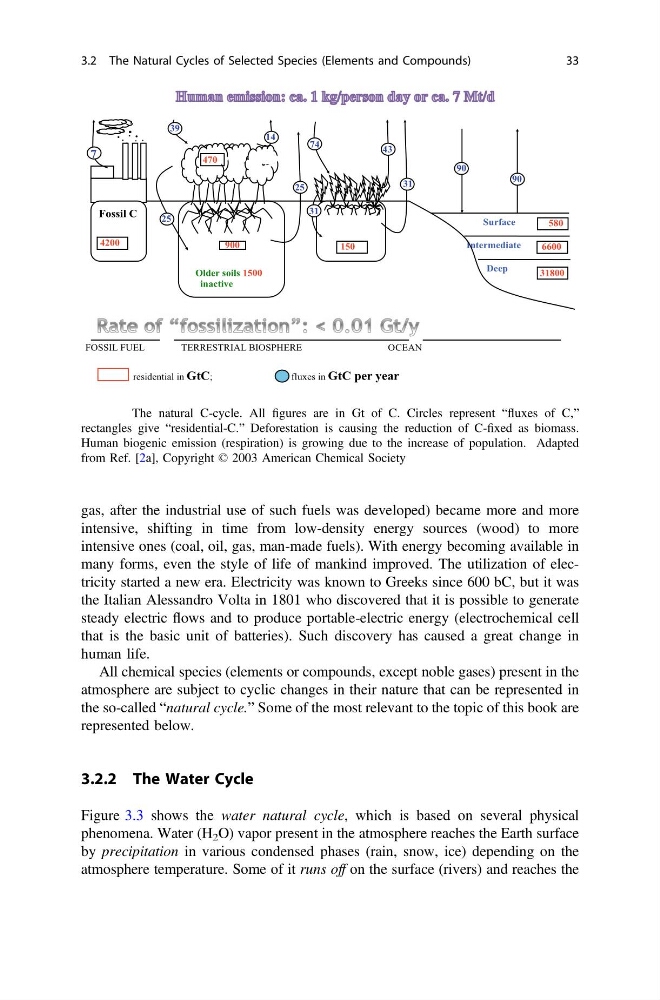
Fig. 3.2 The natural C-cycle. All figures are in Gt of C. Circles represent “fluxes of C,”
rectangles give “residential-C.” Deforestation is causing the reduction of C-fixed as biomass.
Human biogenic emission (respiration) is growing due to the increase of population. Adapted
from Ref. [2a], Copyright © 2003 American Chemical Society
3.2 The Natural Cycles of Selected Species (Elements and Compounds)
33
intensive, shifting in time from low-density energy sources (wood) to more
intensive ones (coal, oil, gas, man-made fuels). With energy becoming available in
many forms, even the style of life of mankind improved. The utilization of electricity started a new era. Electricity was known to Greeks since 600 bC, but it was
the Italian Alessandro Volta in 1801 who discovered that it is possible to generate
steady electric flows and to produce portable-electric energy (electrochemical cell
that is the basic unit of batteries). Such discovery has caused a great change in
human life.
All chemical species (elements or compounds, except noble gases) present in the
atmosphere are subject to cyclic changes in their nature that can be represented in
the so-called “natural cycle.” Some of the most relevant to the topic of this book are
represented below.
3.2.2 The Water Cycle
Figure 3.3 shows the water natural cycle, which is based on several physical
phenomena. Water (H 2 O) vapor present in the atmosphere reaches the Earth surface
by precipitation in various condensed phases (rain, snow, ice) depending on the
atmosphere temperature. Some of it runs off on the surface (rivers) and reaches the
Older soils 1500
inactive
Intermediate
Deep
Surface
900
470
25
39
14
25
Fossil C
4200
FOSSIL FUEL
TERRESTRIAL BIOSPHERE
OCEAN
7
150
31800
6600
580
43
31
74
31
residential in GtC;
fluxes in GtC per year
90
90
Fig. 3.2 The natural C-cycle. All figures are in Gt of C. Circles represent “fluxes of C,”
rectangles give “residential-C.” Deforestation is causing the reduction of C-fixed as biomass.
Human biogenic emission (respiration) is growing due to the increase of population. Adapted
from Ref. [2a], Copyright © 2003 American Chemical Society
3.2 The Natural Cycles of Selected Species (Elements and Compounds)
33