

3.2 The Natural Cycles of Selected Species (Elements
and Compounds)
3.2.1 The Carbon Cycle
Whatever C-based good we use, it will be converted into CO 2 at the end of its life
and will reach the atmosphere starting its natural “cycle”: the so-called “Carbon
Cycle” represented in Fig. 3.2.
The natural C-cycle has been developed on Earth in billion years. There is
evidence of early autotrophic C-fixation at 3.7–3.8 billion years ago, and first
photosynthetic organisms were present some 3.2–3.5 billion years ago on our planet
[2b]. The accumulated evidence suggests that (i) photosynthesis began early in
Earth’s history, but was probably not one of the earliest metabolisms; (ii) the
earliest forms of photosynthesis were anoxygenic, with oxygenic forms arising
significantly later. However, the C-cycle represents the “equilibrium of CO 2 uptake
– CO 2 release” that controls the CO 2 atmospheric concentration keeping it at a
constant level that was around 270 ppm (or 0.0270% v/v) until the start of the
“Industrial Age.” The Industrial Age is a period of history that encompasses the
changes in economic and social organization that began around 1760 in Great
Britain. From 1830 and later, the industrial age heavily started in Europe and in the
geographic area today known as USA, and after in the entire Earth planet. Industry
is energivorous and the use of any kind of fuel (wood at the start, and then coal, oil,
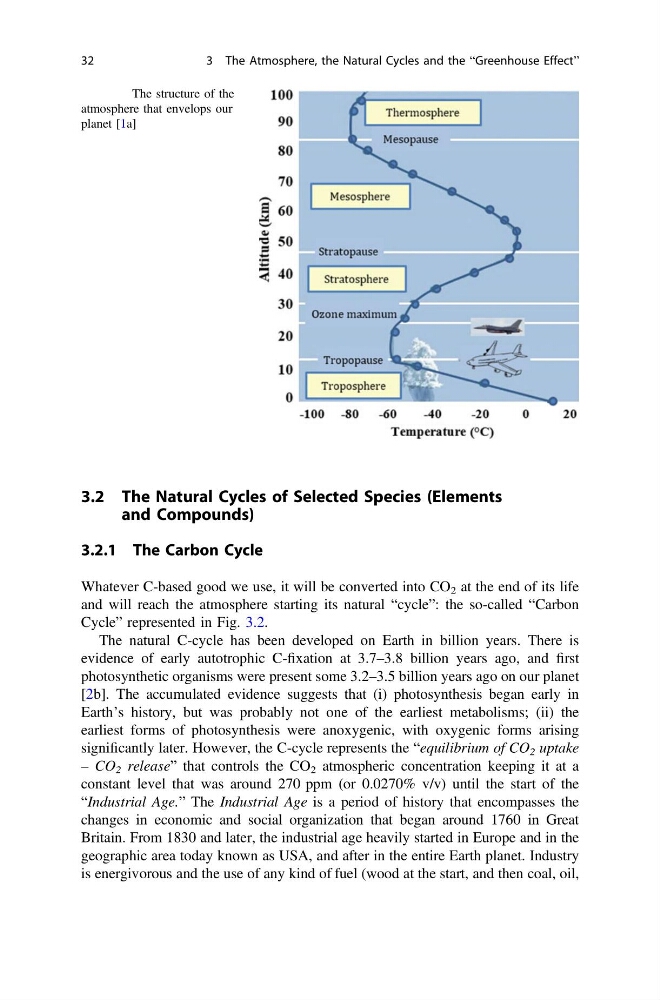
Fig. 3.1 The structure of the
atmosphere that envelops our
planet [1a]
32
3 The Atmosphere, the Natural Cycles and the “Greenhouse Effect”
and Compounds)
3.2.1 The Carbon Cycle
Whatever C-based good we use, it will be converted into CO 2 at the end of its life
and will reach the atmosphere starting its natural “cycle”: the so-called “Carbon
Cycle” represented in Fig. 3.2.
The natural C-cycle has been developed on Earth in billion years. There is
evidence of early autotrophic C-fixation at 3.7–3.8 billion years ago, and first
photosynthetic organisms were present some 3.2–3.5 billion years ago on our planet
[2b]. The accumulated evidence suggests that (i) photosynthesis began early in
Earth’s history, but was probably not one of the earliest metabolisms; (ii) the
earliest forms of photosynthesis were anoxygenic, with oxygenic forms arising
significantly later. However, the C-cycle represents the “equilibrium of CO 2 uptake
– CO 2 release” that controls the CO 2 atmospheric concentration keeping it at a
constant level that was around 270 ppm (or 0.0270% v/v) until the start of the
“Industrial Age.” The Industrial Age is a period of history that encompasses the
changes in economic and social organization that began around 1760 in Great
Britain. From 1830 and later, the industrial age heavily started in Europe and in the
geographic area today known as USA, and after in the entire Earth planet. Industry
is energivorous and the use of any kind of fuel (wood at the start, and then coal, oil,
Fig. 3.1 The structure of the
atmosphere that envelops our
planet [1a]
32
3 The Atmosphere, the Natural Cycles and the “Greenhouse Effect”