

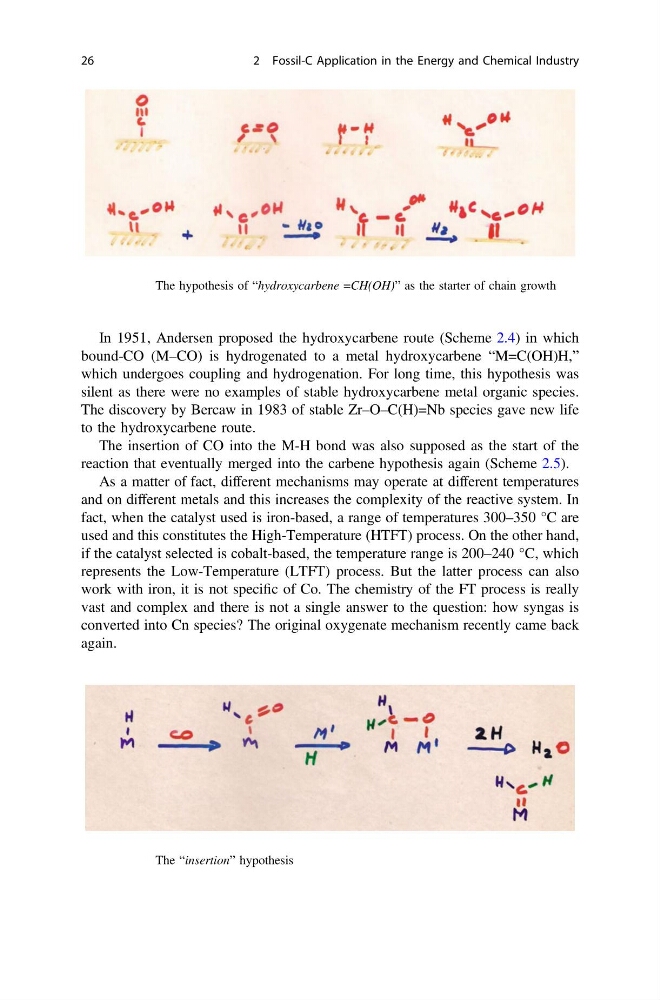
In 1951, Andersen proposed the hydroxycarbene route (Scheme 2.4) in which
bound-CO (M–CO) is hydrogenated to a metal hydroxycarbene “M=C(OH)H,”
which undergoes coupling and hydrogenation. For long time, this hypothesis was
silent as there were no examples of stable hydroxycarbene metal organic species.
The discovery by Bercaw in 1983 of stable Zr–O–C(H)=Nb species gave new life
to the hydroxycarbene route.
The insertion of CO into the M-H bond was also supposed as the start of the
reaction that eventually merged into the carbene hypothesis again (Scheme 2.5).
As a matter of fact, different mechanisms may operate at different temperatures
and on different metals and this increases the complexity of the reactive system. In
fact, when the catalyst used is iron-based, a range of temperatures 300–350 °C are
used and this constitutes the High-Temperature (HTFT) process. On the other hand,
if the catalyst selected is cobalt-based, the temperature range is 200–240 °C, which
represents the Low-Temperature (LTFT) process. But the latter process can also
work with iron, it is not specific of Co. The chemistry of the FT process is really
vast and complex and there is not a single answer to the question: how syngas is
converted into Cn species? The original oxygenate mechanism recently came back
again.
Scheme 2.4 The hypothesis of “hydroxycarbene =CH(OH)” as the starter of chain growth
Scheme 2.5 The “insertion” hypothesis
26
2 Fossil-C Application in the Energy and Chemical Industry
bound-CO (M–CO) is hydrogenated to a metal hydroxycarbene “M=C(OH)H,”
which undergoes coupling and hydrogenation. For long time, this hypothesis was
silent as there were no examples of stable hydroxycarbene metal organic species.
The discovery by Bercaw in 1983 of stable Zr–O–C(H)=Nb species gave new life
to the hydroxycarbene route.
The insertion of CO into the M-H bond was also supposed as the start of the
reaction that eventually merged into the carbene hypothesis again (Scheme 2.5).
As a matter of fact, different mechanisms may operate at different temperatures
and on different metals and this increases the complexity of the reactive system. In
fact, when the catalyst used is iron-based, a range of temperatures 300–350 °C are
used and this constitutes the High-Temperature (HTFT) process. On the other hand,
if the catalyst selected is cobalt-based, the temperature range is 200–240 °C, which
represents the Low-Temperature (LTFT) process. But the latter process can also
work with iron, it is not specific of Co. The chemistry of the FT process is really
vast and complex and there is not a single answer to the question: how syngas is
converted into Cn species? The original oxygenate mechanism recently came back
again.
Scheme 2.4 The hypothesis of “hydroxycarbene =CH(OH)” as the starter of chain growth
Scheme 2.5 The “insertion” hypothesis
26
2 Fossil-C Application in the Energy and Chemical Industry