

In time, evidence was found for this or that mechanism. The iron catalysts were
the most studied because they are the most used in plants and some new hypotheses
have been put forward which, for example, separate the nature of the “initiator”
from that of the “propagator.” Even a question on the putative activity of iron
oxides was risen. Experimental spectroscopic data seem to suggest that the active
surface is made of iron carbide, while oxides can be in the internal part of the
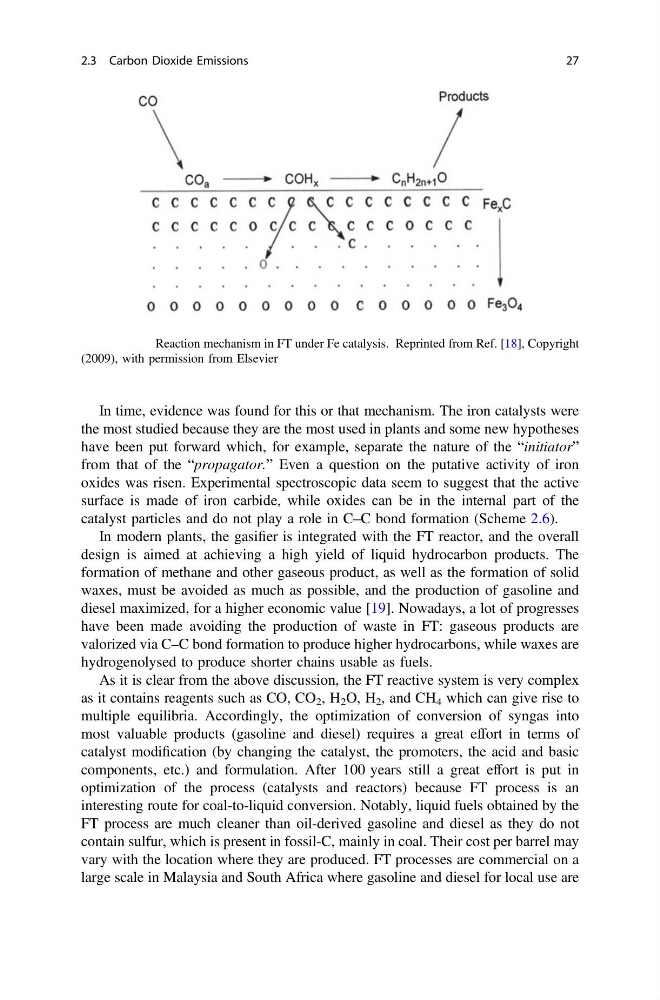
catalyst particles and do not play a role in C–C bond formation (Scheme 2.6).
In modern plants, the gasifier is integrated with the FT reactor, and the overall
design is aimed at achieving a high yield of liquid hydrocarbon products. The
formation of methane and other gaseous product, as well as the formation of solid
waxes, must be avoided as much as possible, and the production of gasoline and
diesel maximized, for a higher economic value [19]. Nowadays, a lot of progresses
have been made avoiding the production of waste in FT: gaseous products are
valorized via C–C bond formation to produce higher hydrocarbons, while waxes are
hydrogenolysed to produce shorter chains usable as fuels.
As it is clear from the above discussion, the FT reactive system is very complex
as it contains reagents such as CO, CO 2 , H 2 O, H 2 , and CH 4 which can give rise to
multiple equilibria. Accordingly, the optimization of conversion of syngas into
most valuable products (gasoline and diesel) requires a great effort in terms of
catalyst modification (by changing the catalyst, the promoters, the acid and basic
components, etc.) and formulation. After 100 years still a great effort is put in
optimization of the process (catalysts and reactors) because FT process is an
interesting route for coal-to-liquid conversion. Notably, liquid fuels obtained by the
FT process are much cleaner than oil-derived gasoline and diesel as they do not
contain sulfur, which is present in fossil-C, mainly in coal. Their cost per barrel may
vary with the location where they are produced. FT processes are commercial on a
large scale in Malaysia and South Africa where gasoline and diesel for local use are
Scheme 2.6 Reaction mechanism in FT under Fe catalysis. Reprinted from Ref. [18], Copyright
(2009), with permission from Elsevier
2.3 Carbon Dioxide Emissions
27
the most studied because they are the most used in plants and some new hypotheses
have been put forward which, for example, separate the nature of the “initiator”
from that of the “propagator.” Even a question on the putative activity of iron
oxides was risen. Experimental spectroscopic data seem to suggest that the active
surface is made of iron carbide, while oxides can be in the internal part of the
catalyst particles and do not play a role in C–C bond formation (Scheme 2.6).
In modern plants, the gasifier is integrated with the FT reactor, and the overall
design is aimed at achieving a high yield of liquid hydrocarbon products. The
formation of methane and other gaseous product, as well as the formation of solid
waxes, must be avoided as much as possible, and the production of gasoline and
diesel maximized, for a higher economic value [19]. Nowadays, a lot of progresses
have been made avoiding the production of waste in FT: gaseous products are
valorized via C–C bond formation to produce higher hydrocarbons, while waxes are
hydrogenolysed to produce shorter chains usable as fuels.
As it is clear from the above discussion, the FT reactive system is very complex
as it contains reagents such as CO, CO 2 , H 2 O, H 2 , and CH 4 which can give rise to
multiple equilibria. Accordingly, the optimization of conversion of syngas into
most valuable products (gasoline and diesel) requires a great effort in terms of
catalyst modification (by changing the catalyst, the promoters, the acid and basic
components, etc.) and formulation. After 100 years still a great effort is put in
optimization of the process (catalysts and reactors) because FT process is an
interesting route for coal-to-liquid conversion. Notably, liquid fuels obtained by the
FT process are much cleaner than oil-derived gasoline and diesel as they do not
contain sulfur, which is present in fossil-C, mainly in coal. Their cost per barrel may
vary with the location where they are produced. FT processes are commercial on a
large scale in Malaysia and South Africa where gasoline and diesel for local use are
Scheme 2.6 Reaction mechanism in FT under Fe catalysis. Reprinted from Ref. [18], Copyright
(2009), with permission from Elsevier
2.3 Carbon Dioxide Emissions
27