

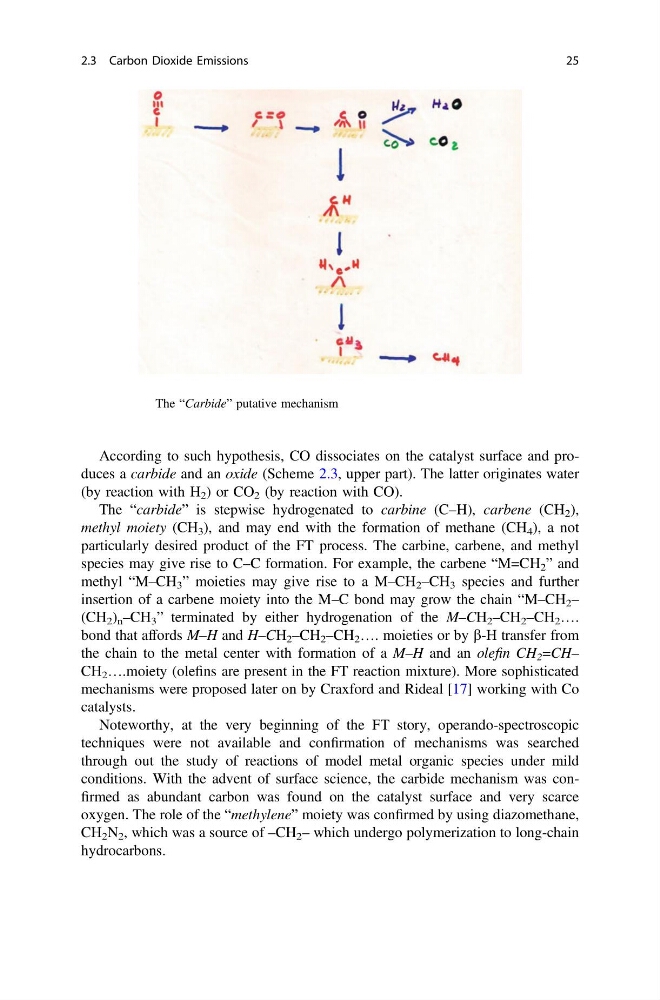
According to such hypothesis, CO dissociates on the catalyst surface and produces a carbide and an oxide (Scheme 2.3, upper part). The latter originates water
(by reaction with H 2 ) or CO 2 (by reaction with CO).
The “carbide” is stepwise hydrogenated to carbine (C–H), carbene (CH 2 ),
methyl moiety (CH 3 ), and may end with the formation of methane (CH 4 ), a not
particularly desired product of the FT process. The carbine, carbene, and methyl
species may give rise to C–C formation. For example, the carbene “M=CH 2 ” and
methyl “M–CH 3 ” moieties may give rise to a M–CH 2 –CH 3 species and further
insertion of a carbene moiety into the M–C bond may grow the chain “M–CH 2 –
(CH 2 ) n –CH 3 ” terminated by either hydrogenation of the M–CH 2 –CH 2 –CH 2 ….
bond that affords M–H and H–CH 2 –CH 2 –CH 2 …. moieties or by b-H transfer from
the chain to the metal center with formation of a M–H and an olefin CH 2 =CH–
CH 2 ….moiety (olefins are present in the FT reaction mixture). More sophisticated
mechanisms were proposed later on by Craxford and Rideal [17] working with Co
catalysts.
Noteworthy, at the very beginning of the FT story, operando-spectroscopic
techniques were not available and confirmation of mechanisms was searched
through out the study of reactions of model metal organic species under mild
conditions. With the advent of surface science, the carbide mechanism was confirmed as abundant carbon was found on the catalyst surface and very scarce
oxygen. The role of the “methylene” moiety was confirmed by using diazomethane,
CH 2 N 2 , which was a source of –CH 2 – which undergo polymerization to long-chain
hydrocarbons.
Scheme 2.3 The “Carbide” putative mechanism
2.3 Carbon Dioxide Emissions
25
(by reaction with H 2 ) or CO 2 (by reaction with CO).
The “carbide” is stepwise hydrogenated to carbine (C–H), carbene (CH 2 ),
methyl moiety (CH 3 ), and may end with the formation of methane (CH 4 ), a not
particularly desired product of the FT process. The carbine, carbene, and methyl
species may give rise to C–C formation. For example, the carbene “M=CH 2 ” and
methyl “M–CH 3 ” moieties may give rise to a M–CH 2 –CH 3 species and further
insertion of a carbene moiety into the M–C bond may grow the chain “M–CH 2 –
(CH 2 ) n –CH 3 ” terminated by either hydrogenation of the M–CH 2 –CH 2 –CH 2 ….
bond that affords M–H and H–CH 2 –CH 2 –CH 2 …. moieties or by b-H transfer from
the chain to the metal center with formation of a M–H and an olefin CH 2 =CH–
CH 2 ….moiety (olefins are present in the FT reaction mixture). More sophisticated
mechanisms were proposed later on by Craxford and Rideal [17] working with Co
catalysts.
Noteworthy, at the very beginning of the FT story, operando-spectroscopic
techniques were not available and confirmation of mechanisms was searched
through out the study of reactions of model metal organic species under mild
conditions. With the advent of surface science, the carbide mechanism was confirmed as abundant carbon was found on the catalyst surface and very scarce
oxygen. The role of the “methylene” moiety was confirmed by using diazomethane,
CH 2 N 2 , which was a source of –CH 2 – which undergo polymerization to long-chain
hydrocarbons.
Scheme 2.3 The “Carbide” putative mechanism
2.3 Carbon Dioxide Emissions
25