

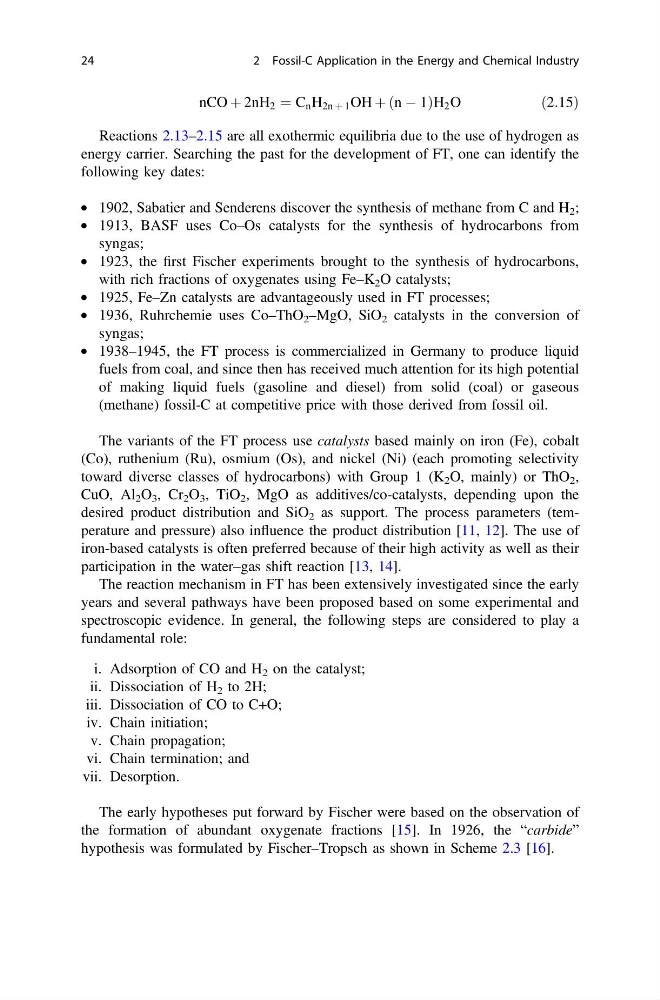
nCO þ 2nH 2 ¼ C n H 2n þ 1 OH þ n À 1
ð
ÞH 2 O
ð2:15Þ
Reactions 2.13–2.15 are all exothermic equilibria due to the use of hydrogen as
energy carrier. Searching the past for the development of FT, one can identify the
following key dates:
• 1902, Sabatier and Senderens discover the synthesis of methane from C and H 2 ;
• 1913, BASF uses Co–Os catalysts for the synthesis of hydrocarbons from
syngas;
• 1923, the first Fischer experiments brought to the synthesis of hydrocarbons,
with rich fractions of oxygenates using Fe–K 2 O catalysts;
• 1925, Fe–Zn catalysts are advantageously used in FT processes;
• 1936, Ruhrchemie uses Co–ThO 2 –MgO, SiO 2 catalysts in the conversion of
syngas;
• 1938–1945, the FT process is commercialized in Germany to produce liquid
fuels from coal, and since then has received much attention for its high potential
of making liquid fuels (gasoline and diesel) from solid (coal) or gaseous
(methane) fossil-C at competitive price with those derived from fossil oil.
The variants of the FT process use catalysts based mainly on iron (Fe), cobalt
(Co), ruthenium (Ru), osmium (Os), and nickel (Ni) (each promoting selectivity
toward diverse classes of hydrocarbons) with Group 1 (K 2 O, mainly) or ThO 2 ,
CuO, Al 2 O 3 , Cr 2 O 3 , TiO 2 , MgO as additives/co-catalysts, depending upon the
desired product distribution and SiO 2 as support. The process parameters (temperature and pressure) also influence the product distribution [11, 12]. The use of
iron-based catalysts is often preferred because of their high activity as well as their
participation in the water–gas shift reaction [13, 14].
The reaction mechanism in FT has been extensively investigated since the early
years and several pathways have been proposed based on some experimental and
spectroscopic evidence. In general, the following steps are considered to play a
fundamental role:
i. Adsorption of CO and H 2 on the catalyst;
ii. Dissociation of H 2 to 2H;
iii. Dissociation of CO to C+O;
iv. Chain initiation;
v. Chain propagation;
vi. Chain termination; and
vii. Desorption.
The early hypotheses put forward by Fischer were based on the observation of
the formation of abundant oxygenate fractions [15]. In 1926, the “carbide”
hypothesis was formulated by Fischer–Tropsch as shown in Scheme 2.3 [16].
24
2 Fossil-C Application in the Energy and Chemical Industry
ð
ÞH 2 O
ð2:15Þ
Reactions 2.13–2.15 are all exothermic equilibria due to the use of hydrogen as
energy carrier. Searching the past for the development of FT, one can identify the
following key dates:
• 1902, Sabatier and Senderens discover the synthesis of methane from C and H 2 ;
• 1913, BASF uses Co–Os catalysts for the synthesis of hydrocarbons from
syngas;
• 1923, the first Fischer experiments brought to the synthesis of hydrocarbons,
with rich fractions of oxygenates using Fe–K 2 O catalysts;
• 1925, Fe–Zn catalysts are advantageously used in FT processes;
• 1936, Ruhrchemie uses Co–ThO 2 –MgO, SiO 2 catalysts in the conversion of
syngas;
• 1938–1945, the FT process is commercialized in Germany to produce liquid
fuels from coal, and since then has received much attention for its high potential
of making liquid fuels (gasoline and diesel) from solid (coal) or gaseous
(methane) fossil-C at competitive price with those derived from fossil oil.
The variants of the FT process use catalysts based mainly on iron (Fe), cobalt
(Co), ruthenium (Ru), osmium (Os), and nickel (Ni) (each promoting selectivity
toward diverse classes of hydrocarbons) with Group 1 (K 2 O, mainly) or ThO 2 ,
CuO, Al 2 O 3 , Cr 2 O 3 , TiO 2 , MgO as additives/co-catalysts, depending upon the
desired product distribution and SiO 2 as support. The process parameters (temperature and pressure) also influence the product distribution [11, 12]. The use of
iron-based catalysts is often preferred because of their high activity as well as their
participation in the water–gas shift reaction [13, 14].
The reaction mechanism in FT has been extensively investigated since the early
years and several pathways have been proposed based on some experimental and
spectroscopic evidence. In general, the following steps are considered to play a
fundamental role:
i. Adsorption of CO and H 2 on the catalyst;
ii. Dissociation of H 2 to 2H;
iii. Dissociation of CO to C+O;
iv. Chain initiation;
v. Chain propagation;
vi. Chain termination; and
vii. Desorption.
The early hypotheses put forward by Fischer were based on the observation of
the formation of abundant oxygenate fractions [15]. In 1926, the “carbide”
hypothesis was formulated by Fischer–Tropsch as shown in Scheme 2.3 [16].
24
2 Fossil-C Application in the Energy and Chemical Industry