

oxygen evolution cocatalyst Co-Pi for effective use of water as source of (H
+ + e
− )
used in CO 2 reduction.
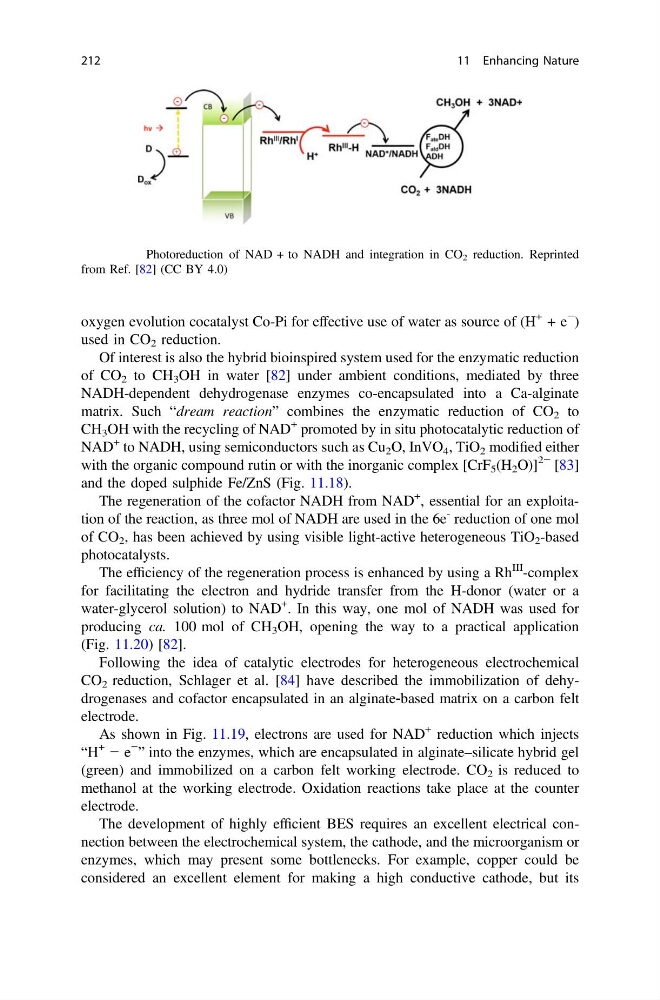
Of interest is also the hybrid bioinspired system used for the enzymatic reduction
of CO 2 to CH 3 OH in water [82] under ambient conditions, mediated by three
NADH-dependent dehydrogenase enzymes co-encapsulated into a Ca-alginate
matrix. Such “dream reaction” combines the enzymatic reduction of CO 2 to
CH 3 OH with the recycling of NAD
+ promoted by in situ photocatalytic reduction of
NAD
+ to NADH, using semiconductors such as Cu 2 O, InVO 4 , TiO 2 modified either
with the organic compound rutin or with the inorganic complex [CrF 5 (H 2 O)]
2− [83]
and the doped sulphide Fe/ZnS (Fig. 11.18).
The regeneration of the cofactor NADH from NAD
+ , essential for an exploitation of the reaction, as three mol of NADH are used in the 6e
- reduction of one mol
of CO 2 , has been achieved by using visible light-active heterogeneous TiO 2 -based
photocatalysts.
The efficiency of the regeneration process is enhanced by using a Rh
III -complex
for facilitating the electron and hydride transfer from the H-donor (water or a
water-glycerol solution) to NAD
+ . In this way, one mol of NADH was used for
producing ca. 100 mol of CH 3 OH, opening the way to a practical application
(Fig. 11.20) [82].
Following the idea of catalytic electrodes for heterogeneous electrochemical
CO 2 reduction, Schlager et al. [84] have described the immobilization of dehydrogenases and cofactor encapsulated in an alginate‐based matrix on a carbon felt
electrode.
As shown in Fig. 11.19, electrons are used for NAD
+ reduction which injects
“H
+
− e
−
” into the enzymes, which are encapsulated in alginate–silicate hybrid gel
(green) and immobilized on a carbon felt working electrode. CO 2 is reduced to
methanol at the working electrode. Oxidation reactions take place at the counter
electrode.
The development of highly efficient BES requires an excellent electrical connection between the electrochemical system, the cathode, and the microorganism or
enzymes, which may present some bottlenecks. For example, copper could be
considered an excellent element for making a high conductive cathode, but its
Fig. 11.18 Photoreduction of NAD + to NADH and integration in CO 2 reduction. Reprinted
from Ref. [82] (CC BY 4.0)
212
11 Enhancing Nature
+ + e
− )
used in CO 2 reduction.
Of interest is also the hybrid bioinspired system used for the enzymatic reduction
of CO 2 to CH 3 OH in water [82] under ambient conditions, mediated by three
NADH-dependent dehydrogenase enzymes co-encapsulated into a Ca-alginate
matrix. Such “dream reaction” combines the enzymatic reduction of CO 2 to
CH 3 OH with the recycling of NAD
+ promoted by in situ photocatalytic reduction of
NAD
+ to NADH, using semiconductors such as Cu 2 O, InVO 4 , TiO 2 modified either
with the organic compound rutin or with the inorganic complex [CrF 5 (H 2 O)]
2− [83]
and the doped sulphide Fe/ZnS (Fig. 11.18).
The regeneration of the cofactor NADH from NAD
+ , essential for an exploitation of the reaction, as three mol of NADH are used in the 6e
- reduction of one mol
of CO 2 , has been achieved by using visible light-active heterogeneous TiO 2 -based
photocatalysts.
The efficiency of the regeneration process is enhanced by using a Rh
III -complex
for facilitating the electron and hydride transfer from the H-donor (water or a
water-glycerol solution) to NAD
+ . In this way, one mol of NADH was used for
producing ca. 100 mol of CH 3 OH, opening the way to a practical application
(Fig. 11.20) [82].
Following the idea of catalytic electrodes for heterogeneous electrochemical
CO 2 reduction, Schlager et al. [84] have described the immobilization of dehydrogenases and cofactor encapsulated in an alginate‐based matrix on a carbon felt
electrode.
As shown in Fig. 11.19, electrons are used for NAD
+ reduction which injects
“H
+
− e
−
” into the enzymes, which are encapsulated in alginate–silicate hybrid gel
(green) and immobilized on a carbon felt working electrode. CO 2 is reduced to
methanol at the working electrode. Oxidation reactions take place at the counter
electrode.
The development of highly efficient BES requires an excellent electrical connection between the electrochemical system, the cathode, and the microorganism or
enzymes, which may present some bottlenecks. For example, copper could be
considered an excellent element for making a high conductive cathode, but its
Fig. 11.18 Photoreduction of NAD + to NADH and integration in CO 2 reduction. Reprinted
from Ref. [82] (CC BY 4.0)
212
11 Enhancing Nature