

Bioelectrochemical systems have been used also for the microbial electrosynthesis (MES) to generate acetate from the biocathodic reduction of carbon dioxide
with a continuous acetate production rate of 0.98 mmol C L NCC
−1
d
−1 (NCC = net
cathode compartment) under controlled pH-conditions (pH = 5.8) [80].
11.5 Integration of Catalysis and Biotechnology
An integrated approach that combines the strong points of electrochemical processes and biosystems in CO 2 reduction could be a way to take advantage of the
high conversion rate and selectivity of metal enzymes intensified by using chemical
processes. A “two-step” approach for CO 2 reduction to methane has been proposed.
CO 2 is first reduced very selectively to formate electrochemically, then formate is
separated by electrodialysis and used as feed by Methanococcus maripaludis, a
methanogen microorganism [71]. Such kind of system combines chemo(electro)catalysis with enzymatic catalysis, making use of solar energy for the selective
conversion of CO 2 into useful, energy-rich products.
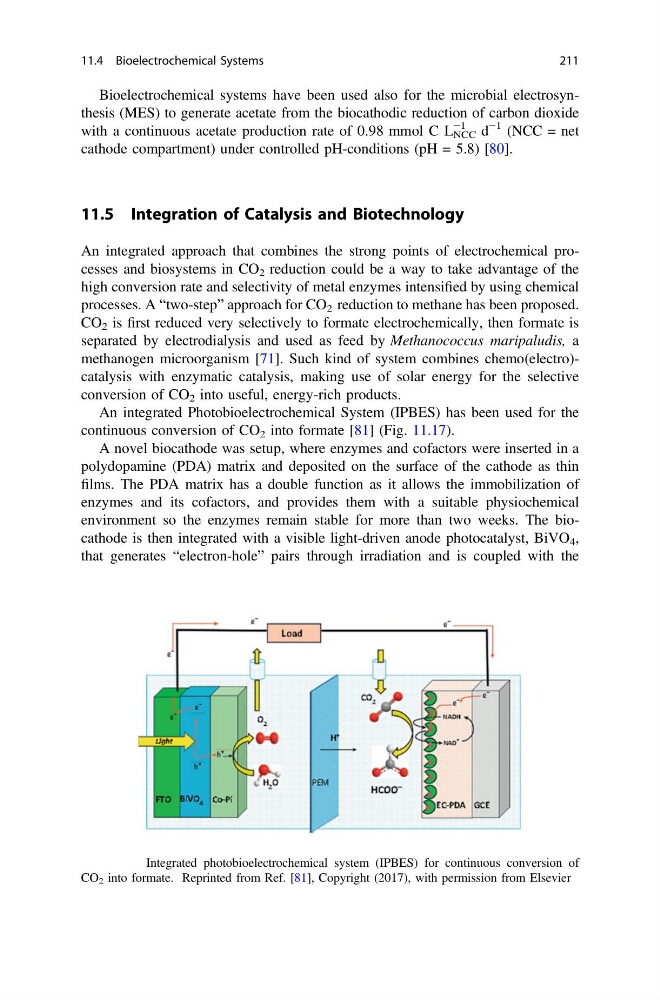
An integrated Photobioelectrochemical System (IPBES) has been used for the
continuous conversion of CO 2 into formate [81] (Fig. 11.17).
A novel biocathode was setup, where enzymes and cofactors were inserted in a
polydopamine (PDA) matrix and deposited on the surface of the cathode as thin
films. The PDA matrix has a double function as it allows the immobilization of
enzymes and its cofactors, and provides them with a suitable physiochemical
environment so the enzymes remain stable for more than two weeks. The biocathode is then integrated with a visible light-driven anode photocatalyst, BiVO 4 ,
that generates “electron-hole” pairs through irradiation and is coupled with the
Fig. 11.17 Integrated photobioelectrochemical system (IPBES) for continuous conversion of
CO 2 into formate. Reprinted from Ref. [81], Copyright (2017), with permission from Elsevier
11.4 Bioelectrochemical Systems
211
with a continuous acetate production rate of 0.98 mmol C L NCC
−1
d
−1 (NCC = net
cathode compartment) under controlled pH-conditions (pH = 5.8) [80].
11.5 Integration of Catalysis and Biotechnology
An integrated approach that combines the strong points of electrochemical processes and biosystems in CO 2 reduction could be a way to take advantage of the
high conversion rate and selectivity of metal enzymes intensified by using chemical
processes. A “two-step” approach for CO 2 reduction to methane has been proposed.
CO 2 is first reduced very selectively to formate electrochemically, then formate is
separated by electrodialysis and used as feed by Methanococcus maripaludis, a
methanogen microorganism [71]. Such kind of system combines chemo(electro)catalysis with enzymatic catalysis, making use of solar energy for the selective
conversion of CO 2 into useful, energy-rich products.
An integrated Photobioelectrochemical System (IPBES) has been used for the
continuous conversion of CO 2 into formate [81] (Fig. 11.17).
A novel biocathode was setup, where enzymes and cofactors were inserted in a
polydopamine (PDA) matrix and deposited on the surface of the cathode as thin
films. The PDA matrix has a double function as it allows the immobilization of
enzymes and its cofactors, and provides them with a suitable physiochemical
environment so the enzymes remain stable for more than two weeks. The biocathode is then integrated with a visible light-driven anode photocatalyst, BiVO 4 ,
that generates “electron-hole” pairs through irradiation and is coupled with the
Fig. 11.17 Integrated photobioelectrochemical system (IPBES) for continuous conversion of
CO 2 into formate. Reprinted from Ref. [81], Copyright (2017), with permission from Elsevier
11.4 Bioelectrochemical Systems
211