

antimicrobial properties represent a limit for bioelectrochemistry. Bioelectrochemical reduction of CO 2 to acetate has been achieved using microbial electrosynthesis (MES) reactors. Pant et al. [85] have studied the production of acetate
from CO 2 combining MES system with an anion exchange resin for sorption of
acetate from the broth. Acetate desorption from the resin allows to have a final
concentration of 5.0 g L
−1 of acetate in the eluent. Interesting is the work reported
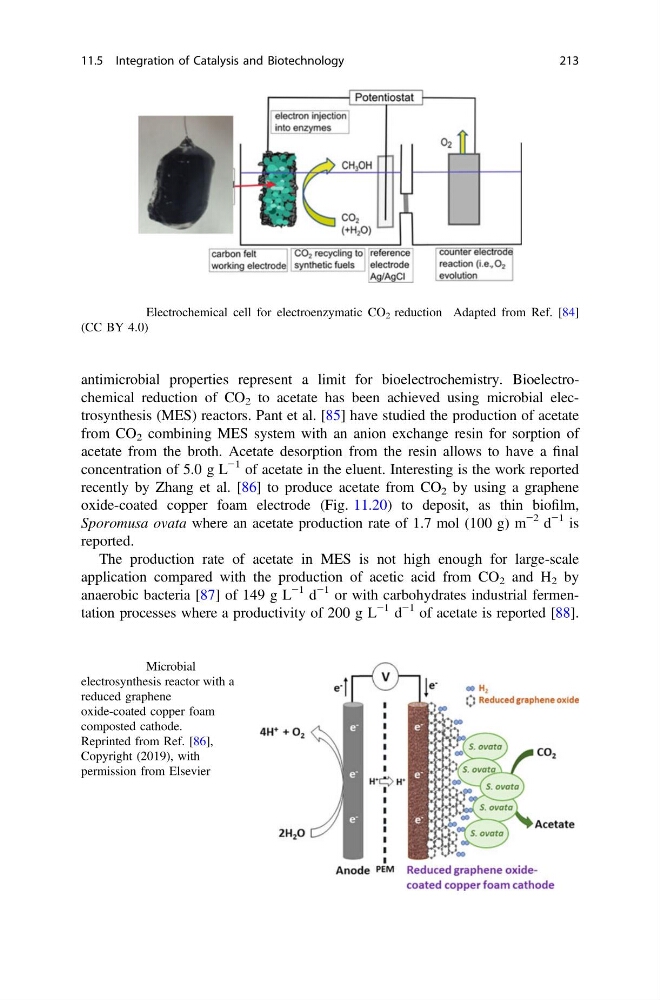
recently by Zhang et al. [86] to produce acetate from CO 2 by using a graphene
oxide-coated copper foam electrode (Fig. 11.20) to deposit, as thin biofilm,
Sporomusa ovata where an acetate production rate of 1.7 mol (100 g) m
−2 d
−1 is
reported.
The production rate of acetate in MES is not high enough for large-scale
application compared with the production of acetic acid from CO 2 and H 2 by
anaerobic bacteria [87] of 149 g L
−1 d
−1 or with carbohydrates industrial fermentation processes where a productivity of 200 g L
−1 d
−1 of acetate is reported [88].
Fig. 11.19 Electrochemical cell for electroenzymatic CO 2 reduction Adapted from Ref. [84]
(CC BY 4.0)
Fig. 11.20 Microbial
electrosynthesis reactor with a
reduced graphene
oxide-coated copper foam
composted cathode.
Reprinted from Ref. [86],
Copyright (2019), with
permission from Elsevier
11.5 Integration of Catalysis and Biotechnology
213
from CO 2 combining MES system with an anion exchange resin for sorption of
acetate from the broth. Acetate desorption from the resin allows to have a final
concentration of 5.0 g L
−1 of acetate in the eluent. Interesting is the work reported
recently by Zhang et al. [86] to produce acetate from CO 2 by using a graphene
oxide-coated copper foam electrode (Fig. 11.20) to deposit, as thin biofilm,
Sporomusa ovata where an acetate production rate of 1.7 mol (100 g) m
−2 d
−1 is
reported.
The production rate of acetate in MES is not high enough for large-scale
application compared with the production of acetic acid from CO 2 and H 2 by
anaerobic bacteria [87] of 149 g L
−1 d
−1 or with carbohydrates industrial fermentation processes where a productivity of 200 g L
−1 d
−1 of acetate is reported [88].
Fig. 11.19 Electrochemical cell for electroenzymatic CO 2 reduction Adapted from Ref. [84]
(CC BY 4.0)
Fig. 11.20 Microbial
electrosynthesis reactor with a
reduced graphene
oxide-coated copper foam
composted cathode.
Reprinted from Ref. [86],
Copyright (2019), with
permission from Elsevier
11.5 Integration of Catalysis and Biotechnology
213