

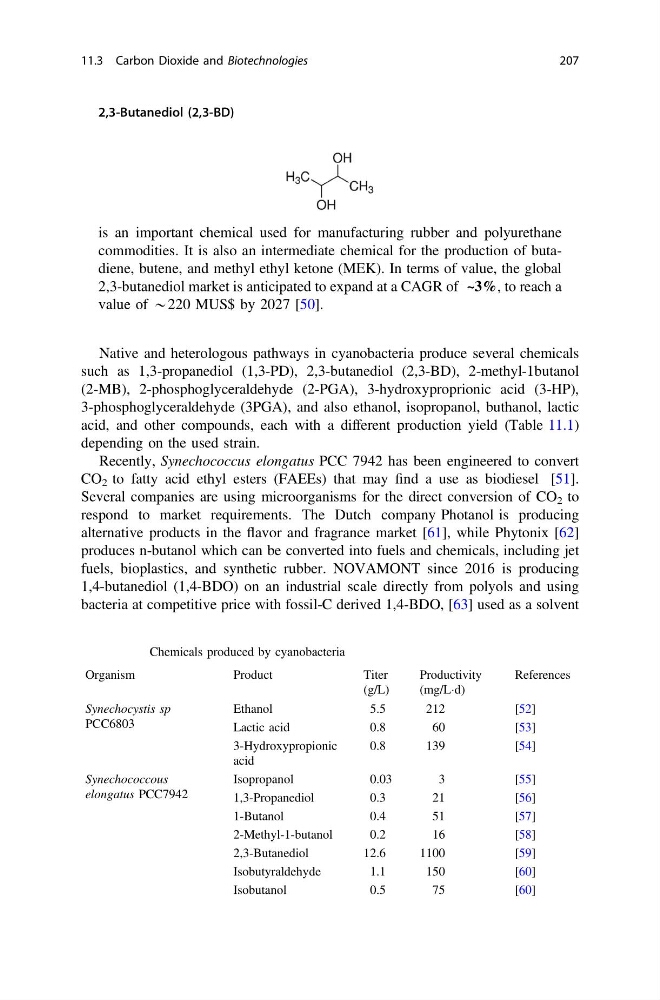
2,3-Butanediol (2,3-BD)
is an important chemical used for manufacturing rubber and polyurethane
commodities. It is also an intermediate chemical for the production of butadiene, butene, and methyl ethyl ketone (MEK). In terms of value, the global
2,3-butanediol market is anticipated to expand at a CAGR of ~3%, to reach a
value of *220 MUS$ by 2027 [50].
Native and heterologous pathways in cyanobacteria produce several chemicals
such as 1,3-propanediol (1,3-PD), 2,3-butanediol (2,3-BD), 2-methyl-1butanol
(2-MB), 2-phosphoglyceraldehyde (2-PGA), 3-hydroxyproprionic acid (3-HP),
3-phosphoglyceraldehyde (3PGA), and also ethanol, isopropanol, buthanol, lactic
acid, and other compounds, each with a different production yield (Table 11.1)
depending on the used strain.
Recently, Synechococcus elongatus PCC 7942 has been engineered to convert
CO 2 to fatty acid ethyl esters (FAEEs) that may find a use as biodiesel [51].
Several companies are using microorganisms for the direct conversion of CO 2 to
respond to market requirements. The Dutch company Photanol is producing
alternative products in the flavor and fragrance market [61], while Phytonix [62]
produces n-butanol which can be converted into fuels and chemicals, including jet
fuels, bioplastics, and synthetic rubber. NOVAMONT since 2016 is producing
1,4-butanediol (1,4-BDO) on an industrial scale directly from polyols and using
bacteria at competitive price with fossil-C derived 1,4-BDO, [63] used as a solvent
Table 11.1 Chemicals produced by cyanobacteria
Organism
Product
Titer
(g/L)
Productivity
(mg/LÁd)
References
Synechocystis sp
PCC6803
Ethanol
5.5
212
[52]
Lactic acid
0.8
60
[53]
3-Hydroxypropionic
acid
0.8
139
[54]
Synechococcous
elongatus PCC7942
Isopropanol
0.03
3
[55]
1,3-Propanediol
0.3
21
[56]
1-Butanol
0.4
51
[57]
2-Methyl-1-butanol
0.2
16
[58]
2,3-Butanediol
12.6
1100
[59]
Isobutyraldehyde
1.1
150
[60]
Isobutanol
0.5
75
[60]
11.3 Carbon Dioxide and Biotechnologies
207
is an important chemical used for manufacturing rubber and polyurethane
commodities. It is also an intermediate chemical for the production of butadiene, butene, and methyl ethyl ketone (MEK). In terms of value, the global
2,3-butanediol market is anticipated to expand at a CAGR of ~3%, to reach a
value of *220 MUS$ by 2027 [50].
Native and heterologous pathways in cyanobacteria produce several chemicals
such as 1,3-propanediol (1,3-PD), 2,3-butanediol (2,3-BD), 2-methyl-1butanol
(2-MB), 2-phosphoglyceraldehyde (2-PGA), 3-hydroxyproprionic acid (3-HP),
3-phosphoglyceraldehyde (3PGA), and also ethanol, isopropanol, buthanol, lactic
acid, and other compounds, each with a different production yield (Table 11.1)
depending on the used strain.
Recently, Synechococcus elongatus PCC 7942 has been engineered to convert
CO 2 to fatty acid ethyl esters (FAEEs) that may find a use as biodiesel [51].
Several companies are using microorganisms for the direct conversion of CO 2 to
respond to market requirements. The Dutch company Photanol is producing
alternative products in the flavor and fragrance market [61], while Phytonix [62]
produces n-butanol which can be converted into fuels and chemicals, including jet
fuels, bioplastics, and synthetic rubber. NOVAMONT since 2016 is producing
1,4-butanediol (1,4-BDO) on an industrial scale directly from polyols and using
bacteria at competitive price with fossil-C derived 1,4-BDO, [63] used as a solvent
Table 11.1 Chemicals produced by cyanobacteria
Organism
Product
Titer
(g/L)
Productivity
(mg/LÁd)
References
Synechocystis sp
PCC6803
Ethanol
5.5
212
[52]
Lactic acid
0.8
60
[53]
3-Hydroxypropionic
acid
0.8
139
[54]
Synechococcous
elongatus PCC7942
Isopropanol
0.03
3
[55]
1,3-Propanediol
0.3
21
[56]
1-Butanol
0.4
51
[57]
2-Methyl-1-butanol
0.2
16
[58]
2,3-Butanediol
12.6
1100
[59]
Isobutyraldehyde
1.1
150
[60]
Isobutanol
0.5
75
[60]
11.3 Carbon Dioxide and Biotechnologies
207