

and for the production of plastics, elastic fibers and polyurethanes. The global
1,4-BDO market size was valued at USD 6.19 billion in 2015 and is expected to
grow at an estimated CAGR of 7.7% from 2016 to 2025 [64].
Another example of biotechnological application comes from the UK company
Deep Branch Biotechnology that, together with Drax Power Station, the biggest
renewable electricity generator in the UK, has developed the production of proteins
(titre 70%) from CO 2 by using a pool of microorganisms [65].
All cases presented above are good examples of application of the principles of
the circular economy.
11.4 Bioelectrochemical Systems
Bioelectrochemical systems (BES) have recently been proposed as a new and
sustainable technology for the generation of energy and useful products from waste
[66]; in a BES, bacteria interact with solid-state electrodes (covered with semiconductor materials so that electricity is generated by shining light on the electrode
surface) and exchange electrons with them, either directly or via redox mediators.
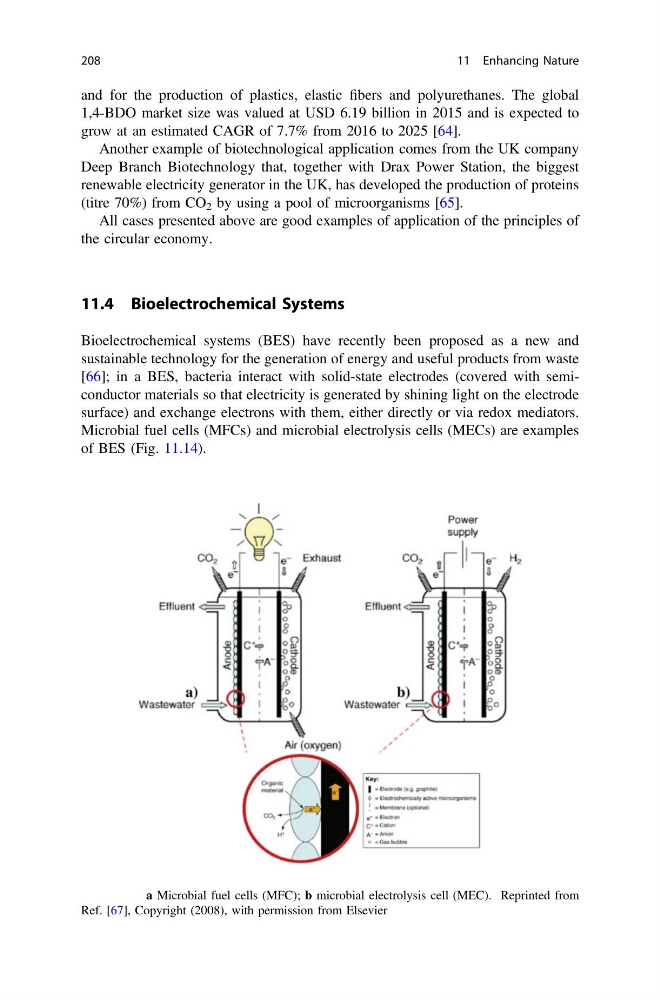
Microbial fuel cells (MFCs) and microbial electrolysis cells (MECs) are examples
of BES (Fig. 11.14).
Fig. 11.14 a Microbial fuel cells (MFC); b microbial electrolysis cell (MEC). Reprinted from
Ref. [67], Copyright (2008), with permission from Elsevier
208
11 Enhancing Nature
1,4-BDO market size was valued at USD 6.19 billion in 2015 and is expected to
grow at an estimated CAGR of 7.7% from 2016 to 2025 [64].
Another example of biotechnological application comes from the UK company
Deep Branch Biotechnology that, together with Drax Power Station, the biggest
renewable electricity generator in the UK, has developed the production of proteins
(titre 70%) from CO 2 by using a pool of microorganisms [65].
All cases presented above are good examples of application of the principles of
the circular economy.
11.4 Bioelectrochemical Systems
Bioelectrochemical systems (BES) have recently been proposed as a new and
sustainable technology for the generation of energy and useful products from waste
[66]; in a BES, bacteria interact with solid-state electrodes (covered with semiconductor materials so that electricity is generated by shining light on the electrode
surface) and exchange electrons with them, either directly or via redox mediators.
Microbial fuel cells (MFCs) and microbial electrolysis cells (MECs) are examples
of BES (Fig. 11.14).
Fig. 11.14 a Microbial fuel cells (MFC); b microbial electrolysis cell (MEC). Reprinted from
Ref. [67], Copyright (2008), with permission from Elsevier
208
11 Enhancing Nature