

11.3 Carbon Dioxide and Biotechnologies
CO 2 can be used as C-1 building block for chemicals and materials or as source of
carbon for the synthesis of products. The energetics of the chemical conversion of
CO 2 says that the synthesis of carboxylates and lactones (RCOOR′), carbamates
(RR′NCOOR″), ureas (RR′NCONRR′), isocyanates (RNCO), and carbonates [ROC
(O)OR′] require moderate external energy input, if not zero [45, 46], while formates, methanol or methane and hydrocarbons require energy and hydrogen. Plants
or microorganisms in Nature convert carbon dioxide and water into a large variety
of energy-rich products using either solar energy or even chemical energy under
ambient conditions.
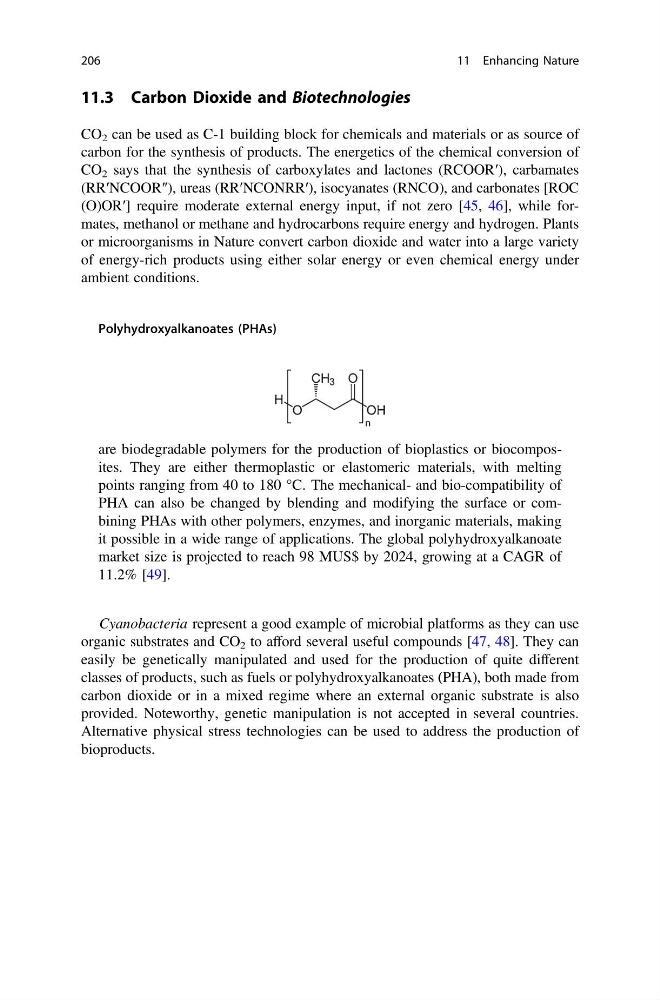
Polyhydroxyalkanoates (PHAs)
are biodegradable polymers for the production of bioplastics or biocomposites. They are either thermoplastic or elastomeric materials, with melting
points ranging from 40 to 180 °C. The mechanical- and bio-compatibility of
PHA can also be changed by blending and modifying the surface or combining PHAs with other polymers, enzymes, and inorganic materials, making
it possible in a wide range of applications. The global polyhydroxyalkanoate
market size is projected to reach 98 MUS$ by 2024, growing at a CAGR of
11.2% [49].
Cyanobacteria represent a good example of microbial platforms as they can use
organic substrates and CO 2 to afford several useful compounds [47, 48]. They can
easily be genetically manipulated and used for the production of quite different
classes of products, such as fuels or polyhydroxyalkanoates (PHA), both made from
carbon dioxide or in a mixed regime where an external organic substrate is also
provided. Noteworthy, genetic manipulation is not accepted in several countries.
Alternative physical stress technologies can be used to address the production of
bioproducts.
206
11 Enhancing Nature
CO 2 can be used as C-1 building block for chemicals and materials or as source of
carbon for the synthesis of products. The energetics of the chemical conversion of
CO 2 says that the synthesis of carboxylates and lactones (RCOOR′), carbamates
(RR′NCOOR″), ureas (RR′NCONRR′), isocyanates (RNCO), and carbonates [ROC
(O)OR′] require moderate external energy input, if not zero [45, 46], while formates, methanol or methane and hydrocarbons require energy and hydrogen. Plants
or microorganisms in Nature convert carbon dioxide and water into a large variety
of energy-rich products using either solar energy or even chemical energy under
ambient conditions.
Polyhydroxyalkanoates (PHAs)
are biodegradable polymers for the production of bioplastics or biocomposites. They are either thermoplastic or elastomeric materials, with melting
points ranging from 40 to 180 °C. The mechanical- and bio-compatibility of
PHA can also be changed by blending and modifying the surface or combining PHAs with other polymers, enzymes, and inorganic materials, making
it possible in a wide range of applications. The global polyhydroxyalkanoate
market size is projected to reach 98 MUS$ by 2024, growing at a CAGR of
11.2% [49].
Cyanobacteria represent a good example of microbial platforms as they can use
organic substrates and CO 2 to afford several useful compounds [47, 48]. They can
easily be genetically manipulated and used for the production of quite different
classes of products, such as fuels or polyhydroxyalkanoates (PHA), both made from
carbon dioxide or in a mixed regime where an external organic substrate is also
provided. Noteworthy, genetic manipulation is not accepted in several countries.
Alternative physical stress technologies can be used to address the production of
bioproducts.
206
11 Enhancing Nature