

Polyethylene furandicarboxylate (PEF)
The value for 2,5-Furandicarboxylic Acid (FDCA) market was USD 391.3
million in 2018. The projected production potential by 2020 is 496.0 Mt, and
a value of 498 MUS$, out of which 65% goes to PEF and the rest mainly to
polyamides, polycarbonates, and plasticizers. The market is expected to reach
786.3 MUS$ by 2026 [36].
FDCA attracts much attention as it can be used to make polyethene furandicarboxylate (PEF), a potential effective substitute of petroleum-derived polyethene
terephthalate (PET). Moreover, HMF can afford oxalic (OA) and succinic acid
(SA) via aerobic oxidative cleavage [40] with high conversion and good selectivity
(Scheme 11.3).
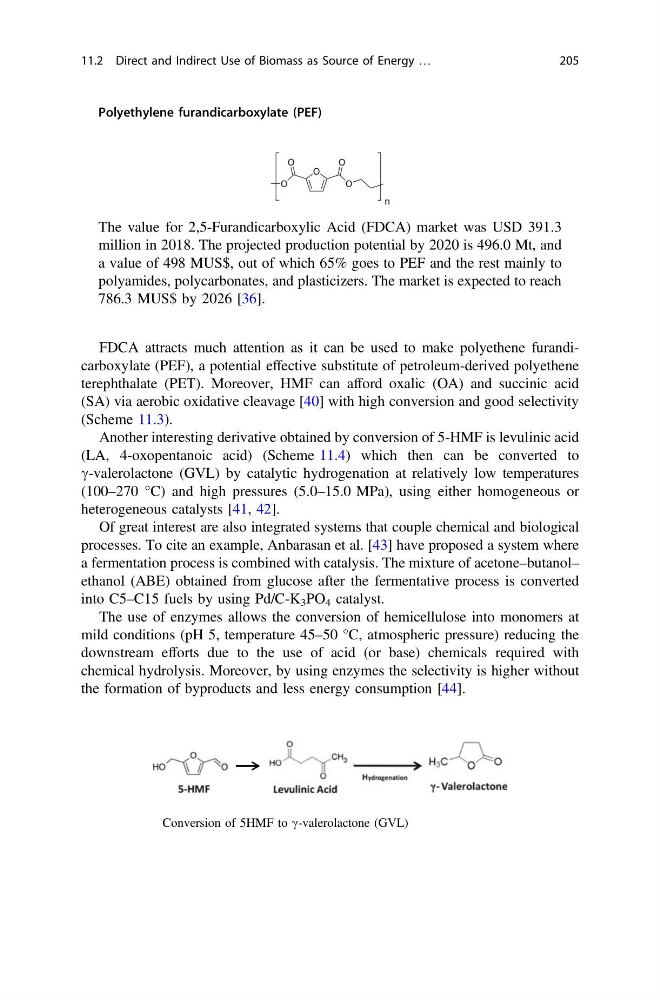
Another interesting derivative obtained by conversion of 5-HMF is levulinic acid
(LA, 4-oxopentanoic acid) (Scheme 11.4) which then can be converted to
c-valerolactone (GVL) by catalytic hydrogenation at relatively low temperatures
(100–270 °C) and high pressures (5.0–15.0 MPa), using either homogeneous or
heterogeneous catalysts [41, 42].
Of great interest are also integrated systems that couple chemical and biological
processes. To cite an example, Anbarasan et al. [43] have proposed a system where
a fermentation process is combined with catalysis. The mixture of acetone–butanol–
ethanol (ABE) obtained from glucose after the fermentative process is converted
into C5–C15 fuels by using Pd/C-K 3 PO 4 catalyst.
The use of enzymes allows the conversion of hemicellulose into monomers at
mild conditions (pH 5, temperature 45–50 °C, atmospheric pressure) reducing the
downstream efforts due to the use of acid (or base) chemicals required with
chemical hydrolysis. Moreover, by using enzymes the selectivity is higher without
the formation of byproducts and less energy consumption [44].
Scheme 11.4 Conversion of 5HMF to c-valerolactone (GVL)
11.2 Direct and Indirect Use of Biomass as Source of Energy …
205
The value for 2,5-Furandicarboxylic Acid (FDCA) market was USD 391.3
million in 2018. The projected production potential by 2020 is 496.0 Mt, and
a value of 498 MUS$, out of which 65% goes to PEF and the rest mainly to
polyamides, polycarbonates, and plasticizers. The market is expected to reach
786.3 MUS$ by 2026 [36].
FDCA attracts much attention as it can be used to make polyethene furandicarboxylate (PEF), a potential effective substitute of petroleum-derived polyethene
terephthalate (PET). Moreover, HMF can afford oxalic (OA) and succinic acid
(SA) via aerobic oxidative cleavage [40] with high conversion and good selectivity
(Scheme 11.3).
Another interesting derivative obtained by conversion of 5-HMF is levulinic acid
(LA, 4-oxopentanoic acid) (Scheme 11.4) which then can be converted to
c-valerolactone (GVL) by catalytic hydrogenation at relatively low temperatures
(100–270 °C) and high pressures (5.0–15.0 MPa), using either homogeneous or
heterogeneous catalysts [41, 42].
Of great interest are also integrated systems that couple chemical and biological
processes. To cite an example, Anbarasan et al. [43] have proposed a system where
a fermentation process is combined with catalysis. The mixture of acetone–butanol–
ethanol (ABE) obtained from glucose after the fermentative process is converted
into C5–C15 fuels by using Pd/C-K 3 PO 4 catalyst.
The use of enzymes allows the conversion of hemicellulose into monomers at
mild conditions (pH 5, temperature 45–50 °C, atmospheric pressure) reducing the
downstream efforts due to the use of acid (or base) chemicals required with
chemical hydrolysis. Moreover, by using enzymes the selectivity is higher without
the formation of byproducts and less energy consumption [44].
Scheme 11.4 Conversion of 5HMF to c-valerolactone (GVL)
11.2 Direct and Indirect Use of Biomass as Source of Energy …
205