

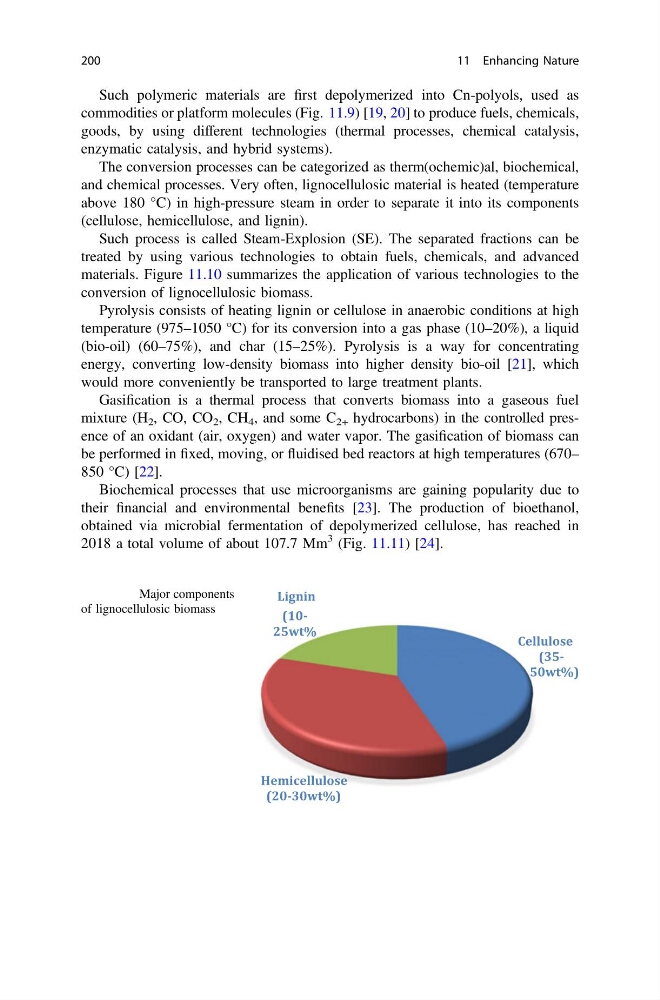
Such polymeric materials are first depolymerized into Cn-polyols, used as
commodities or platform molecules (Fig. 11.9) [19, 20] to produce fuels, chemicals,
goods, by using different technologies (thermal processes, chemical catalysis,
enzymatic catalysis, and hybrid systems).
The conversion processes can be categorized as therm(ochemic)al, biochemical,
and chemical processes. Very often, lignocellulosic material is heated (temperature
above 180 °C) in high-pressure steam in order to separate it into its components
(cellulose, hemicellulose, and lignin).
Such process is called Steam-Explosion (SE). The separated fractions can be
treated by using various technologies to obtain fuels, chemicals, and advanced
materials. Figure 11.10 summarizes the application of various technologies to the
conversion of lignocellulosic biomass.
Pyrolysis consists of heating lignin or cellulose in anaerobic conditions at high
temperature (975–1050 °C) for its conversion into a gas phase (10–20%), a liquid
(bio-oil) (60–75%), and char (15–25%). Pyrolysis is a way for concentrating
energy, converting low-density biomass into higher density bio-oil [21], which
would more conveniently be transported to large treatment plants.
Gasification is a thermal process that converts biomass into a gaseous fuel
mixture (H 2 , CO, CO 2 , CH 4 , and some C 2+ hydrocarbons) in the controlled presence of an oxidant (air, oxygen) and water vapor. The gasification of biomass can
be performed in fixed, moving, or fluidised bed reactors at high temperatures (670–
850 °C) [22].
Biochemical processes that use microorganisms are gaining popularity due to
their financial and environmental benefits [23]. The production of bioethanol,
obtained via microbial fermentation of depolymerized cellulose, has reached in
2018 a total volume of about 107.7 Mm
3 (Fig. 11.11) [24].
Cellulose
(3550wt%)
Hemicellulose
(20-30wt%)
Lignin
(1025wt%
Fig. 11.8 Major components
of lignocellulosic biomass
200
11 Enhancing Nature
commodities or platform molecules (Fig. 11.9) [19, 20] to produce fuels, chemicals,
goods, by using different technologies (thermal processes, chemical catalysis,
enzymatic catalysis, and hybrid systems).
The conversion processes can be categorized as therm(ochemic)al, biochemical,
and chemical processes. Very often, lignocellulosic material is heated (temperature
above 180 °C) in high-pressure steam in order to separate it into its components
(cellulose, hemicellulose, and lignin).
Such process is called Steam-Explosion (SE). The separated fractions can be
treated by using various technologies to obtain fuels, chemicals, and advanced
materials. Figure 11.10 summarizes the application of various technologies to the
conversion of lignocellulosic biomass.
Pyrolysis consists of heating lignin or cellulose in anaerobic conditions at high
temperature (975–1050 °C) for its conversion into a gas phase (10–20%), a liquid
(bio-oil) (60–75%), and char (15–25%). Pyrolysis is a way for concentrating
energy, converting low-density biomass into higher density bio-oil [21], which
would more conveniently be transported to large treatment plants.
Gasification is a thermal process that converts biomass into a gaseous fuel
mixture (H 2 , CO, CO 2 , CH 4 , and some C 2+ hydrocarbons) in the controlled presence of an oxidant (air, oxygen) and water vapor. The gasification of biomass can
be performed in fixed, moving, or fluidised bed reactors at high temperatures (670–
850 °C) [22].
Biochemical processes that use microorganisms are gaining popularity due to
their financial and environmental benefits [23]. The production of bioethanol,
obtained via microbial fermentation of depolymerized cellulose, has reached in
2018 a total volume of about 107.7 Mm
3 (Fig. 11.11) [24].
Cellulose
(3550wt%)
Hemicellulose
(20-30wt%)
Lignin
(1025wt%
Fig. 11.8 Major components
of lignocellulosic biomass
200
11 Enhancing Nature