

unsaturation can cause problems to engines during combustion) and need treatment
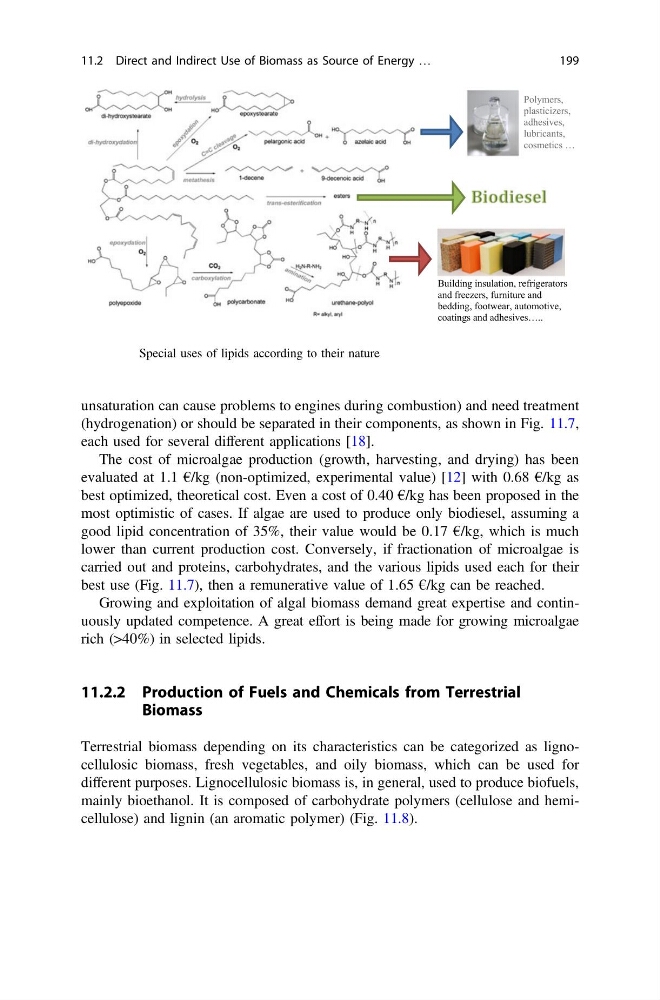
(hydrogenation) or should be separated in their components, as shown in Fig. 11.7,
each used for several different applications [18].
The cost of microalgae production (growth, harvesting, and drying) has been
evaluated at 1.1 €/kg (non-optimized, experimental value) [12] with 0.68 €/kg as
best optimized, theoretical cost. Even a cost of 0.40 €/kg has been proposed in the
most optimistic of cases. If algae are used to produce only biodiesel, assuming a
good lipid concentration of 35%, their value would be 0.17 €/kg, which is much
lower than current production cost. Conversely, if fractionation of microalgae is
carried out and proteins, carbohydrates, and the various lipids used each for their
best use (Fig. 11.7), then a remunerative value of 1.65 €/kg can be reached.
Growing and exploitation of algal biomass demand great expertise and continuously updated competence. A great effort is being made for growing microalgae
rich (>40%) in selected lipids.
11.2.2 Production of Fuels and Chemicals from Terrestrial
Biomass
Terrestrial biomass depending on its characteristics can be categorized as lignocellulosic biomass, fresh vegetables, and oily biomass, which can be used for
different purposes. Lignocellulosic biomass is, in general, used to produce biofuels,
mainly bioethanol. It is composed of carbohydrate polymers (cellulose and hemicellulose) and lignin (an aromatic polymer) (Fig. 11.8).
Polymers,
plasticizers,
adhesives,
lubricants,
cosmetics …
Building insulation, refrigerators
and freezers, furniture and
bedding, footwear, automotive,
coatings and adhesives…..
Fig. 11.7 Special uses of lipids according to their nature
11.2 Direct and Indirect Use of Biomass as Source of Energy …
199
(hydrogenation) or should be separated in their components, as shown in Fig. 11.7,
each used for several different applications [18].
The cost of microalgae production (growth, harvesting, and drying) has been
evaluated at 1.1 €/kg (non-optimized, experimental value) [12] with 0.68 €/kg as
best optimized, theoretical cost. Even a cost of 0.40 €/kg has been proposed in the
most optimistic of cases. If algae are used to produce only biodiesel, assuming a
good lipid concentration of 35%, their value would be 0.17 €/kg, which is much
lower than current production cost. Conversely, if fractionation of microalgae is
carried out and proteins, carbohydrates, and the various lipids used each for their
best use (Fig. 11.7), then a remunerative value of 1.65 €/kg can be reached.
Growing and exploitation of algal biomass demand great expertise and continuously updated competence. A great effort is being made for growing microalgae
rich (>40%) in selected lipids.
11.2.2 Production of Fuels and Chemicals from Terrestrial
Biomass
Terrestrial biomass depending on its characteristics can be categorized as lignocellulosic biomass, fresh vegetables, and oily biomass, which can be used for
different purposes. Lignocellulosic biomass is, in general, used to produce biofuels,
mainly bioethanol. It is composed of carbohydrate polymers (cellulose and hemicellulose) and lignin (an aromatic polymer) (Fig. 11.8).
Polymers,
plasticizers,
adhesives,
lubricants,
cosmetics …
Building insulation, refrigerators
and freezers, furniture and
bedding, footwear, automotive,
coatings and adhesives…..
Fig. 11.7 Special uses of lipids according to their nature
11.2 Direct and Indirect Use of Biomass as Source of Energy …
199