

Other important operations that may influence the economics of microalgae
production are harvesting [14], drying, and processing of biomass. A huge effort is
being made in order to reduce the energetic cost and CAPEX of equipment necessary for separation and dehydration of algal biomass, in addition to implementing
efficient fractionation techniques for efficiently applying the concept of biorefinery
and valorize all algal components [7].
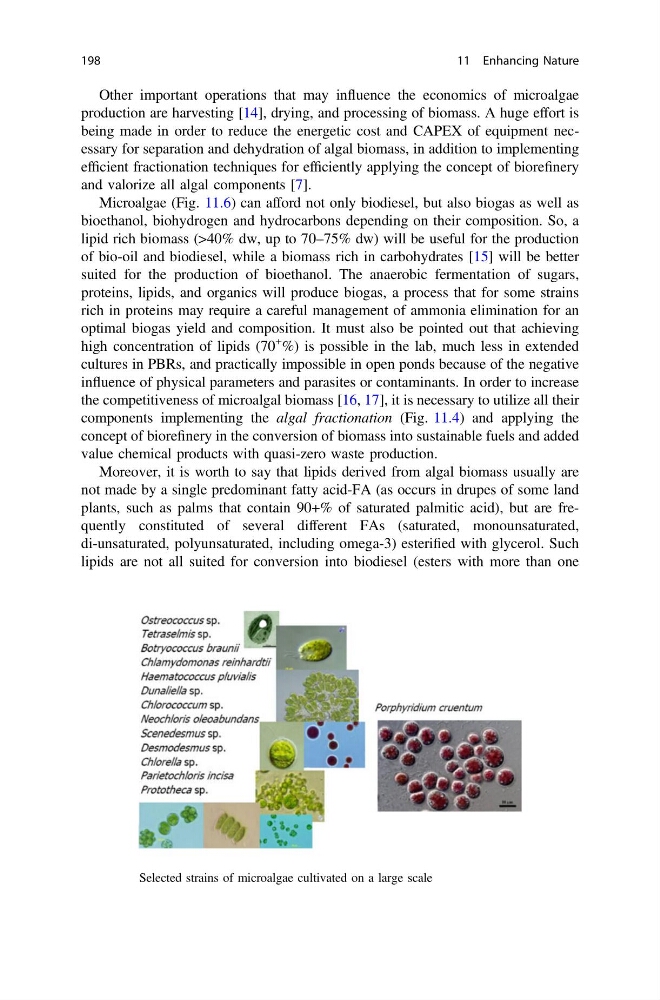
Microalgae (Fig. 11.6) can afford not only biodiesel, but also biogas as well as
bioethanol, biohydrogen and hydrocarbons depending on their composition. So, a
lipid rich biomass (>40% dw, up to 70–75% dw) will be useful for the production
of bio-oil and biodiesel, while a biomass rich in carbohydrates [15] will be better
suited for the production of bioethanol. The anaerobic fermentation of sugars,
proteins, lipids, and organics will produce biogas, a process that for some strains
rich in proteins may require a careful management of ammonia elimination for an
optimal biogas yield and composition. It must also be pointed out that achieving
high concentration of lipids (70
+ %) is possible in the lab, much less in extended
cultures in PBRs, and practically impossible in open ponds because of the negative
influence of physical parameters and parasites or contaminants. In order to increase
the competitiveness of microalgal biomass [16, 17], it is necessary to utilize all their
components implementing the algal fractionation (Fig. 11.4) and applying the
concept of biorefinery in the conversion of biomass into sustainable fuels and added
value chemical products with quasi-zero waste production.
Moreover, it is worth to say that lipids derived from algal biomass usually are
not made by a single predominant fatty acid-FA (as occurs in drupes of some land
plants, such as palms that contain 90+% of saturated palmitic acid), but are frequently constituted of several different FAs (saturated, monounsaturated,
di-unsaturated, polyunsaturated, including omega-3) esterified with glycerol. Such
lipids are not all suited for conversion into biodiesel (esters with more than one
Fig. 11.6 Selected strains of microalgae cultivated on a large scale
198
11 Enhancing Nature
production are harvesting [14], drying, and processing of biomass. A huge effort is
being made in order to reduce the energetic cost and CAPEX of equipment necessary for separation and dehydration of algal biomass, in addition to implementing
efficient fractionation techniques for efficiently applying the concept of biorefinery
and valorize all algal components [7].
Microalgae (Fig. 11.6) can afford not only biodiesel, but also biogas as well as
bioethanol, biohydrogen and hydrocarbons depending on their composition. So, a
lipid rich biomass (>40% dw, up to 70–75% dw) will be useful for the production
of bio-oil and biodiesel, while a biomass rich in carbohydrates [15] will be better
suited for the production of bioethanol. The anaerobic fermentation of sugars,
proteins, lipids, and organics will produce biogas, a process that for some strains
rich in proteins may require a careful management of ammonia elimination for an
optimal biogas yield and composition. It must also be pointed out that achieving
high concentration of lipids (70
+ %) is possible in the lab, much less in extended
cultures in PBRs, and practically impossible in open ponds because of the negative
influence of physical parameters and parasites or contaminants. In order to increase
the competitiveness of microalgal biomass [16, 17], it is necessary to utilize all their
components implementing the algal fractionation (Fig. 11.4) and applying the
concept of biorefinery in the conversion of biomass into sustainable fuels and added
value chemical products with quasi-zero waste production.
Moreover, it is worth to say that lipids derived from algal biomass usually are
not made by a single predominant fatty acid-FA (as occurs in drupes of some land
plants, such as palms that contain 90+% of saturated palmitic acid), but are frequently constituted of several different FAs (saturated, monounsaturated,
di-unsaturated, polyunsaturated, including omega-3) esterified with glycerol. Such
lipids are not all suited for conversion into biodiesel (esters with more than one
Fig. 11.6 Selected strains of microalgae cultivated on a large scale
198
11 Enhancing Nature