

1.3 The Fossil-C Availability
Fossil-C is, in principle, renewable, but, unfortunately, it cannot be regenerated at
the rate we use it: its availability is got to inexorably decrease with time. This is due
to the difference between the rate of combustion of biomass and that of biomass
generation: the former is some 1 000–10 000 times faster than the latter. In fact, the
rate of production of CO 2 by combustion of carbon-based materials (6 − 15 g CO2
m
−2 s
−1 for several kinds of wood [3]) is much faster than the fixation of CO 2 by
photosynthesis (the best values are observed in microalgae [4], more efficient fixing
agents than terrestrial plants, in the range 0.1−1.7 g CO2 L
−1 day
−1 or 0.00057 −
0.0098 g CO2 m
−2 s
−1 ). Additionally, the increasing population (our planet population is 7 Bpersons today and is expected to grow to 10 Bpersons by 2030), the ethic
question of assuring a decent quality of life to 1.1 Bpeople (UNICEF 2017) who
live in poverty (with 750 Mpeople living in extreme poverty), and the general wish
of improving the worldwide average standard of life demand more energy.
In several areas, deforestation is pervasive (land is used as arable soil or for
setting new production sites or inhabitations): the agents able to fix CO 2 (trees) are
decreasing in number while the emitters (humans) are increasing with time, reinforcing the CO 2 accumulation in the atmosphere.
However, our society is squeezed between two walls: from one side the
increasing need of energy for satisfying wishes of a high standard of life of an
ever-increasing number of persons and from the other the impossibility of satisfying
such necessity in the usual way (use of fossil carbon), because of the scarce
availability for the future generations and the putative negative effects of the
emission of CO 2 on climate.
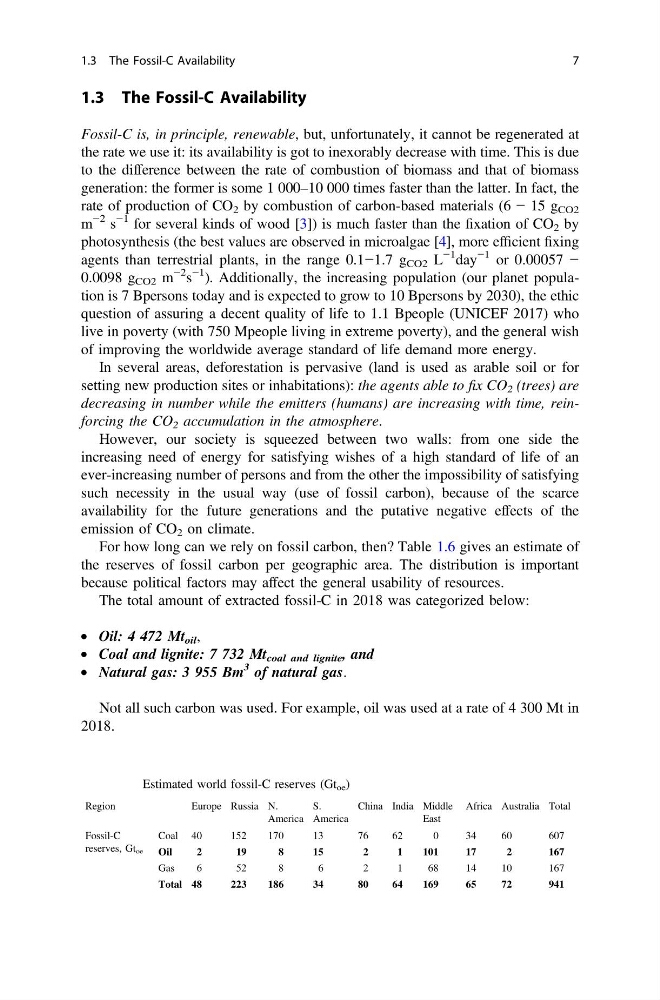
For how long can we rely on fossil carbon, then? Table 1.6 gives an estimate of
the reserves of fossil carbon per geographic area. The distribution is important
because political factors may affect the general usability of resources.
The total amount of extracted fossil-C in 2018 was categorized below:
• Oil: 4 472 Mt oil ,
• Coal and lignite: 7 732 Mt coal and lignite , and
• Natural gas: 3 955 Bm
3 of natural gas.
Not all such carbon was used. For example, oil was used at a rate of 4 300 Mt in
2018.
Table 1.6 Estimated world fossil-C reserves (Gt oe )
Region
Europe Russia N.
America
S.
America
China India Middle
East
Africa Australia Total
Fossil-C
reserves, Gt oe
Coal 40
152
170
13
76
62
0
34
60
607
Oil
2
19
8
15
2
1
101
17
2
167
Gas
6
52
8
6
2
1
68
14
10
167
Total 48
223
186
34
80
64
169
65
72
941
1.3 The Fossil-C Availability
7
Fossil-C is, in principle, renewable, but, unfortunately, it cannot be regenerated at
the rate we use it: its availability is got to inexorably decrease with time. This is due
to the difference between the rate of combustion of biomass and that of biomass
generation: the former is some 1 000–10 000 times faster than the latter. In fact, the
rate of production of CO 2 by combustion of carbon-based materials (6 − 15 g CO2
m
−2 s
−1 for several kinds of wood [3]) is much faster than the fixation of CO 2 by
photosynthesis (the best values are observed in microalgae [4], more efficient fixing
agents than terrestrial plants, in the range 0.1−1.7 g CO2 L
−1 day
−1 or 0.00057 −
0.0098 g CO2 m
−2 s
−1 ). Additionally, the increasing population (our planet population is 7 Bpersons today and is expected to grow to 10 Bpersons by 2030), the ethic
question of assuring a decent quality of life to 1.1 Bpeople (UNICEF 2017) who
live in poverty (with 750 Mpeople living in extreme poverty), and the general wish
of improving the worldwide average standard of life demand more energy.
In several areas, deforestation is pervasive (land is used as arable soil or for
setting new production sites or inhabitations): the agents able to fix CO 2 (trees) are
decreasing in number while the emitters (humans) are increasing with time, reinforcing the CO 2 accumulation in the atmosphere.
However, our society is squeezed between two walls: from one side the
increasing need of energy for satisfying wishes of a high standard of life of an
ever-increasing number of persons and from the other the impossibility of satisfying
such necessity in the usual way (use of fossil carbon), because of the scarce
availability for the future generations and the putative negative effects of the
emission of CO 2 on climate.
For how long can we rely on fossil carbon, then? Table 1.6 gives an estimate of
the reserves of fossil carbon per geographic area. The distribution is important
because political factors may affect the general usability of resources.
The total amount of extracted fossil-C in 2018 was categorized below:
• Oil: 4 472 Mt oil ,
• Coal and lignite: 7 732 Mt coal and lignite , and
• Natural gas: 3 955 Bm
3 of natural gas.
Not all such carbon was used. For example, oil was used at a rate of 4 300 Mt in
2018.
Table 1.6 Estimated world fossil-C reserves (Gt oe )
Region
Europe Russia N.
America
S.
America
China India Middle
East
Africa Australia Total
Fossil-C
reserves, Gt oe
Coal 40
152
170
13
76
62
0
34
60
607
Oil
2
19
8
15
2
1
101
17
2
167
Gas
6
52
8
6
2
1
68
14
10
167
Total 48
223
186
34
80
64
169
65
72
941
1.3 The Fossil-C Availability
7