

NG, which is made mainly of methane, is also used in the chemical industry as
starting material for producing chemicals (see Chap. 2) through its conversion into
syngas (methane reforming). The recent economic implementation of the technology of “shale fracking” (hydraulic fracturing of shale clay rocks that contain gas
formed upon decomposition of organic materials) has opened a new market that is
already exploited at an interesting level in USA.
1.2.3 Oil and Its Superior Properties
The discovery of oil dates back to 650 bC in China where first attempts to transport
by pipelines (made of bamboo) were also made. It had a spot utilization until 1859,
when it was discovered and drilled in Pennsylvania, USA. With the discovery of the
Texas-USA wells in 1901, the large-scale commercialization of oil started. Today,
oil is drilled all over the world not only on Earth surface, but also in seas and
oceans, reaching deepness (7 000
+ m) not imagined 40 years ago. Oil is the main
source of fuels and chemicals today. On oil refining and conversion is based the
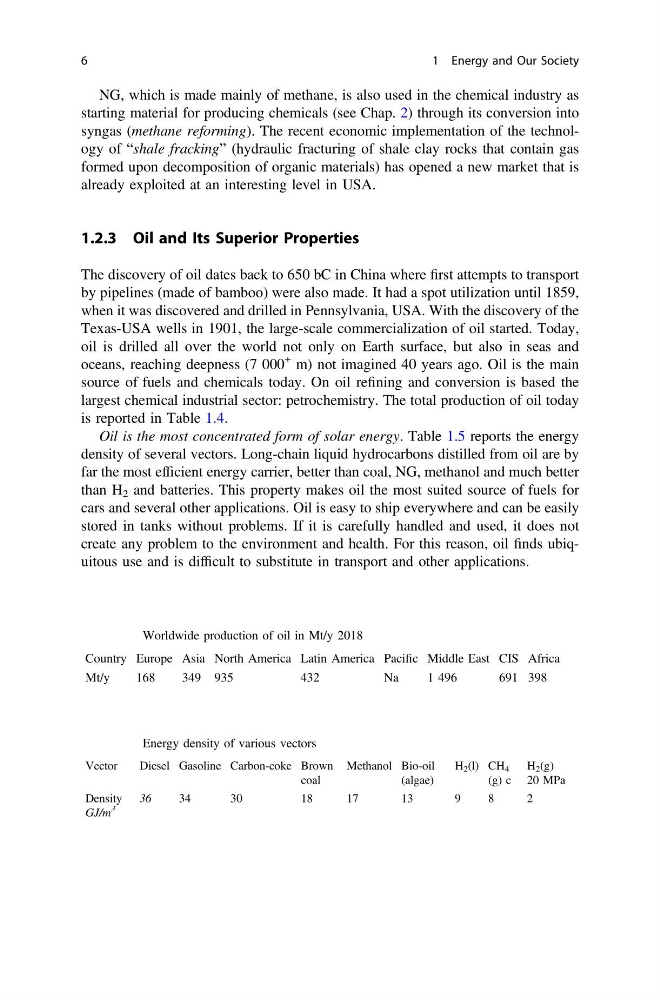
largest chemical industrial sector: petrochemistry. The total production of oil today
is reported in Table 1.4.
Oil is the most concentrated form of solar energy. Table 1.5 reports the energy
density of several vectors. Long-chain liquid hydrocarbons distilled from oil are by
far the most efficient energy carrier, better than coal, NG, methanol and much better
than H 2 and batteries. This property makes oil the most suited source of fuels for
cars and several other applications. Oil is easy to ship everywhere and can be easily
stored in tanks without problems. If it is carefully handled and used, it does not
create any problem to the environment and health. For this reason, oil finds ubiquitous use and is difficult to substitute in transport and other applications.
Table 1.4 Worldwide production of oil in Mt/y 2018
Country Europe Asia North America Latin America Pacific Middle East CIS Africa
Mt/y
168
349 935
432
Na
1 496
691 398
Table 1.5 Energy density of various vectors
Vector
Diesel Gasoline Carbon-coke Brown
coal
Methanol Bio-oil
(algae)
H 2 (l) CH 4
(g) c
H 2 (g)
20 MPa
Density
GJ/m
3
36
34
30
18
17
13
9
8
2
6
1 Energy and Our Society
starting material for producing chemicals (see Chap. 2) through its conversion into
syngas (methane reforming). The recent economic implementation of the technology of “shale fracking” (hydraulic fracturing of shale clay rocks that contain gas
formed upon decomposition of organic materials) has opened a new market that is
already exploited at an interesting level in USA.
1.2.3 Oil and Its Superior Properties
The discovery of oil dates back to 650 bC in China where first attempts to transport
by pipelines (made of bamboo) were also made. It had a spot utilization until 1859,
when it was discovered and drilled in Pennsylvania, USA. With the discovery of the
Texas-USA wells in 1901, the large-scale commercialization of oil started. Today,
oil is drilled all over the world not only on Earth surface, but also in seas and
oceans, reaching deepness (7 000
+ m) not imagined 40 years ago. Oil is the main
source of fuels and chemicals today. On oil refining and conversion is based the
largest chemical industrial sector: petrochemistry. The total production of oil today
is reported in Table 1.4.
Oil is the most concentrated form of solar energy. Table 1.5 reports the energy
density of several vectors. Long-chain liquid hydrocarbons distilled from oil are by
far the most efficient energy carrier, better than coal, NG, methanol and much better
than H 2 and batteries. This property makes oil the most suited source of fuels for
cars and several other applications. Oil is easy to ship everywhere and can be easily
stored in tanks without problems. If it is carefully handled and used, it does not
create any problem to the environment and health. For this reason, oil finds ubiquitous use and is difficult to substitute in transport and other applications.
Table 1.4 Worldwide production of oil in Mt/y 2018
Country Europe Asia North America Latin America Pacific Middle East CIS Africa
Mt/y
168
349 935
432
Na
1 496
691 398
Table 1.5 Energy density of various vectors
Vector
Diesel Gasoline Carbon-coke Brown
coal
Methanol Bio-oil
(algae)
H 2 (l) CH 4
(g) c
H 2 (g)
20 MPa
Density
GJ/m
3
36
34
30
18
17
13
9
8
2
6
1 Energy and Our Society