

(natural gas) so that the situation is today much improved, even if largest cities,
located in not well-aerated areas, have still to face critical situations. Technology
innovation has made that the direct burning of coal is even avoided and instead it is
converted into other forms of cleaner fuels, mostly through its conversion (“reforming process”) into syngas—a mixture of CO and H 2— which is converted
through the catalytic Fischer–Tropsch (FT) process into gaseous, liquid, and solid
products (see Chap. 2). South Africa and Malaysia make most of their gasoline
through FT processes. The application of technologies such as Water–Gas Shift
(WGS) to reforming allows to convert coal and water into H 2 and CO 2 (Eq. 1.1a–
1.1b) that are separated and H 2 can then be used in a clean combustion with oxygen
affording water as combustion product. (Eq. 1.2). If such reaction takes place in a
cell (fuel cell), electricity is produced.
C + H 2 O ! CO + H 2 ! syngas
ð
Þ
ð1:1aÞ
CO þ H 2 O ! CO 2 þ H 2 WGS
ð
Þ
ð1:1bÞ
H 2 þ 1=2O 2 ! H 2 O þ Energy
ð1:2Þ
This approach is at the basis of the innovative technology known as Integrated
Gasification Combined Cycle (IGCC) that allows decarbonization of fuels with CO 2
capture prior to combustion for making electric energy (see Chap. 2).
1.2.2 Natural Gas: Its Discovery, Early and Actual Uses
Natural Gas (NG) is known since 1000 bC and was discovered in China. Spontaneous emissions were used as flames in front of or inside temples by antic Greeks.
Such emissions were also known as “eternal fires,” mostly used as house ornament.
Chinese people first tried to transport NG using bamboo pipes. In 1800, NG was
transported using cast iron pipelines and largely used for lightening houses and
streets (UK, since 1785, and USA were pioneer in such application). The discovery
and exploitation of oil pushed NG to a second level of importance because of the
easier transportation of oil and its higher energy density. Today, NG is coming back
to massive use because it emits less CO 2 than oil and coal for the same energy
generated. In fact, for producing one kWh of electric energy, ca. 1 kg of CO 2 is
produced burning coal, while only 0.5 kg CO2 are emitted using NG, with oil sitting
in the middle. NG is considered a clean fuel for use in houses (heating, cooking),
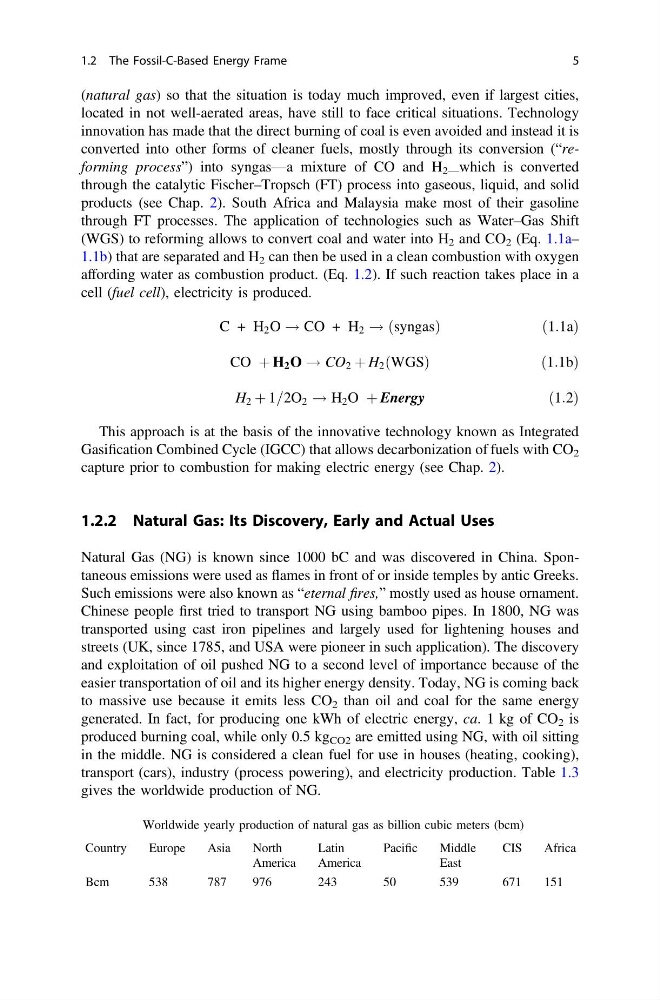
transport (cars), industry (process powering), and electricity production. Table 1.3
gives the worldwide production of NG.
Table 1.3 Worldwide yearly production of natural gas as billion cubic meters (bcm)
Country
Europe
Asia
North
America
Latin
America
Pacific
Middle
East
CIS
Africa
Bcm
538
787
976
243
50
539
671
151
1.2 The Fossil-C-Based Energy Frame
5
located in not well-aerated areas, have still to face critical situations. Technology
innovation has made that the direct burning of coal is even avoided and instead it is
converted into other forms of cleaner fuels, mostly through its conversion (“reforming process”) into syngas—a mixture of CO and H 2— which is converted
through the catalytic Fischer–Tropsch (FT) process into gaseous, liquid, and solid
products (see Chap. 2). South Africa and Malaysia make most of their gasoline
through FT processes. The application of technologies such as Water–Gas Shift
(WGS) to reforming allows to convert coal and water into H 2 and CO 2 (Eq. 1.1a–
1.1b) that are separated and H 2 can then be used in a clean combustion with oxygen
affording water as combustion product. (Eq. 1.2). If such reaction takes place in a
cell (fuel cell), electricity is produced.
C + H 2 O ! CO + H 2 ! syngas
ð
Þ
ð1:1aÞ
CO þ H 2 O ! CO 2 þ H 2 WGS
ð
Þ
ð1:1bÞ
H 2 þ 1=2O 2 ! H 2 O þ Energy
ð1:2Þ
This approach is at the basis of the innovative technology known as Integrated
Gasification Combined Cycle (IGCC) that allows decarbonization of fuels with CO 2
capture prior to combustion for making electric energy (see Chap. 2).
1.2.2 Natural Gas: Its Discovery, Early and Actual Uses
Natural Gas (NG) is known since 1000 bC and was discovered in China. Spontaneous emissions were used as flames in front of or inside temples by antic Greeks.
Such emissions were also known as “eternal fires,” mostly used as house ornament.
Chinese people first tried to transport NG using bamboo pipes. In 1800, NG was
transported using cast iron pipelines and largely used for lightening houses and
streets (UK, since 1785, and USA were pioneer in such application). The discovery
and exploitation of oil pushed NG to a second level of importance because of the
easier transportation of oil and its higher energy density. Today, NG is coming back
to massive use because it emits less CO 2 than oil and coal for the same energy
generated. In fact, for producing one kWh of electric energy, ca. 1 kg of CO 2 is
produced burning coal, while only 0.5 kg CO2 are emitted using NG, with oil sitting
in the middle. NG is considered a clean fuel for use in houses (heating, cooking),
transport (cars), industry (process powering), and electricity production. Table 1.3
gives the worldwide production of NG.
Table 1.3 Worldwide yearly production of natural gas as billion cubic meters (bcm)
Country
Europe
Asia
North
America
Latin
America
Pacific
Middle
East
CIS
Africa
Bcm
538
787
976
243
50
539
671
151
1.2 The Fossil-C-Based Energy Frame
5