

W1.1 Average dry atmosphere composition and its pollution
Dry atmosphere, the gaseous mass that surrounds our Planet Earth, is composed
of 78.08% N 2 , 20.94% O 2 , 0.93% Ar, 0.04% CO 2 , 0.00005% He, and other
trace gases. Figures given above represent an average composition, which
slightly varies with the height over the Earth surface: heavier gases (CO 2 , Ar,
O 2 ) are more abundant close to the surface, lighter (He) in the higher layers.
Water vapor can be present in various amounts (humidity), depending on the
climatic conditions. Emissions by fossil-C combustion cause accumulation in
the atmosphere of pollutants that may cause damages to goods and humans. For
example, the emission of S or N oxides (SOx, NOy) causes the formation of
acid species which can fall down with rain (acid rain) and cause serious
damages to humans, vegetation and even buildings.
Some apparently inert species can be converted by sunlight in the atmosphere and generate dangerous pollutants. Other gaseous species, like
chlorofluorocarbons (CFCs) (vide infra), can pass the troposphere unaltered
(Chap. 2) and reach the stratosphere where they are converted by UV solar
radiations into species which destroy ozone and cause the known ozone hole.
Particulate of various dimensions can be suspended in the atmosphere and
reach a variety of targets. Inspiration of very fine particulate (PM2.5 and
PM5, dimensions of 2.5 and 5 micrometers) is very dangerous as it can reach
deep parts of the respiratory apparatus and cause cancer.
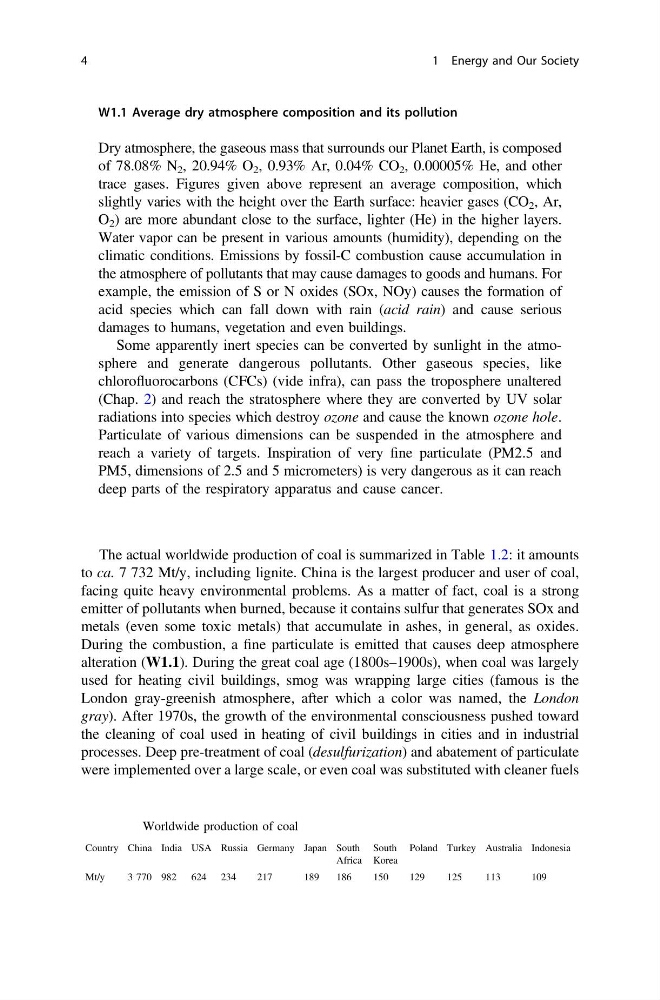
The actual worldwide production of coal is summarized in Table 1.2: it amounts
to ca. 7 732 Mt/y, including lignite. China is the largest producer and user of coal,
facing quite heavy environmental problems. As a matter of fact, coal is a strong
emitter of pollutants when burned, because it contains sulfur that generates SOx and
metals (even some toxic metals) that accumulate in ashes, in general, as oxides.
During the combustion, a fine particulate is emitted that causes deep atmosphere
alteration (W1.1). During the great coal age (1800s–1900s), when coal was largely
used for heating civil buildings, smog was wrapping large cities (famous is the
London gray-greenish atmosphere, after which a color was named, the London
gray). After 1970s, the growth of the environmental consciousness pushed toward
the cleaning of coal used in heating of civil buildings in cities and in industrial
processes. Deep pre-treatment of coal (desulfurization) and abatement of particulate
were implemented over a large scale, or even coal was substituted with cleaner fuels
Table 1.2 Worldwide production of coal
Country China India USA Russia Germany Japan South
Africa
South
Korea
Poland Turkey Australia Indonesia
Mt/y
3 770 982 624 234
217
189
186
150
129
125
113
109
4
1 Energy and Our Society
Dry atmosphere, the gaseous mass that surrounds our Planet Earth, is composed
of 78.08% N 2 , 20.94% O 2 , 0.93% Ar, 0.04% CO 2 , 0.00005% He, and other
trace gases. Figures given above represent an average composition, which
slightly varies with the height over the Earth surface: heavier gases (CO 2 , Ar,
O 2 ) are more abundant close to the surface, lighter (He) in the higher layers.
Water vapor can be present in various amounts (humidity), depending on the
climatic conditions. Emissions by fossil-C combustion cause accumulation in
the atmosphere of pollutants that may cause damages to goods and humans. For
example, the emission of S or N oxides (SOx, NOy) causes the formation of
acid species which can fall down with rain (acid rain) and cause serious
damages to humans, vegetation and even buildings.
Some apparently inert species can be converted by sunlight in the atmosphere and generate dangerous pollutants. Other gaseous species, like
chlorofluorocarbons (CFCs) (vide infra), can pass the troposphere unaltered
(Chap. 2) and reach the stratosphere where they are converted by UV solar
radiations into species which destroy ozone and cause the known ozone hole.
Particulate of various dimensions can be suspended in the atmosphere and
reach a variety of targets. Inspiration of very fine particulate (PM2.5 and
PM5, dimensions of 2.5 and 5 micrometers) is very dangerous as it can reach
deep parts of the respiratory apparatus and cause cancer.
The actual worldwide production of coal is summarized in Table 1.2: it amounts
to ca. 7 732 Mt/y, including lignite. China is the largest producer and user of coal,
facing quite heavy environmental problems. As a matter of fact, coal is a strong
emitter of pollutants when burned, because it contains sulfur that generates SOx and
metals (even some toxic metals) that accumulate in ashes, in general, as oxides.
During the combustion, a fine particulate is emitted that causes deep atmosphere
alteration (W1.1). During the great coal age (1800s–1900s), when coal was largely
used for heating civil buildings, smog was wrapping large cities (famous is the
London gray-greenish atmosphere, after which a color was named, the London
gray). After 1970s, the growth of the environmental consciousness pushed toward
the cleaning of coal used in heating of civil buildings in cities and in industrial
processes. Deep pre-treatment of coal (desulfurization) and abatement of particulate
were implemented over a large scale, or even coal was substituted with cleaner fuels
Table 1.2 Worldwide production of coal
Country China India USA Russia Germany Japan South
Africa
South
Korea
Poland Turkey Australia Indonesia
Mt/y
3 770 982 624 234
217
189
186
150
129
125
113
109
4
1 Energy and Our Society