

microorganisms can be attached to the cathode [12]. The reaction product is either
HCO 2
− or CH 3 CO 2
− that can be further biotechnologically converted into longer
chain hydrocarbons, reaching the use of products as fuels.
In some cases, hydrogen is produced photoelectrochemically which is used by
microorganisms in solution. This helps to generate “in situ” a “high concentration”
of H 2 that would not be otherwise generated by bubbling H 2 due to its low solubility in water (Table 10.3) [13]. Such hydrogen is used by microorganisms for the
reduction of CO 2 .
10.6 High-Temperature Processes Driven by Solar Power
Concentrators
In Chap. 5, we have shown that it is possible to concentrate the solar energy and
reach quite high temperatures, even above 1000 °C. Such temperature is used to
drive energy-requiring reactions such as the CO 2 dissociation (CO 2 >> CO + 1/2
O 2 ) and water splitting (H 2 O >> H 2 + 1/2O 2 ). In order to improve the reaction rate
and yield, the reactions are carried out in presence of a catalyst. The sequence of
steps is represented in Eqs. 10.1–10.4.
MO x [ [ MO xÀ1 þ 1=2O 2
ð10:1Þ
H 2 O þ MO xÀ1 [ [ H 2 þ MO x
ð10:2Þ
CO 2 þ MO xÀ1 [ [ CO þ MO x
ð10:3Þ
mH 2 þ nCO [ [ CH 3 OH; HCn
ð10:4Þ
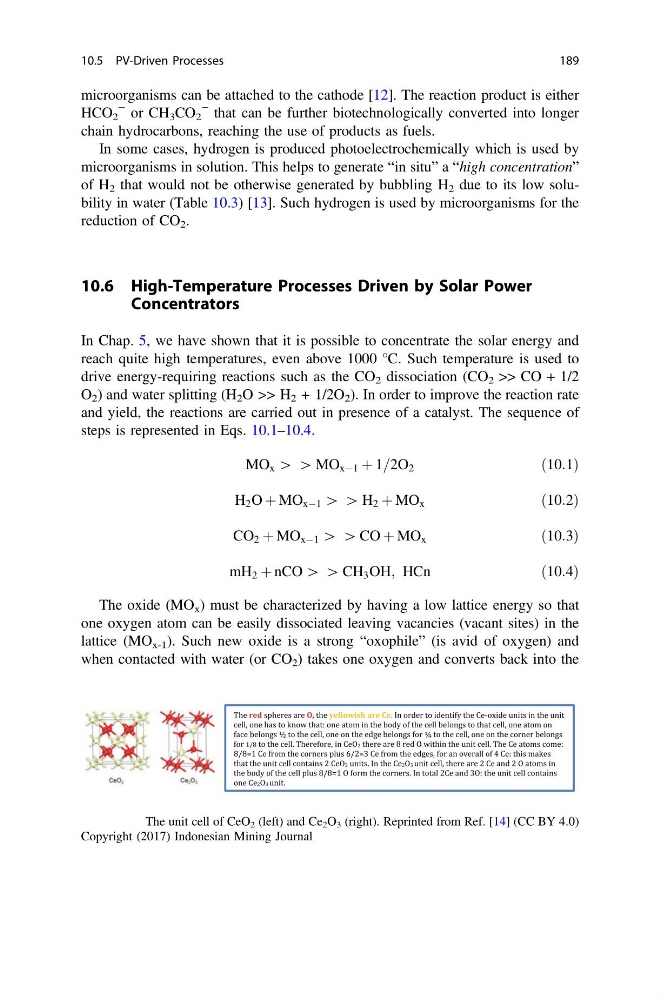
The oxide (MO x ) must be characterized by having a low lattice energy so that
one oxygen atom can be easily dissociated leaving vacancies (vacant sites) in the
lattice (MO x-1 ). Such new oxide is a strong “oxophile” (is avid of oxygen) and
when contacted with water (or CO 2 ) takes one oxygen and converts back into the
Fig. 10.11 The unit cell of CeO 2 (left) and Ce 2 O 3 (right). Reprinted from Ref. [14] (CC BY 4.0)
Copyright (2017) Indonesian Mining Journal
10.5 PV-Driven Processes
189
HCO 2
− or CH 3 CO 2
− that can be further biotechnologically converted into longer
chain hydrocarbons, reaching the use of products as fuels.
In some cases, hydrogen is produced photoelectrochemically which is used by
microorganisms in solution. This helps to generate “in situ” a “high concentration”
of H 2 that would not be otherwise generated by bubbling H 2 due to its low solubility in water (Table 10.3) [13]. Such hydrogen is used by microorganisms for the
reduction of CO 2 .
10.6 High-Temperature Processes Driven by Solar Power
Concentrators
In Chap. 5, we have shown that it is possible to concentrate the solar energy and
reach quite high temperatures, even above 1000 °C. Such temperature is used to
drive energy-requiring reactions such as the CO 2 dissociation (CO 2 >> CO + 1/2
O 2 ) and water splitting (H 2 O >> H 2 + 1/2O 2 ). In order to improve the reaction rate
and yield, the reactions are carried out in presence of a catalyst. The sequence of
steps is represented in Eqs. 10.1–10.4.
MO x [ [ MO xÀ1 þ 1=2O 2
ð10:1Þ
H 2 O þ MO xÀ1 [ [ H 2 þ MO x
ð10:2Þ
CO 2 þ MO xÀ1 [ [ CO þ MO x
ð10:3Þ
mH 2 þ nCO [ [ CH 3 OH; HCn
ð10:4Þ
The oxide (MO x ) must be characterized by having a low lattice energy so that
one oxygen atom can be easily dissociated leaving vacancies (vacant sites) in the
lattice (MO x-1 ). Such new oxide is a strong “oxophile” (is avid of oxygen) and
when contacted with water (or CO 2 ) takes one oxygen and converts back into the
Fig. 10.11 The unit cell of CeO 2 (left) and Ce 2 O 3 (right). Reprinted from Ref. [14] (CC BY 4.0)
Copyright (2017) Indonesian Mining Journal
10.5 PV-Driven Processes
189