

For a full exploitation of the Photoelectrochemical option, new materials are
needed that assure a better light utilization efficiency coupled to improve catalytic
properties and high selectivity. Such application has found quite innovative
applications, as described in Chap. 11.
10.5.3 Electrochemical and Photoelectrochemical Processes
Coupled with Biosystems
Such innovative application will be discussed in detail in Chap. 11. Here we just
announce that the novelty is in the use of biosystems (enzymes or full microorganisms) as the “catalysts” in the reduction process. Both enzymes and
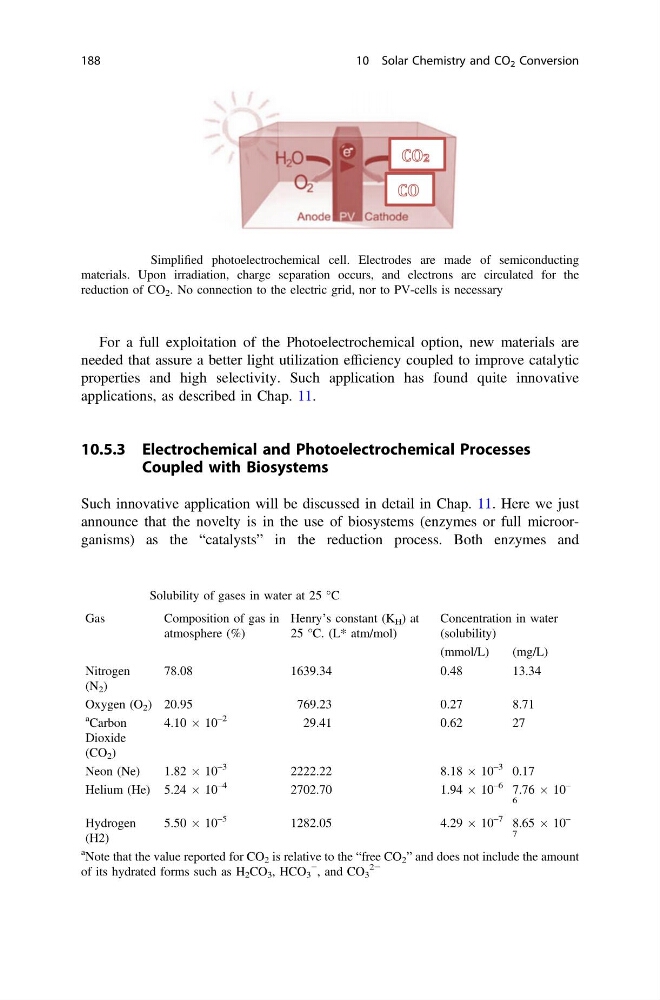
Fig. 10.10 Simplified photoelectrochemical cell. Electrodes are made of semiconducting
materials. Upon irradiation, charge separation occurs, and electrons are circulated for the
reduction of CO 2 . No connection to the electric grid, nor to PV-cells is necessary
Table 10.3 Solubility of gases in water at 25 °C
Gas
Composition of gas in
atmosphere (%)
Henry’s constant (K H ) at
25 °C. (L* atm/mol)
Concentration in water
(solubility)
(mmol/L)
(mg/L)
Nitrogen
(N 2 )
78.08
1639.34
0.48
13.34
Oxygen (O 2 ) 20.95
769.23
0.27
8.71
a Carbon
Dioxide
(CO 2 )
4.10 Â 10
–2
29.41
0.62
27
Neon (Ne)
1.82 Â 10
–3
2222.22
8.18 Â 10
–3 0.17
Helium (He) 5.24 Â 10
–4
2702.70
1.94 Â 10
–6 7.76 Â 10
–
6
Hydrogen
(H2)
5.50 Â 10
–5
1282.05
4.29 Â 10
–7 8.65 Â 10
–
7
a Note that the value reported for CO 2 is relative to the “free CO 2 ” and does not include the amount
of its hydrated forms such as H 2 CO 3 , HCO 3
− , and CO 3
2−
188
10 Solar Chemistry and CO 2 Conversion
needed that assure a better light utilization efficiency coupled to improve catalytic
properties and high selectivity. Such application has found quite innovative
applications, as described in Chap. 11.
10.5.3 Electrochemical and Photoelectrochemical Processes
Coupled with Biosystems
Such innovative application will be discussed in detail in Chap. 11. Here we just
announce that the novelty is in the use of biosystems (enzymes or full microorganisms) as the “catalysts” in the reduction process. Both enzymes and
Fig. 10.10 Simplified photoelectrochemical cell. Electrodes are made of semiconducting
materials. Upon irradiation, charge separation occurs, and electrons are circulated for the
reduction of CO 2 . No connection to the electric grid, nor to PV-cells is necessary
Table 10.3 Solubility of gases in water at 25 °C
Gas
Composition of gas in
atmosphere (%)
Henry’s constant (K H ) at
25 °C. (L* atm/mol)
Concentration in water
(solubility)
(mmol/L)
(mg/L)
Nitrogen
(N 2 )
78.08
1639.34
0.48
13.34
Oxygen (O 2 ) 20.95
769.23
0.27
8.71
a Carbon
Dioxide
(CO 2 )
4.10 Â 10
–2
29.41
0.62
27
Neon (Ne)
1.82 Â 10
–3
2222.22
8.18 Â 10
–3 0.17
Helium (He) 5.24 Â 10
–4
2702.70
1.94 Â 10
–6 7.76 Â 10
–
6
Hydrogen
(H2)
5.50 Â 10
–5
1282.05
4.29 Â 10
–7 8.65 Â 10
–
7
a Note that the value reported for CO 2 is relative to the “free CO 2 ” and does not include the amount
of its hydrated forms such as H 2 CO 3 , HCO 3
− , and CO 3
2−
188
10 Solar Chemistry and CO 2 Conversion