

The electrochemical reduction of CO 2 is performed in an electrochemical cell in
which CO 2 is bubbled and reduced at the negative electrode (cathode). The electric
energy is ideally generated using non-fossil sources (perennial SWHG, Nuclear).
The electro-reduction can occur directly on the electrode surface (which can
undergo corrosion or be consumed) or can be mediated by an “electrocatalyst”
which accepts electrons from the cathode and transfers them to CO 2 . In this way,
the electrode corrosion and consumption are prevented. The electrocatalysts can be
either attached on the surface of the electrode or dissolved in solution. By electrolysis, two different classes of products can be obtained:
i. Carboxylates: CH 2 = CH 2 + 2CO 2 + 2e− + 2H
+ = HO 2 C–CH 2 –CH 2 –CO 2 H
ii. Reduced forms: CO 2 >>> CO, HCO 2 H, CH 2 O, CH 3 OH, CH 4 , Cn
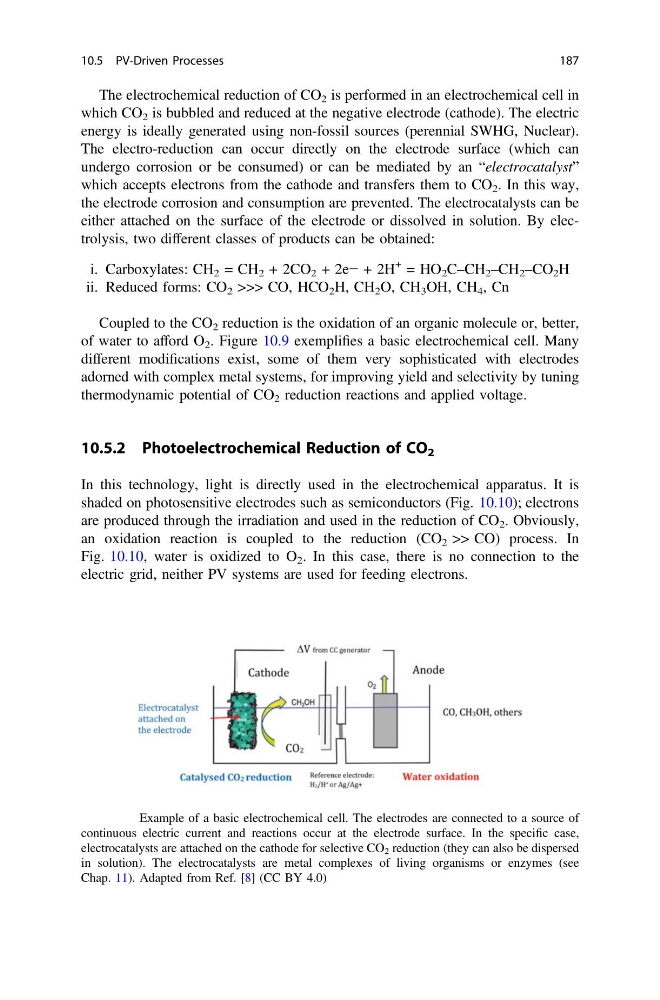
Coupled to the CO 2 reduction is the oxidation of an organic molecule or, better,
of water to afford O 2 . Figure 10.9 exemplifies a basic electrochemical cell. Many
different modifications exist, some of them very sophisticated with electrodes
adorned with complex metal systems, for improving yield and selectivity by tuning
thermodynamic potential of CO 2 reduction reactions and applied voltage.
10.5.2 Photoelectrochemical Reduction of CO 2
In this technology, light is directly used in the electrochemical apparatus. It is
shaded on photosensitive electrodes such as semiconductors (Fig. 10.10); electrons
are produced through the irradiation and used in the reduction of CO 2 . Obviously,
an oxidation reaction is coupled to the reduction (CO 2 >> CO) process. In
Fig. 10.10, water is oxidized to O 2 . In this case, there is no connection to the
electric grid, neither PV systems are used for feeding electrons.
Fig. 10.9 Example of a basic electrochemical cell. The electrodes are connected to a source of
continuous electric current and reactions occur at the electrode surface. In the specific case,
electrocatalysts are attached on the cathode for selective CO 2 reduction (they can also be dispersed
in solution). The electrocatalysts are metal complexes of living organisms or enzymes (see
Chap. 11). Adapted from Ref. [8] (CC BY 4.0)
10.5 PV-Driven Processes
187
which CO 2 is bubbled and reduced at the negative electrode (cathode). The electric
energy is ideally generated using non-fossil sources (perennial SWHG, Nuclear).
The electro-reduction can occur directly on the electrode surface (which can
undergo corrosion or be consumed) or can be mediated by an “electrocatalyst”
which accepts electrons from the cathode and transfers them to CO 2 . In this way,
the electrode corrosion and consumption are prevented. The electrocatalysts can be
either attached on the surface of the electrode or dissolved in solution. By electrolysis, two different classes of products can be obtained:
i. Carboxylates: CH 2 = CH 2 + 2CO 2 + 2e− + 2H
+ = HO 2 C–CH 2 –CH 2 –CO 2 H
ii. Reduced forms: CO 2 >>> CO, HCO 2 H, CH 2 O, CH 3 OH, CH 4 , Cn
Coupled to the CO 2 reduction is the oxidation of an organic molecule or, better,
of water to afford O 2 . Figure 10.9 exemplifies a basic electrochemical cell. Many
different modifications exist, some of them very sophisticated with electrodes
adorned with complex metal systems, for improving yield and selectivity by tuning
thermodynamic potential of CO 2 reduction reactions and applied voltage.
10.5.2 Photoelectrochemical Reduction of CO 2
In this technology, light is directly used in the electrochemical apparatus. It is
shaded on photosensitive electrodes such as semiconductors (Fig. 10.10); electrons
are produced through the irradiation and used in the reduction of CO 2 . Obviously,
an oxidation reaction is coupled to the reduction (CO 2 >> CO) process. In
Fig. 10.10, water is oxidized to O 2 . In this case, there is no connection to the
electric grid, neither PV systems are used for feeding electrons.
Fig. 10.9 Example of a basic electrochemical cell. The electrodes are connected to a source of
continuous electric current and reactions occur at the electrode surface. In the specific case,
electrocatalysts are attached on the cathode for selective CO 2 reduction (they can also be dispersed
in solution). The electrocatalysts are metal complexes of living organisms or enzymes (see
Chap. 11). Adapted from Ref. [8] (CC BY 4.0)
10.5 PV-Driven Processes
187