

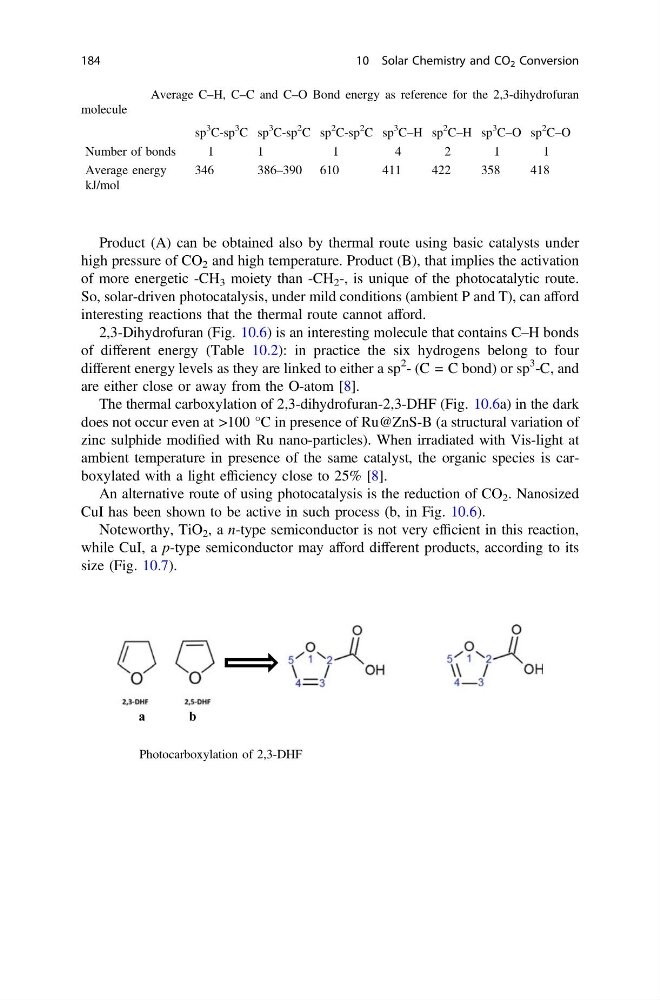
Product (A) can be obtained also by thermal route using basic catalysts under
high pressure of CO 2 and high temperature. Product (B), that implies the activation
of more energetic -CH 3 moiety than -CH 2 -, is unique of the photocatalytic route.
So, solar-driven photocatalysis, under mild conditions (ambient P and T), can afford
interesting reactions that the thermal route cannot afford.
2,3-Dihydrofuran (Fig. 10.6) is an interesting molecule that contains C–H bonds
of different energy (Table 10.2): in practice the six hydrogens belong to four
different energy levels as they are linked to either a sp
2 - (C = C bond) or sp
3 -C, and
are either close or away from the O-atom [8].
The thermal carboxylation of 2,3-dihydrofuran-2,3-DHF (Fig. 10.6a) in the dark
does not occur even at >100 °C in presence of Ru@ZnS-B (a structural variation of
zinc sulphide modified with Ru nano-particles). When irradiated with Vis-light at
ambient temperature in presence of the same catalyst, the organic species is carboxylated with a light efficiency close to 25% [8].
An alternative route of using photocatalysis is the reduction of CO 2 . Nanosized
CuI has been shown to be active in such process (b, in Fig. 10.6).
Noteworthy, TiO 2 , a n-type semiconductor is not very efficient in this reaction,
while CuI, a p-type semiconductor may afford different products, according to its
size (Fig. 10.7).
a
b
Fig. 10.6 Photocarboxylation of 2,3-DHF
Table 10.2 Average C–H, C–C and C–O Bond energy as reference for the 2,3-dihydrofuran
molecule
sp
3
C-sp
3
C sp
3
C-sp
2
C sp
2
C-sp
2
C sp
3
C–H sp
2
C–H sp
3
C–O sp
2
C–O
Number of bonds
1
1
1
4
2
1
1
Average energy
kJ/mol
346
386–390 610
411
422
358
418
184
10 Solar Chemistry and CO 2 Conversion
high pressure of CO 2 and high temperature. Product (B), that implies the activation
of more energetic -CH 3 moiety than -CH 2 -, is unique of the photocatalytic route.
So, solar-driven photocatalysis, under mild conditions (ambient P and T), can afford
interesting reactions that the thermal route cannot afford.
2,3-Dihydrofuran (Fig. 10.6) is an interesting molecule that contains C–H bonds
of different energy (Table 10.2): in practice the six hydrogens belong to four
different energy levels as they are linked to either a sp
2 - (C = C bond) or sp
3 -C, and
are either close or away from the O-atom [8].
The thermal carboxylation of 2,3-dihydrofuran-2,3-DHF (Fig. 10.6a) in the dark
does not occur even at >100 °C in presence of Ru@ZnS-B (a structural variation of
zinc sulphide modified with Ru nano-particles). When irradiated with Vis-light at
ambient temperature in presence of the same catalyst, the organic species is carboxylated with a light efficiency close to 25% [8].
An alternative route of using photocatalysis is the reduction of CO 2 . Nanosized
CuI has been shown to be active in such process (b, in Fig. 10.6).
Noteworthy, TiO 2 , a n-type semiconductor is not very efficient in this reaction,
while CuI, a p-type semiconductor may afford different products, according to its
size (Fig. 10.7).
a
b
Fig. 10.6 Photocarboxylation of 2,3-DHF
Table 10.2 Average C–H, C–C and C–O Bond energy as reference for the 2,3-dihydrofuran
molecule
sp
3
C-sp
3
C sp
3
C-sp
2
C sp
2
C-sp
2
C sp
3
C–H sp
2
C–H sp
3
C–O sp
2
C–O
Number of bonds
1
1
1
4
2
1
1
Average energy
kJ/mol
346
386–390 610
411
422
358
418
184
10 Solar Chemistry and CO 2 Conversion