

As already mentioned, in order for a photocatalyst to work, its band gap (the
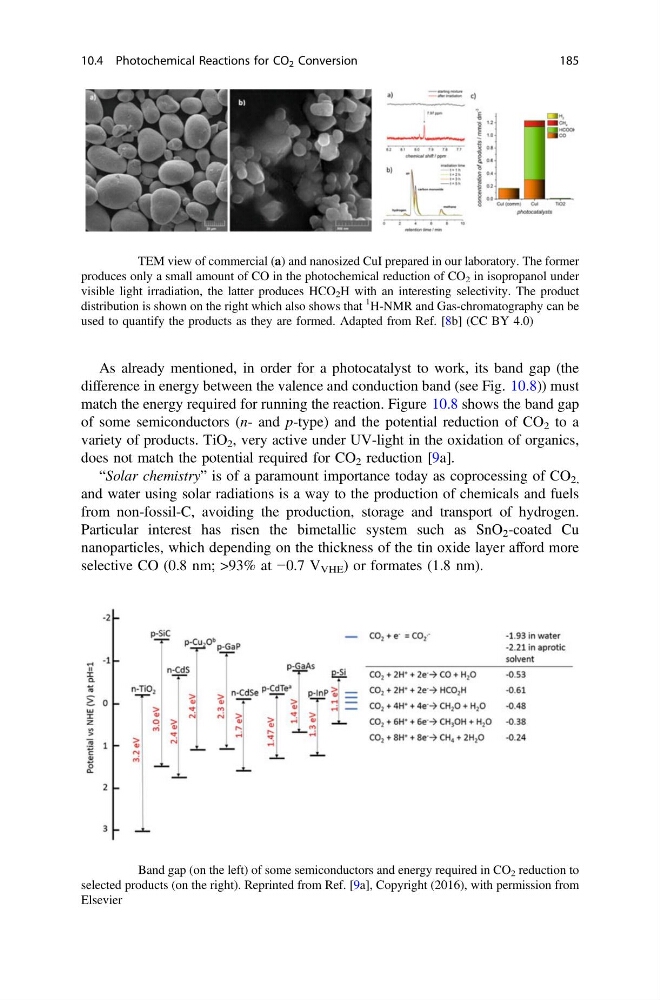
difference in energy between the valence and conduction band (see Fig. 10.8)) must
match the energy required for running the reaction. Figure 10.8 shows the band gap
of some semiconductors (n- and p-type) and the potential reduction of CO 2 to a
variety of products. TiO 2 , very active under UV-light in the oxidation of organics,
does not match the potential required for CO 2 reduction [9a].
“Solar chemistry” is of a paramount importance today as coprocessing of CO 2,
and water using solar radiations is a way to the production of chemicals and fuels
from non-fossil-C, avoiding the production, storage and transport of hydrogen.
Particular interest has risen the bimetallic system such as SnO 2 -coated Cu
nanoparticles, which depending on the thickness of the tin oxide layer afford more
selective CO (0.8 nm; >93% at −0.7 V VHE ) or formates (1.8 nm).
Fig. 10.8 Band gap (on the left) of some semiconductors and energy required in CO 2 reduction to
selected products (on the right). Reprinted from Ref. [9a], Copyright (2016), with permission from
Elsevier
Fig. 10.7 TEM view of commercial (a) and nanosized CuI prepared in our laboratory. The former
produces only a small amount of CO in the photochemical reduction of CO 2 in isopropanol under
visible light irradiation, the latter produces HCO 2 H with an interesting selectivity. The product
distribution is shown on the right which also shows that
1
H-NMR and Gas-chromatography can be
used to quantify the products as they are formed. Adapted from Ref. [8b] (CC BY 4.0)
10.4 Photochemical Reactions for CO 2 Conversion
185
difference in energy between the valence and conduction band (see Fig. 10.8)) must
match the energy required for running the reaction. Figure 10.8 shows the band gap
of some semiconductors (n- and p-type) and the potential reduction of CO 2 to a
variety of products. TiO 2 , very active under UV-light in the oxidation of organics,
does not match the potential required for CO 2 reduction [9a].
“Solar chemistry” is of a paramount importance today as coprocessing of CO 2,
and water using solar radiations is a way to the production of chemicals and fuels
from non-fossil-C, avoiding the production, storage and transport of hydrogen.
Particular interest has risen the bimetallic system such as SnO 2 -coated Cu
nanoparticles, which depending on the thickness of the tin oxide layer afford more
selective CO (0.8 nm; >93% at −0.7 V VHE ) or formates (1.8 nm).
Fig. 10.8 Band gap (on the left) of some semiconductors and energy required in CO 2 reduction to
selected products (on the right). Reprinted from Ref. [9a], Copyright (2016), with permission from
Elsevier
Fig. 10.7 TEM view of commercial (a) and nanosized CuI prepared in our laboratory. The former
produces only a small amount of CO in the photochemical reduction of CO 2 in isopropanol under
visible light irradiation, the latter produces HCO 2 H with an interesting selectivity. The product
distribution is shown on the right which also shows that
1
H-NMR and Gas-chromatography can be
used to quantify the products as they are formed. Adapted from Ref. [8b] (CC BY 4.0)
10.4 Photochemical Reactions for CO 2 Conversion
185