

Semiconductors have found several applications in CO 2 conversion, either in
carboxylation reactions or in reduction reactions. A number of selected cases will be
discussed, to present the variety of applications and photocatalysts. In photocatalysis, an important point is the efficiency in light utilization. It has been anticipated
that plants have a low efficiency in the use of solar light: only around 1.8–2.2% of the
total energy that impacts the leaf is converted into chemical energy. Microalgae are
better users: the photo-efficiency may reach 8% in natural environments and even
12% in photobioreactors (see Chap. 11). Man-made systems have been for long time
confined in the range 0.1–0.5%, much below plants. The target is to do better than
Nature, by reaching an efficiency threshold of 15–20%. This is already done with
PV-systems in the solar energy conversion to electricity (StE), that are now targeting
40% (see Chap. 5). The objective is to do the same within the direct conversion of
solar energy to reduce carbon dioxide to chemicals (StC) or fuels (StF).
Two classes of reactions will be presented: the direct photocarboxylation of
organic substrates with CO 2 and the photoreduction of CO 2 to higher energy
products.
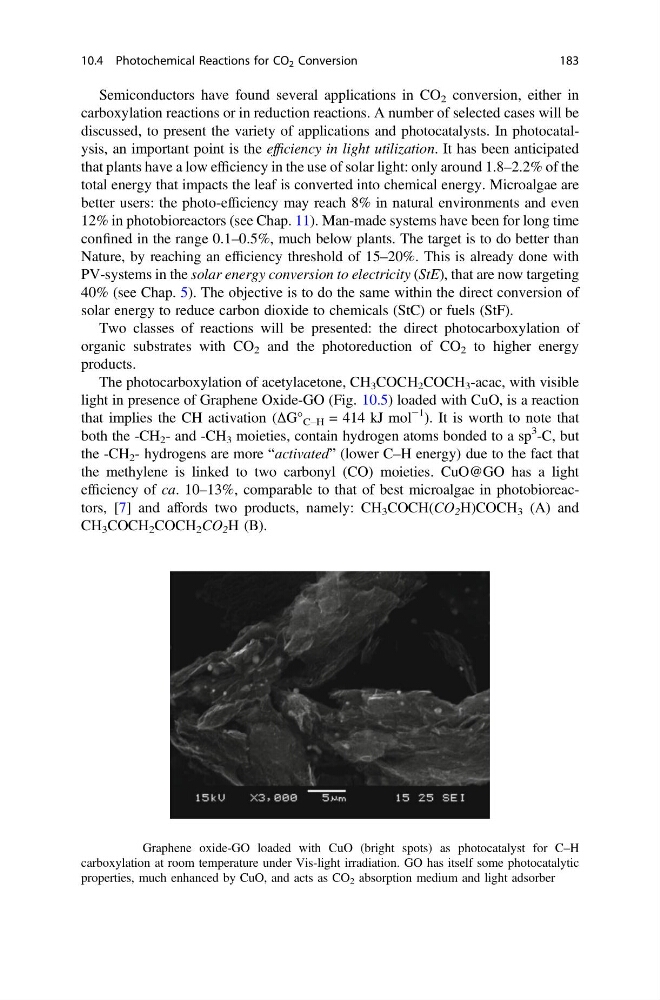
The photocarboxylation of acetylacetone, CH 3 COCH 2 COCH 3 -acac, with visible
light in presence of Graphene Oxide-GO (Fig. 10.5) loaded with CuO, is a reaction
that implies the CH activation (ΔG° C–H = 414 kJ mol
−1 ). It is worth to note that
both the -CH 2 - and -CH 3 moieties, contain hydrogen atoms bonded to a sp
3 -C, but
the -CH 2 - hydrogens are more “activated” (lower C–H energy) due to the fact that
the methylene is linked to two carbonyl (CO) moieties. CuO@GO has a light
efficiency of ca. 10–13%, comparable to that of best microalgae in photobioreactors, [7] and affords two products, namely: CH 3 COCH(CO 2 H)COCH 3 (A) and
CH 3 COCH 2 COCH 2 CO 2 H (B).
Fig. 10.5 Graphene oxide-GO loaded with CuO (bright spots) as photocatalyst for C–H
carboxylation at room temperature under Vis-light irradiation. GO has itself some photocatalytic
properties, much enhanced by CuO, and acts as CO 2 absorption medium and light adsorber
10.4 Photochemical Reactions for CO 2 Conversion
183
carboxylation reactions or in reduction reactions. A number of selected cases will be
discussed, to present the variety of applications and photocatalysts. In photocatalysis, an important point is the efficiency in light utilization. It has been anticipated
that plants have a low efficiency in the use of solar light: only around 1.8–2.2% of the
total energy that impacts the leaf is converted into chemical energy. Microalgae are
better users: the photo-efficiency may reach 8% in natural environments and even
12% in photobioreactors (see Chap. 11). Man-made systems have been for long time
confined in the range 0.1–0.5%, much below plants. The target is to do better than
Nature, by reaching an efficiency threshold of 15–20%. This is already done with
PV-systems in the solar energy conversion to electricity (StE), that are now targeting
40% (see Chap. 5). The objective is to do the same within the direct conversion of
solar energy to reduce carbon dioxide to chemicals (StC) or fuels (StF).
Two classes of reactions will be presented: the direct photocarboxylation of
organic substrates with CO 2 and the photoreduction of CO 2 to higher energy
products.
The photocarboxylation of acetylacetone, CH 3 COCH 2 COCH 3 -acac, with visible
light in presence of Graphene Oxide-GO (Fig. 10.5) loaded with CuO, is a reaction
that implies the CH activation (ΔG° C–H = 414 kJ mol
−1 ). It is worth to note that
both the -CH 2 - and -CH 3 moieties, contain hydrogen atoms bonded to a sp
3 -C, but
the -CH 2 - hydrogens are more “activated” (lower C–H energy) due to the fact that
the methylene is linked to two carbonyl (CO) moieties. CuO@GO has a light
efficiency of ca. 10–13%, comparable to that of best microalgae in photobioreactors, [7] and affords two products, namely: CH 3 COCH(CO 2 H)COCH 3 (A) and
CH 3 COCH 2 COCH 2 CO 2 H (B).
Fig. 10.5 Graphene oxide-GO loaded with CuO (bright spots) as photocatalyst for C–H
carboxylation at room temperature under Vis-light irradiation. GO has itself some photocatalytic
properties, much enhanced by CuO, and acts as CO 2 absorption medium and light adsorber
10.4 Photochemical Reactions for CO 2 Conversion
183