

eventually as concentrators. A variety of systems exist which operate in homogeneous conditions with the catalyst and CO 2 in the same (most likely liquid) phase; a
lot of work is going on for developing more efficient metal-complexes which
potential can be finely tuned for matching the potential of one of the reduction
reactions listed in Table 10.1, so to develop selective reduction processes.
In addition to homogeneous systems, heterogeneous systems (two-three phase
systems: gas, solution, solid) are effective which are made of “semiconductors”
(binary metal oxides, ternary or multiple metal oxides, metal salts, metal oxides on
graphene or graphene oxide, etc.) which are able to uptake light and produce an
“exciton” (e
− + h
+
) that drives the CO 2 reduction in presence of a (e
− + H
+
) donor.
Often organic molecules (which cost may be higher than the value of reduced forms
of CO 2 ) are oxidized as model sacrificial agents, but water should be used in the
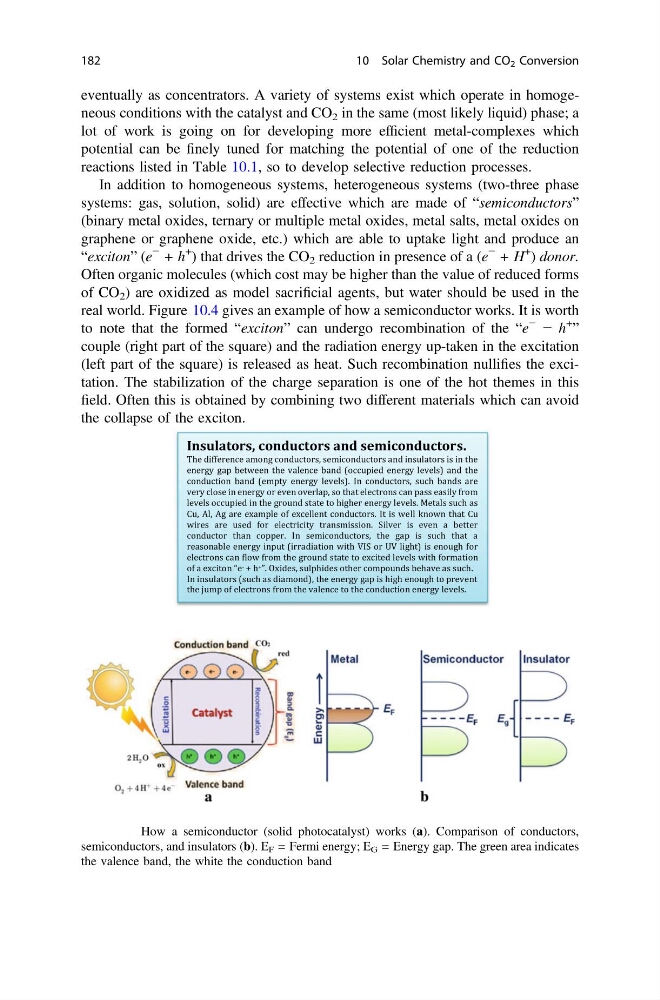
real world. Figure 10.4 gives an example of how a semiconductor works. It is worth
to note that the formed “exciton” can undergo recombination of the “e
−
− h
+
”
couple (right part of the square) and the radiation energy up-taken in the excitation
(left part of the square) is released as heat. Such recombination nullifies the excitation. The stabilization of the charge separation is one of the hot themes in this
field. Often this is obtained by combining two different materials which can avoid
the collapse of the exciton.
Fig. 10.4 How a semiconductor (solid photocatalyst) works (a). Comparison of conductors,
semiconductors, and insulators (b). E F = Fermi energy; E G = Energy gap. The green area indicates
the valence band, the white the conduction band
182
10 Solar Chemistry and CO 2 Conversion
lot of work is going on for developing more efficient metal-complexes which
potential can be finely tuned for matching the potential of one of the reduction
reactions listed in Table 10.1, so to develop selective reduction processes.
In addition to homogeneous systems, heterogeneous systems (two-three phase
systems: gas, solution, solid) are effective which are made of “semiconductors”
(binary metal oxides, ternary or multiple metal oxides, metal salts, metal oxides on
graphene or graphene oxide, etc.) which are able to uptake light and produce an
“exciton” (e
− + h
+
) that drives the CO 2 reduction in presence of a (e
− + H
+
) donor.
Often organic molecules (which cost may be higher than the value of reduced forms
of CO 2 ) are oxidized as model sacrificial agents, but water should be used in the
real world. Figure 10.4 gives an example of how a semiconductor works. It is worth
to note that the formed “exciton” can undergo recombination of the “e
−
− h
+
”
couple (right part of the square) and the radiation energy up-taken in the excitation
(left part of the square) is released as heat. Such recombination nullifies the excitation. The stabilization of the charge separation is one of the hot themes in this
field. Often this is obtained by combining two different materials which can avoid
the collapse of the exciton.
Fig. 10.4 How a semiconductor (solid photocatalyst) works (a). Comparison of conductors,
semiconductors, and insulators (b). E F = Fermi energy; E G = Energy gap. The green area indicates
the valence band, the white the conduction band
182
10 Solar Chemistry and CO 2 Conversion