

It is evident from Table 10.1 that unless the potential is finely tuned, reactions
“2, 3, 5, 8” can occur simultaneously, because they are very close in energy. This
was verified by Lehn and others who have shown that CO (Entry 3), formates
(Entry 2) and H 2 (Entry 8) are often coproduced [6], rising some selectivity issues.
It is worth to note that CO and H 2 are not very soluble in water, while formates are.
However, if CO and H 2 could be produced in such a way to approximate the Syngas
composition, this would be an interesting way to produce Syngas and from it
methanol or liquid fuels, but it is not so, the composition varies in a random mode
with the reaction conditions. The CO 2 photoreduction to CO is only apparently a
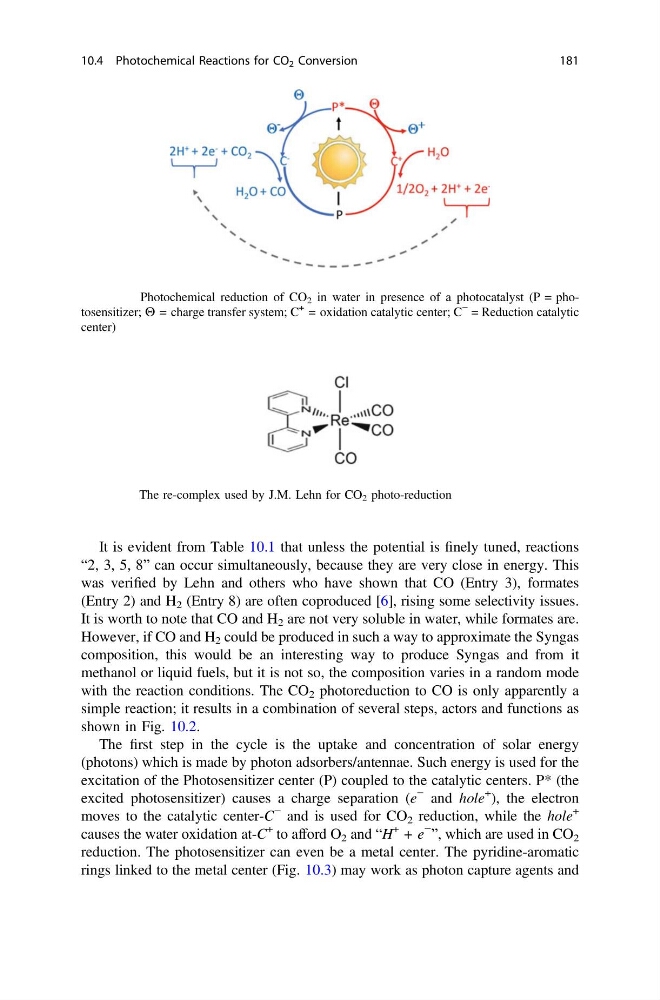
simple reaction; it results in a combination of several steps, actors and functions as
shown in Fig. 10.2.
The first step in the cycle is the uptake and concentration of solar energy
(photons) which is made by photon adsorbers/antennae. Such energy is used for the
excitation of the Photosensitizer center (P) coupled to the catalytic centers. P* (the
excited photosensitizer) causes a charge separation (e
− and hole
+
), the electron
moves to the catalytic center-C
− and is used for CO 2 reduction, while the hole
+
causes the water oxidation at-C
+ to afford O 2 and “H
+ + e
−
”, which are used in CO 2
reduction. The photosensitizer can even be a metal center. The pyridine-aromatic
rings linked to the metal center (Fig. 10.3) may work as photon capture agents and
Fig. 10.2 Photochemical reduction of CO 2 in water in presence of a photocatalyst (P = photosensitizer; H = charge transfer system; C
+ = oxidation catalytic center; C
− = Reduction catalytic
center)
Fig. 10.3 The re-complex used by J.M. Lehn for CO 2 photo-reduction
10.4 Photochemical Reactions for CO 2 Conversion
181
“2, 3, 5, 8” can occur simultaneously, because they are very close in energy. This
was verified by Lehn and others who have shown that CO (Entry 3), formates
(Entry 2) and H 2 (Entry 8) are often coproduced [6], rising some selectivity issues.
It is worth to note that CO and H 2 are not very soluble in water, while formates are.
However, if CO and H 2 could be produced in such a way to approximate the Syngas
composition, this would be an interesting way to produce Syngas and from it
methanol or liquid fuels, but it is not so, the composition varies in a random mode
with the reaction conditions. The CO 2 photoreduction to CO is only apparently a
simple reaction; it results in a combination of several steps, actors and functions as
shown in Fig. 10.2.
The first step in the cycle is the uptake and concentration of solar energy
(photons) which is made by photon adsorbers/antennae. Such energy is used for the
excitation of the Photosensitizer center (P) coupled to the catalytic centers. P* (the
excited photosensitizer) causes a charge separation (e
− and hole
+
), the electron
moves to the catalytic center-C
− and is used for CO 2 reduction, while the hole
+
causes the water oxidation at-C
+ to afford O 2 and “H
+ + e
−
”, which are used in CO 2
reduction. The photosensitizer can even be a metal center. The pyridine-aromatic
rings linked to the metal center (Fig. 10.3) may work as photon capture agents and
Fig. 10.2 Photochemical reduction of CO 2 in water in presence of a photocatalyst (P = photosensitizer; H = charge transfer system; C
+ = oxidation catalytic center; C
− = Reduction catalytic
center)
Fig. 10.3 The re-complex used by J.M. Lehn for CO 2 photo-reduction
10.4 Photochemical Reactions for CO 2 Conversion
181