

RR0NH þ R
00
O
ð
Þ 2 CO ! RR
0
NÀCO 2 R
00
þ R
00
OH
ð9:28Þ
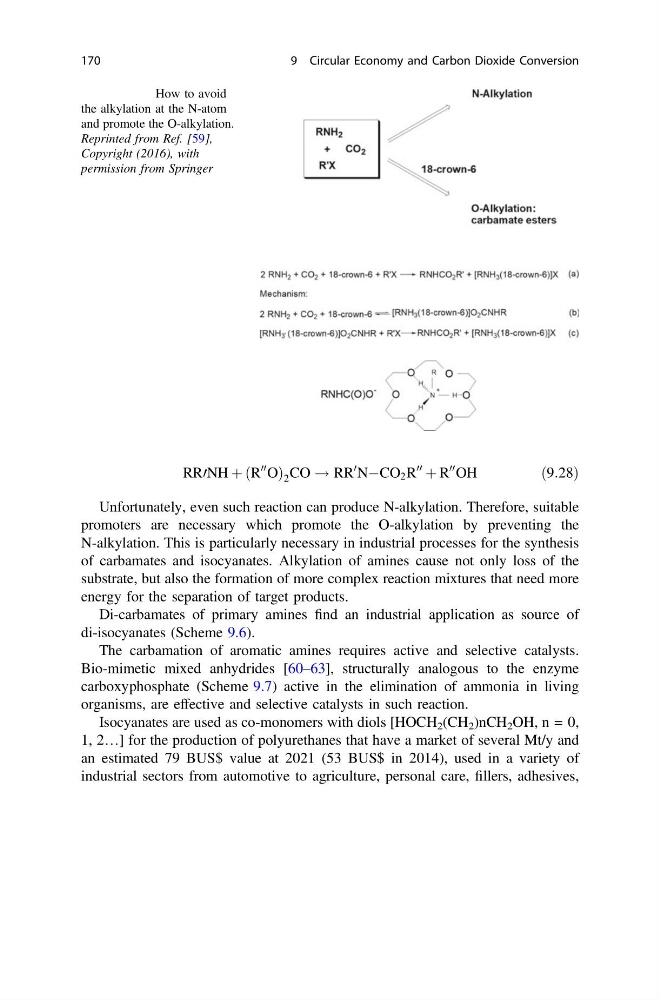
Unfortunately, even such reaction can produce N-alkylation. Therefore, suitable
promoters are necessary which promote the O-alkylation by preventing the
N-alkylation. This is particularly necessary in industrial processes for the synthesis
of carbamates and isocyanates. Alkylation of amines cause not only loss of the
substrate, but also the formation of more complex reaction mixtures that need more
energy for the separation of target products.
Di-carbamates of primary amines find an industrial application as source of
di-isocyanates (Scheme 9.6).
The carbamation of aromatic amines requires active and selective catalysts.
Bio-mimetic mixed anhydrides [60–63], structurally analogous to the enzyme
carboxyphosphate (Scheme 9.7) active in the elimination of ammonia in living
organisms, are effective and selective catalysts in such reaction.
Isocyanates are used as co-monomers with diols [HOCH 2 (CH 2 )nCH 2 OH, n = 0,
1, 2…] for the production of polyurethanes that have a market of several Mt/y and
an estimated 79 BUS$ value at 2021 (53 BUS$ in 2014), used in a variety of
industrial sectors from automotive to agriculture, personal care, fillers, adhesives,
Scheme 9.5 How to avoid
the alkylation at the N-atom
and promote the O-alkylation.
Reprinted from Ref. [59],
Copyright (2016), with
permission from Springer
170
9 Circular Economy and Carbon Dioxide Conversion
00
O
ð
Þ 2 CO ! RR
0
NÀCO 2 R
00
þ R
00
OH
ð9:28Þ
Unfortunately, even such reaction can produce N-alkylation. Therefore, suitable
promoters are necessary which promote the O-alkylation by preventing the
N-alkylation. This is particularly necessary in industrial processes for the synthesis
of carbamates and isocyanates. Alkylation of amines cause not only loss of the
substrate, but also the formation of more complex reaction mixtures that need more
energy for the separation of target products.
Di-carbamates of primary amines find an industrial application as source of
di-isocyanates (Scheme 9.6).
The carbamation of aromatic amines requires active and selective catalysts.
Bio-mimetic mixed anhydrides [60–63], structurally analogous to the enzyme
carboxyphosphate (Scheme 9.7) active in the elimination of ammonia in living
organisms, are effective and selective catalysts in such reaction.
Isocyanates are used as co-monomers with diols [HOCH 2 (CH 2 )nCH 2 OH, n = 0,
1, 2…] for the production of polyurethanes that have a market of several Mt/y and
an estimated 79 BUS$ value at 2021 (53 BUS$ in 2014), used in a variety of
industrial sectors from automotive to agriculture, personal care, fillers, adhesives,
Scheme 9.5 How to avoid
the alkylation at the N-atom
and promote the O-alkylation.
Reprinted from Ref. [59],
Copyright (2016), with
permission from Springer
170
9 Circular Economy and Carbon Dioxide Conversion