

DI9.1 Synthesis of carbamates from CO 2
The development of synthetic methodologies that may afford carbamates from
amines and CO 2 has an industrial interest as such process might supplant the
process based on phosgene, a highly toxic substance, banned in several countries
and whose transport on road is forbidden. Amine are very reactive with CO 2 as they
are electron-rich (the nitrogen atom bears a non-bonding electron pair that may be
used to attack the C-atom of CO 2 ). When CO 2 and primary or secondary aliphatic
amines are contacted in an organic aprotic solvent, a white precipitate of ammonium carbamate is quickly formed (Eq. 9.25). The latter can, in principle, be
alkylated to afford a carbamic ester and ammonium chloride (Eq. 9.26)
2 RR
0
NH þ CO 2 ! RR
0
N À CO
À
2 NH 2 RR
0 þ
ð9:25Þ
RR
0
N À CO
À þ
2 NH 2 RR þ R
00
X ! RR
0
N À CO 2 R
00
þ NH 2 RR
0 þ À
X
ð9:26Þ
RR
0
N À CO
À þ
2 NH 2 RR
0
þ R
00
X ! RR
0
NR
00
þ CO 2 þ NH 2 RR
0 þ À
X
ð9:27Þ
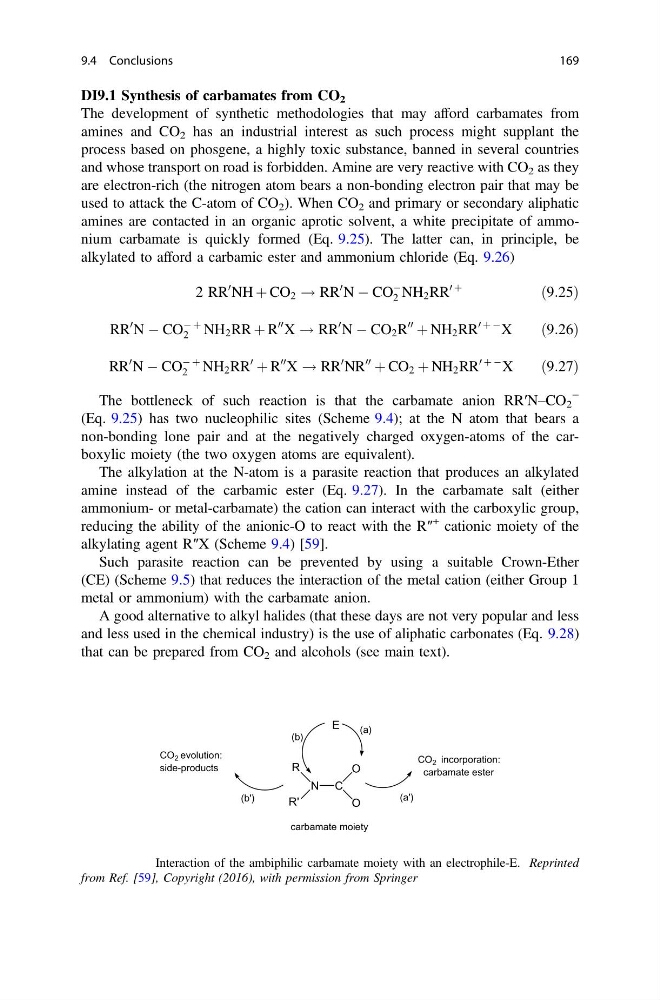
The bottleneck of such reaction is that the carbamate anion RR′N–CO 2
−
(Eq. 9.25) has two nucleophilic sites (Scheme 9.4); at the N atom that bears a
non-bonding lone pair and at the negatively charged oxygen-atoms of the carboxylic moiety (the two oxygen atoms are equivalent).
The alkylation at the N-atom is a parasite reaction that produces an alkylated
amine instead of the carbamic ester (Eq. 9.27). In the carbamate salt (either
ammonium- or metal-carbamate) the cation can interact with the carboxylic group,
reducing the ability of the anionic-O to react with the R″
+ cationic moiety of the
alkylating agent R″X (Scheme 9.4) [59].
Such parasite reaction can be prevented by using a suitable Crown-Ether
(CE) (Scheme 9.5) that reduces the interaction of the metal cation (either Group 1
metal or ammonium) with the carbamate anion.
A good alternative to alkyl halides (that these days are not very popular and less
and less used in the chemical industry) is the use of aliphatic carbonates (Eq. 9.28)
that can be prepared from CO 2 and alcohols (see main text).
N
R
R'
C
O
O
E
(a)
(b)
(a')
(b')
CO 2 incorporation:
carbamate ester
CO 2 evolution:
side-products
carbamate moiety
Scheme 9.4 Interaction of the ambiphilic carbamate moiety with an electrophile-E. Reprinted
from Ref. [59], Copyright (2016), with permission from Springer
9.4 Conclusions
169
The development of synthetic methodologies that may afford carbamates from
amines and CO 2 has an industrial interest as such process might supplant the
process based on phosgene, a highly toxic substance, banned in several countries
and whose transport on road is forbidden. Amine are very reactive with CO 2 as they
are electron-rich (the nitrogen atom bears a non-bonding electron pair that may be
used to attack the C-atom of CO 2 ). When CO 2 and primary or secondary aliphatic
amines are contacted in an organic aprotic solvent, a white precipitate of ammonium carbamate is quickly formed (Eq. 9.25). The latter can, in principle, be
alkylated to afford a carbamic ester and ammonium chloride (Eq. 9.26)
2 RR
0
NH þ CO 2 ! RR
0
N À CO
À
2 NH 2 RR
0 þ
ð9:25Þ
RR
0
N À CO
À þ
2 NH 2 RR þ R
00
X ! RR
0
N À CO 2 R
00
þ NH 2 RR
0 þ À
X
ð9:26Þ
RR
0
N À CO
À þ
2 NH 2 RR
0
þ R
00
X ! RR
0
NR
00
þ CO 2 þ NH 2 RR
0 þ À
X
ð9:27Þ
The bottleneck of such reaction is that the carbamate anion RR′N–CO 2
−
(Eq. 9.25) has two nucleophilic sites (Scheme 9.4); at the N atom that bears a
non-bonding lone pair and at the negatively charged oxygen-atoms of the carboxylic moiety (the two oxygen atoms are equivalent).
The alkylation at the N-atom is a parasite reaction that produces an alkylated
amine instead of the carbamic ester (Eq. 9.27). In the carbamate salt (either
ammonium- or metal-carbamate) the cation can interact with the carboxylic group,
reducing the ability of the anionic-O to react with the R″
+ cationic moiety of the
alkylating agent R″X (Scheme 9.4) [59].
Such parasite reaction can be prevented by using a suitable Crown-Ether
(CE) (Scheme 9.5) that reduces the interaction of the metal cation (either Group 1
metal or ammonium) with the carbamate anion.
A good alternative to alkyl halides (that these days are not very popular and less
and less used in the chemical industry) is the use of aliphatic carbonates (Eq. 9.28)
that can be prepared from CO 2 and alcohols (see main text).
N
R
R'
C
O
O
E
(a)
(b)
(a')
(b')
CO 2 incorporation:
carbamate ester
CO 2 evolution:
side-products
carbamate moiety
Scheme 9.4 Interaction of the ambiphilic carbamate moiety with an electrophile-E. Reprinted
from Ref. [59], Copyright (2016), with permission from Springer
9.4 Conclusions
169